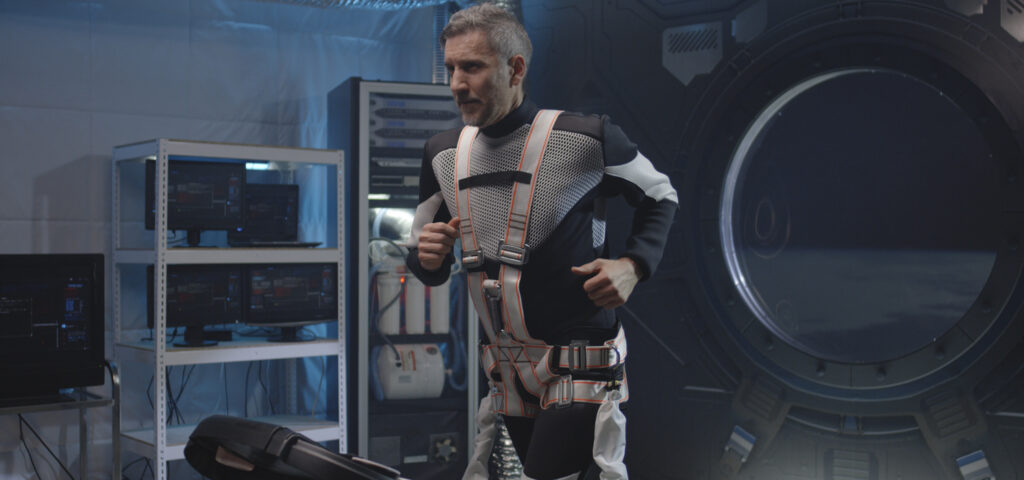
Before sending humans into space, scientists need to understand what the body and mind go through beyond Earth. Since we can’t launch people into orbit for every test, researchers recreate space-like conditions right here on the ground. Some of these methods sound surprisingly simple, while others are downright bizarre. Here are the strangest ways scientists simulate space on Earth to prepare for life among the stars.
1. Lying in bed for months without moving
To mimic weightlessness, space agencies pay volunteers to lie flat in bed for weeks or even months. They’re not allowed to stand or even sit up, as this removes the effects of gravity on the body. The position causes muscle and bone loss, similar to what astronauts experience in orbit.
It sounds like an easy job, but it’s physically tough. Volunteers often feel dizzy, weak, and sore after returning to normal life, showing how quickly the human body starts to decline without gravity.
2. Floating underwater for hours
NASA’s Neutral Buoyancy Laboratory in Texas contains one of the world’s largest swimming pools, where astronauts train underwater to recreate the feeling of weightlessness. They wear full space suits while performing mock repairs on life-sized spacecraft models.
The resistance of the water closely matches the slow, deliberate movements needed in space. It’s not a perfect match, but it helps astronauts learn to control their bodies when every action feels like it’s happening in slow motion.
3. Spinning in giant centrifuges
To prepare for rocket launches and re-entry, astronauts train in massive centrifuges that spin them at high speeds. The machine creates intense forces that simulate what happens when a spacecraft accelerates or slows down.
The experience is exhausting and sometimes nauseating, but it trains the body to handle the crushing pressure of take-off. It also helps doctors understand how much force humans can safely endure.
4. Using underwater caves as space stand-ins

European and American astronauts train inside deep underwater caves that resemble the isolation and teamwork challenges of a space mission. These environments offer complete darkness, tight spaces, and communication delays with the surface. Working in caves forces astronauts to rely on problem-solving, patience, and each other, and those are the same skills needed for long missions where quick help isn’t available.
5. Sealing people inside fake Mars bases
NASA and other space agencies run long-term isolation studies where small groups live in sealed habitats designed to mimic life on Mars. They grow food, wear space suits to go “outside,” and communicate with a time delay to copy what a real Mars mission would feel like. These experiments reveal how people cope with loneliness, boredom, and group tension. The mental strain often becomes harder to handle than the physical conditions.
6. Dropping planes to create brief weightlessness
Parabolic flight training involves flying a plane in a steep arc, then letting it free-fall for about 20 seconds. During the drop, everything inside floats, including the people. It’s nicknamed the “vomit comet” for good reason, as the sudden shifts between weightlessness and gravity often make participants sick. Despite that, it’s still one of the best ways to test space experiments before launching them into orbit.
7. Using deserts to mimic other planets

Earth’s most barren landscapes, like the Atacama Desert in Chile or volcanic fields in Iceland, are used as stand-ins for Mars or the Moon. Scientists test rovers, habitats, and survival gear in these dry, dusty environments. The lack of vegetation, harsh sunlight, and wide temperature swings make these sites ideal for learning how machines, and people, might cope on another world.
8. Freezing volunteers for deep-space testing
Some experiments involve exposing biological samples and even materials to extreme cold to see how they hold up. Temperatures are lowered to mimic what would be experienced on the Moon or in deep space. It helps scientists design equipment and clothing that can survive the brutal cold of space, where one small failure can mean disaster.
9. Locking researchers in Antarctica

Antarctic research stations are used as analogues for space missions because of their isolation and harshness. Teams live there for months with limited sunlight and little outside contact, testing both their endurance and mental stability. It’s one of the best places on Earth to study how humans function in long-term confinement, which is similar to what would happen on a multi-year trip to Mars.
10. Firing rockets into the atmosphere for a few minutes of zero gravity
Sounding rockets give scientists short bursts of microgravity by launching experiments just above Earth’s atmosphere and letting them fall back down. Each flight provides only a few minutes of weightlessness, but it’s enough to test how fluids, flames, and equipment behave.
These brief missions are cheaper than sending payloads into orbit and help prepare technology for the real challenges of space. Every drop, dive, and spin on Earth brings us one step closer to surviving among the stars for good.