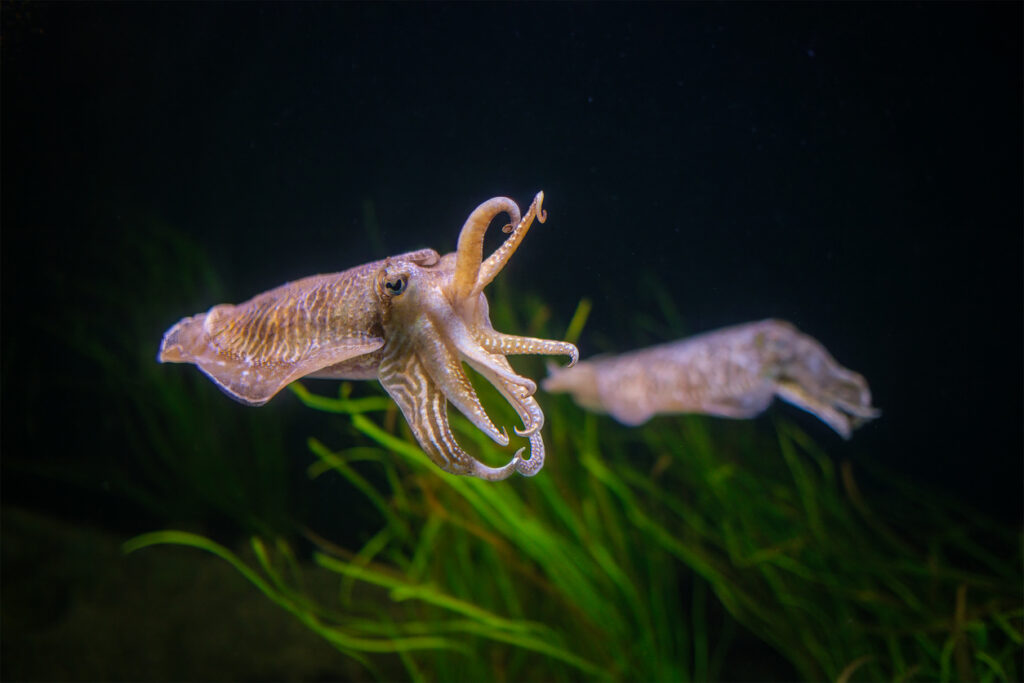
Cuttlefish look like something from another planet with their weird W-shaped pupils and tentacles, but the truly bizarre stuff about them goes way beyond their appearance. These creatures have abilities that seem almost supernatural, yet most people have no idea just how strange they actually are.
Cuttlefish can change colour faster than you can blink.
They don’t gradually shift from one shade to another, they transform instantly across their entire body in less than a second. This happens because their skin contains millions of special cells called chromatophores that expand and contract on command, revealing different pigments underneath.
Beneath those are reflective cells that bounce back light in different ways, and deeper still are cells that create iridescent effects. All three layers work together simultaneously, which means a cuttlefish can display multiple colours and patterns at once across different parts of its body. They use this for camouflage obviously, but also for communication and hunting, flashing patterns at prey to hypnotise them before striking.
They’re completely colourblind despite their incredible colour-changing abilities.
Cuttlefish can perfectly match the colours of coral, rocks, or sand even though they can’t actually see colour at all. They only have one type of photoreceptor in their eyes, which means they see the world in shades of grey. Scientists think they might sense colour through their skin somehow, or they’re matching the brightness and texture of their surroundings rather than the actual hues.
It’s like someone painting a perfect replica of a landscape whilst wearing glasses that turn everything black and white. The fact that they pull this off so flawlessly without being able to see what we’d consider the most important part is genuinely baffling.
@this_is_brainwave Cuttlefish – Master of disguise #interestingfacts#facts #sciencetok #discovery #cuttlefish #camouflage #disguise #animals #animalshorts #seaworld #ocean #marinelife #octopus #oceanlife #underwater #animal #cuteanimals ♬ original sound – Brain Wave
Their blood is blue-green and contains copper instead of iron.
Instead of haemoglobin like mammals use, cuttlefish have hemocyanin in their blood, which uses copper atoms to transport oxygen. This makes their blood appear blue-green when it’s oxygenated. The copper-based system is less efficient at carrying oxygen than our iron-based one, which is partly why cuttlefish are so sensitive to temperature changes and oxygen levels in water.
When the water gets too warm, their blood can’t carry enough oxygen to keep them going. This is also why they’re generally less active than fish and prefer to ambush prey rather than chase it down over long distances.
Cuttlefish have three hearts working together.
Two of their hearts pump blood to their gills to pick up oxygen, and the third heart circulates that oxygenated blood to the rest of their body. The two gill hearts actually stop beating when the cuttlefish swims, which is why they prefer to move slowly or use jet propulsion in short bursts rather than swimming continuously.
All that extra cardiac equipment is housed in a body with no skeleton at all, so their organs are basically floating around in there held together by muscle and tissue. Despite having no bones, they do have an internal shell called a cuttlebone that provides some structure and helps with buoyancy control.
They can see behind themselves without turning their heads.
Cuttlefish eyes wrap around the sides of their head so far that their field of vision overlaps behind them, giving them nearly 360-degree sight. Each eye can also move independently, so one can be watching for predators while the other focuses on potential prey.
Their W-shaped pupils can adjust to control how much light enters from different angles, and they can probably judge distances by comparing what each eye sees. This wraparound vision combined with their ability to change colour means they’re simultaneously watching in all directions whilst adjusting their camouflage based on what they see. It’s an incredible multitasking setup that puts most other animals to shame.
@saeed87479The Cuttlefish is WEIRD
Female cuttlefish can be incredibly picky about mates, so males have developed sneaky tactics.
Smaller male cuttlefish will disguise themselves as females by changing their colour patterns and hiding their extra mating tentacles. They’ll swim right past the large dominant males who would normally chase them off, getting close to the actual females without triggering aggression.
Once they’re in position, they drop the disguise and attempt to mate before the bigger males notice what’s happening. This strategy works often enough that these smaller males manage to pass on their genes despite being physically outmatched. Some males will even display male patterns on the side facing rival males while showing female patterns on the side facing their target female, essentially running two different disguises at once.
Cuttlefish have one of the highest brain-to-body ratios of any invertebrate.
Their brains are genuinely large and complex for a creature without a backbone, with distinct regions that handle different tasks like memory, learning and motor control. They can solve puzzles, learn from watching other cuttlefish and remember solutions to problems for months.
In experiments, they’ve demonstrated they can delay gratification by waiting for a better food reward rather than taking an immediate lesser option. This kind of self-control is rare in the animal kingdom and suggests cognitive abilities we usually associate with vertebrates. They’re also thought to experience something resembling REM sleep, with colour changes rippling across their skin while they rest, which might mean they dream.
Their ink isn’t just a smoke screen, it’s a decoy.
When threatened, cuttlefish release a cloud of dark ink, but it’s not just to obscure their escape. The ink contains compounds that can dull a predator’s sense of smell and taste temporarily, making it harder to track the cuttlefish even after the cloud disperses.
More impressively, they can control the consistency of the ink to create a pseudomorph, which is basically a blob that roughly resembles the shape of a cuttlefish. Predators will often attack this decoy while the real cuttlefish jets away in a different direction. Some species can even produce multiple pseudomorphs in quick succession, creating several fake cuttlefish for a predator to waste time investigating.
They only live for one or two years maximum.
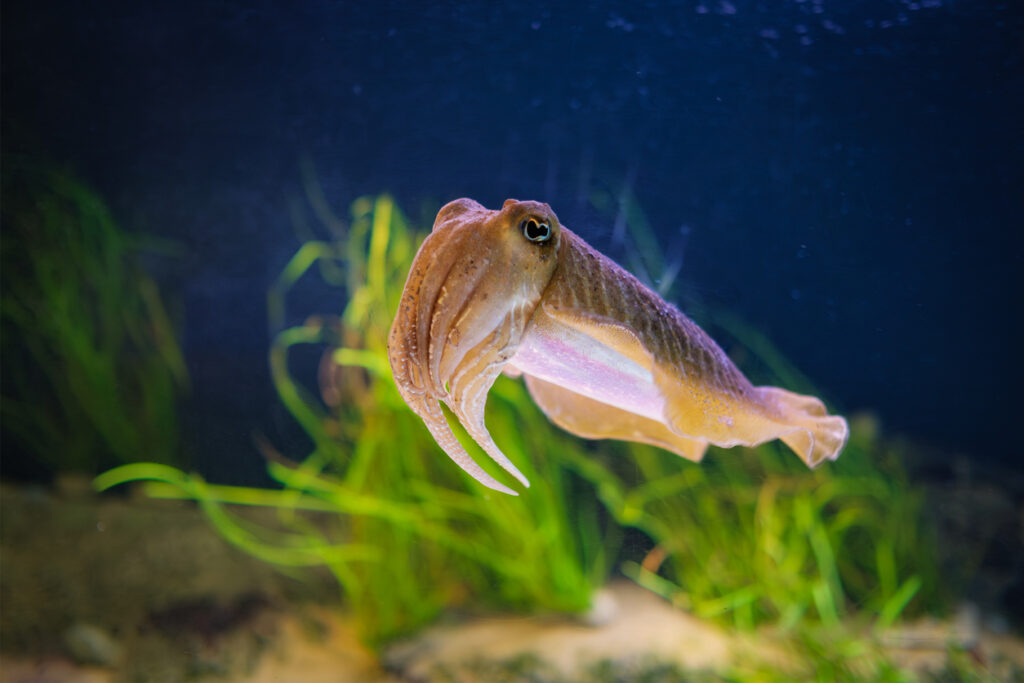
Despite their intelligence and complex behaviours, cuttlefish have incredibly short lifespans compared to other smart animals. Most species die shortly after mating, with females dying after they’ve laid and protected their eggs. This means every single thing they learn has to be figured out from scratch, since there’s no opportunity for older cuttlefish to teach younger ones.
All their sophisticated hunting techniques, camouflage skills and social behaviours are either instinctive or learned through individual trial and error in their first year of life. It’s remarkable that they develop such advanced abilities in such a compressed timeframe.
Cuttlefish can control each arm independently with dedicated mini-brains.
Each of their eight arms and two longer tentacles has its own cluster of neurons that can control movement without waiting for signals from the main brain. This means their arms can be doing ten different things simultaneously while the central brain focuses on bigger decisions like where to swim or what to hunt.
The tentacles can shoot out to grab prey in just 20 milliseconds, which is faster than the main brain could coordinate if it had to control every detail. This distributed nervous system is partly why cuttlefish are such effective hunters despite their relatively sluggish swimming, their arms and tentacles are semi-autonomous weapons that strike before prey can react.