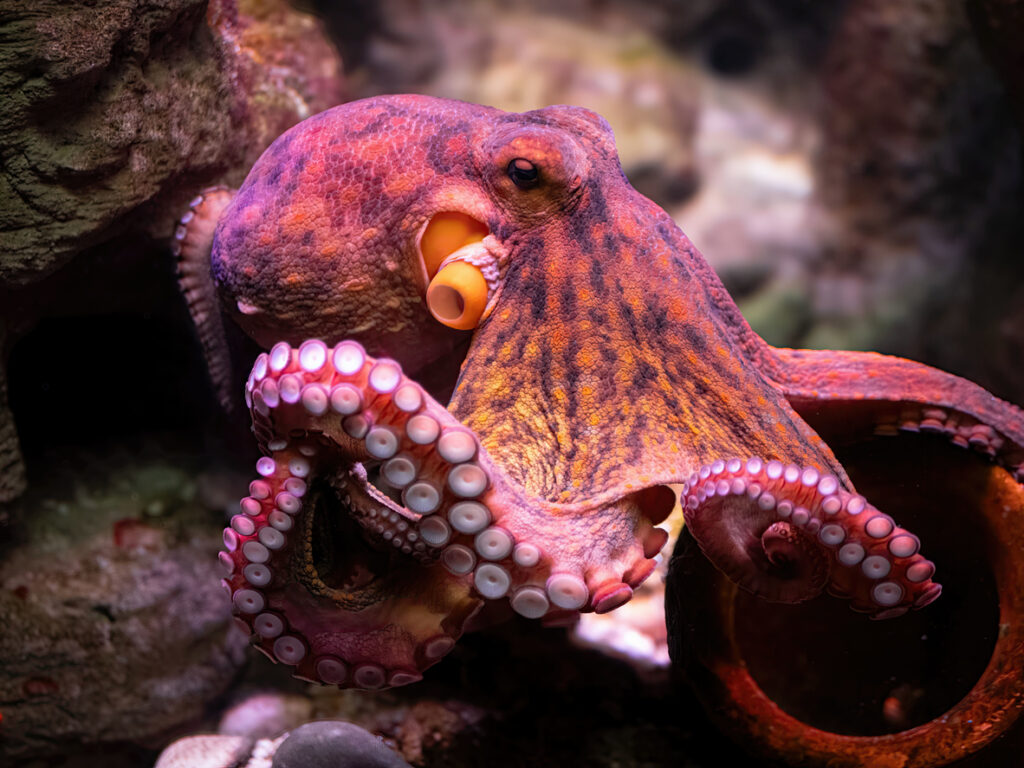
If you ever want to feel slightly outsmarted by something with eight arms and no bones, spend a bit of time learning about octopuses. They don’t just drift around looking mysterious. They solve problems, plan escapes, open jars, and sometimes seem to study us right back. The more scientists look at them, the stranger it gets. These aren’t simple sea creatures running on basic instinct. They’re clever, adaptable, and often one step ahead of whatever tank, predator, or human tries to contain them.
They can open jars from the inside.
In controlled experiments, octopuses have been placed inside clear containers with screw-top lids, and many of them figure out how to twist their way out. They don’t just bash around blindly. They grip, rotate, and apply pressure in the right direction until the lid loosens. What’s more impressive is that they often remember how to do it. Once they’ve solved the problem, they can repeat it later with less hesitation. That suggests learning, not random movement. For an animal with no rigid skeleton and no social schooling system, that’s astonishing.
They can escape from almost anywhere.
Aquariums around the world have stories about octopuses slipping out of tanks, crawling across floors, and finding their way into neighbouring enclosures. If there’s a gap the size of their beak, they can squeeze through it. Their bodies are soft and flexible, so they can compress themselves into openings that seem impossibly small. Combine that with curiosity and problem-solving skills, and you have an escape artist that would put most magicians to shame.
@natgeotv Octopuses are not only masters of disguise but also savvy tool users. #SecretsOfTheOctopus ♬ original sound – National Geographic TV
They use tools.
Tool use used to be considered a marker of higher intelligence. Octopuses shattered that assumption. In the wild, some species collect coconut shells or other hard debris and carry them along the seabed. Later, they assemble these pieces into makeshift shelters, hiding inside when needed. That behaviour shows foresight. They aren’t just reacting in the moment. They’re preparing for possible danger ahead of time.
They can change colour and texture in seconds.
Octopuses have specialised skin cells that allow them to shift colour almost instantly. They can match rocks, sand, coral, and even mimic moving patterns in the water. What’s even more surreal is that they can alter the texture of their skin to resemble rough stone or bumpy coral. It’s camouflage on a level that feels almost unreal. Predators and prey alike can struggle to spot them even when they’re right in front of them.
They have three hearts.
Two of an octopus’s hearts pump blood to the gills, while the third pumps it around the rest of the body. Their blood is also blue because it uses a copper-based protein to carry oxygen instead of iron. This system allows them to survive in cold, low-oxygen environments. It’s a completely different biological setup from ours, yet it works beautifully in the ocean’s depths.
@lovetheearther Do you love Octopuses? 🐙 #fyp #foryou #foryourpage #Boo #viral #trend #animals #animalsoftiktok #petsoftiktok #petthings #octopus #ocean #marine #sea ♬ Stranger Things – Kyle Dixon & Michael Stein
Their arms think for themselves.
A huge portion of an octopus’s neurons aren’t in its central brain. They’re distributed throughout its arms. That means each arm can process information and react independently to a degree. If one arm touches something interesting, it can explore without waiting for detailed instructions from the main brain. It’s like having eight curious, semi-autonomous limbs working together. That decentralised intelligence is rare in the animal kingdom.
They can recognise individual humans.
Some captive octopuses have been observed reacting differently to specific keepers. They may approach one person calmly while avoiding or even squirting water at another. This suggests they can distinguish between people based on behaviour and appearance. They’re not just responding to movement. They seem to form impressions over time.
They can unscrew bolts and dismantle objects.
Given enough time, octopuses have been known to take apart parts of their enclosures. They explore with both touch and sight, testing weaknesses and figuring out how things connect. Their curiosity drives them to investigate mechanisms. That hands-on exploration builds knowledge about their surroundings in a way that feels deliberate rather than random.
They show signs of play.
Play behaviour is often linked to intelligence. Octopuses have been seen repeatedly releasing and recapturing objects in water currents, almost like tossing a ball back and forth with themselves. There’s no immediate survival benefit to this. It appears to be exploration for the sake of stimulation. That willingness to interact with their environment beyond necessity hints at a complex inner world.
@behindthenewstv Amazing #Octopus #Facts for #ScienceWeek! 🐙🌊 @nicholas.maher.au #ScienceFacts#Science #fypツ #fyp #animals #factsyourenotreadyfor #btn#behindthenews ♬ original sound – Behind The News (BTN)
They can mimic other sea creatures.
The mimic octopus, in particular, can impersonate other marine animals such as lionfish or sea snakes by adjusting its posture, movement, and colouring. This isn’t just camouflage. It’s active impersonation. By copying more dangerous species, they discourage predators from attacking. That level of adaptive behaviour requires both physical control and environmental awareness.
They can solve mazes.
In laboratory settings, octopuses have navigated mazes and remembered the correct paths. They don’t simply wander aimlessly until they get lucky; many show a pattern of learning and improvement over repeated attempts. That memory and adaptability allow them to adjust strategies. It’s a reminder that intelligence doesn’t have to look like ours to be real and effective.
They live short lives despite their intelligence.
Perhaps one of the strangest aspects is that most octopus species live only one to two years. For such intelligent animals, that lifespan feels unexpectedly brief. After reproducing, many adults die soon after. Scientists are still trying to understand why evolution produced such advanced cognition paired with such a short life. It adds to the mystery of a creature that already seems almost alien.
The more we learn about octopuses, the harder it becomes to see them as simple sea animals. They solve problems, manipulate objects, plan for danger, and even appear to recognise individuals. It challenges how we define intelligence in the first place. If something with eight arms and blue blood can outthink a sealed jar, maybe the ocean holds far more minds than we ever imagined.