While you’d think anything getting too close to a giant ball of fire would just vaporise instantly, we’ve actually managed to get a lot closer than you’d imagine. It’s a massive feat of engineering that involves heat shields made of carbon and trajectories that use other planets to slingshot us toward the centre of the solar system.
We’re not just talking about looking at it from a distance; we’ve sent probes right into the outer atmosphere where the heat is almost impossible to comprehend. It’s a bit of a mind-bender that we can build something capable of surviving those temperatures while still sending data back to Earth.
The sun is much further away than it feels.
It’s worth starting with some perspective. The sun sits roughly 150 million kilometres from Earth, a distance so large it’s genuinely difficult to picture. Light, travelling at 300,000 kilometres per second, still takes about eight minutes to make the journey. When you hold that in mind, the distances involved in even our most ambitious space missions start to feel a little more humbling.
Most crewed missions have barely left the neighbourhood.
Human spaceflight has, so far, stayed remarkably close to home in cosmic terms. The Apollo missions that landed on the moon in the late 1960s and early 1970s took astronauts to a maximum distance of just over 400,000 kilometres from Earth. That sounds significant, and it was a staggering achievement, but as a fraction of the distance to the sun it’s barely a scratch, which is less than a third of one percent of the way there.
The furthest humans have travelled from Earth was during Apollo 13.
Due to the unusual trajectory required after the spacecraft’s oxygen tank exploded in 1970, the Apollo 13 crew swung around the far side of the moon at a point that put them approximately 400,171 kilometres from Earth—the greatest distance any humans have ever travelled from our planet. It remains the record to this day, and it was very much an accident of emergency navigation rather than a planned milestone.
Unmanned probes have got considerably closer.
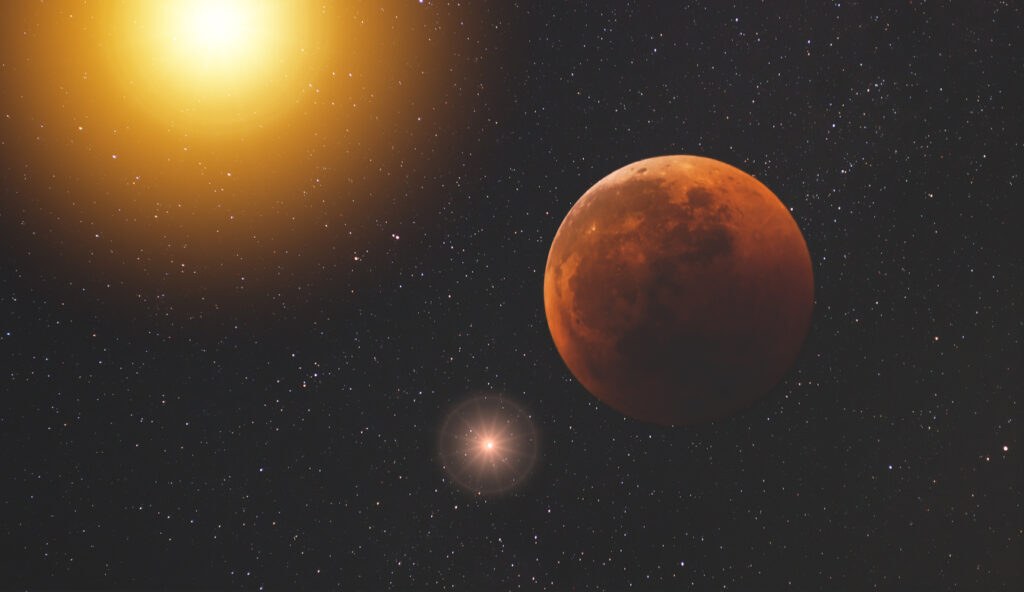
When it comes to actual proximity to the sun, the record holders are robotic spacecraft rather than human crews. The Parker Solar Probe, launched by NASA in 2018, has been methodically closing in on the sun over a series of orbits and has already broken every previous record for solar approach. In late 2024 it came within around 6.1 million kilometres of the sun’s surface. That’s closer than any human-made object in history, and a fraction of the distance between the sun and Mercury.
Parker Solar Probe travels at extraordinary speed.
At its closest approach, Parker isn’t just near the sun, it’s moving faster than any object humans have ever built. At perihelion, the point of closest approach, it reaches speeds of around 690,000 kilometres per hour. That speed is partly a consequence of the sun’s gravity accelerating it as it falls inward on each orbit, and it means the probe covers the distance of its closest pass in a very short window of time.
The heat at that distance is almost incomprehensible.
The sun’s outer atmosphere, called the corona, reaches temperatures of several million degrees. Parker survives this because of a sophisticated heat shield made from carbon composite foam that keeps the instruments behind it at a manageable temperature despite the extraordinary environment outside. The engineering required to protect a spacecraft at that proximity, let alone a human crew, gives you some sense of why sending people anywhere near the sun remains firmly in the realm of the theoretical.
Venus has been used as a slingshot to get closer.
Parker uses repeated gravitational assists from Venus to gradually tighten its orbit around the sun. Each flyby of Venus bends the spacecraft’s trajectory and slows its orbital path just enough to drop it closer to the sun on the next pass. It’s a clever use of orbital mechanics that allows the probe to reach distances no direct launch could achieve, and it’s the same principle that’s been used by various missions to reach the outer planets by swinging past Jupiter.
Helios 2 held the record for decades before Parker.

Before Parker Solar Probe rewrote the record books, the closest any spacecraft had come to the sun was the Helios 2 probe, a joint mission between NASA and West Germany launched in 1976. It reached a closest approach of about 43.5 million kilometres in 1976. It was remarkable for its time, and a record that stood for more than 40 years before Parker surpassed it. Helios 2 also held the speed record for a human-made object for much of that period.
The sun’s surface isn’t actually what you’d hit first.
There’s a common assumption that getting close to the sun means approaching a solid or clearly defined surface, but it’s more complicated than that. What we call the solar surface, the photosphere, is a layer of plasma, and above it sits the corona, which extends millions of kilometres outward. Parker Solar Probe has actually flown through the outer corona, meaning it has in a sense entered the sun’s outer atmosphere, which is a genuinely remarkable distinction.
Sending humans to the sun isn’t being seriously planned.
There are no credible proposals for crewed missions anywhere near the sun. The radiation environment, the temperature, the engineering challenges and the sheer distance involved make it a non-starter with current or near-future technology. The focus of human spaceflight over the coming decades is on the moon, Mars, and possibly some near-Earth asteroids—destinations that are still extraordinarily challenging but at least within the realm of what’s physically achievable with humans on board.
Distance from Earth and distance from the sun aren’t the same thing.
It’s worth separating two different questions that sometimes get muddled. How far humans have travelled from Earth and how close humans have come to the sun are related but distinct things. Earth itself is already 150 million kilometres from the sun, so even a mission that took humans much further from Earth in the direction away from the sun would be moving them further from the sun at the same time. The geometry of the solar system means proximity to the sun requires a very specific kind of trajectory, not just distance from home.
The records will keep being broken by machines before people.
Parker Solar Probe is still active and continuing to refine its orbit, with future passes expected to bring it even closer to the sun than it’s been so far. The trajectory is designed to tighten progressively, and each perihelion sets a new record. For the foreseeable future, the closest anything built by humans will get to the sun will be an unmanned probe travelling at hundreds of thousands of kilometres per hour, not a crewed spacecraft, and that gap between what robots can do and what humans can safely attempt is likely to remain wide for a very long time.