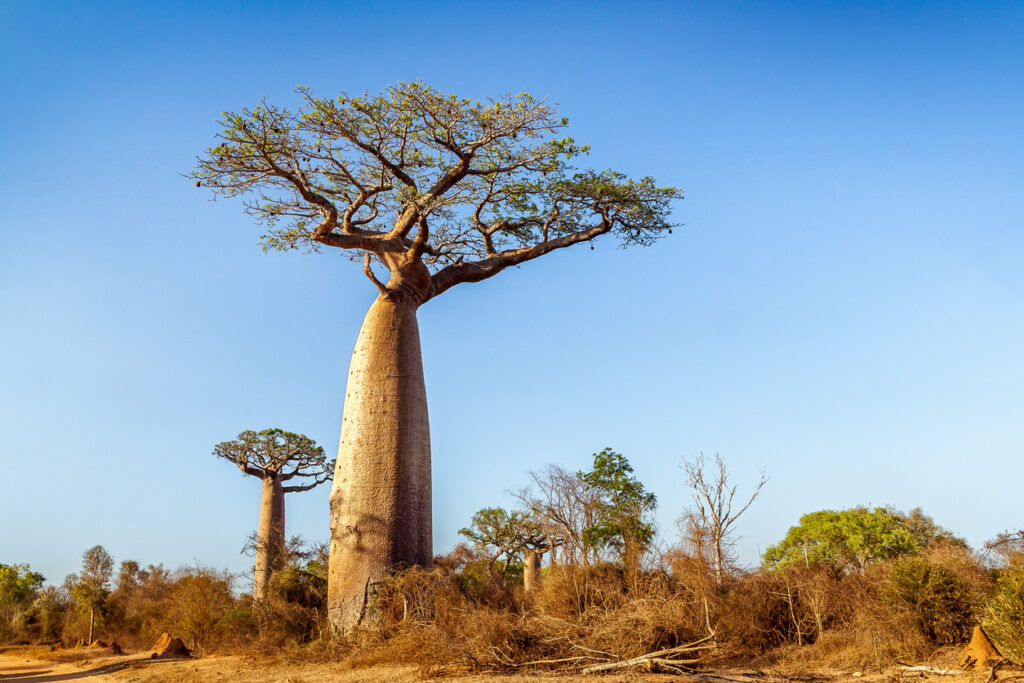
Baobab trees look like they’ve been planted upside down, with thick trunks and sparse branches that resemble roots reaching toward the sky. These massive trees dominate the African landscape and have adapted to some of the continent’s harshest conditions, surviving droughts that kill almost everything else around them. They can live for thousands of years and grow to enormous sizes, becoming landmarks and resources for the communities and wildlife that depend on them.
They store thousands of litres of water in their trunks.
Baobabs survive long dry seasons by storing massive amounts of water inside their swollen trunks, which can hold up to 120,000 litres in the largest specimens. The trunk tissue is spongy and designed to absorb and retain water during rainy periods, then slowly release it to keep the tree alive through months of drought. Such a massive water storage capacity makes baobabs crucial resources for wildlife and humans in arid regions, and trees are sometimes tapped for drinking water during emergencies. The ability to hoard water explains their distinctive bulbous shape and allows them to thrive where other large trees cannot.
They can live for over 2,000 years.
Baobabs are among the longest-lived flowering plants on Earth, with some specimens confirmed to be more than two millennia old. Their extreme longevity means individual trees witness centuries of environmental and cultural change, becoming living monuments to the past. Dating baobabs is difficult because they don’t produce clear growth rings like other trees, so scientists use radiocarbon dating on their wood to determine age. These ancient trees often become sacred sites or community gathering places, their immense age commanding respect across generations.
Their trunks can reach 25 metres in diameter.
@celph_love Have you ever heard of The #baobabtree l? The Baobabtree Also Known as the tree of life has some delicious juice that it produces! #fypシ #treeofflife #fyp #baobab #504vegan #thecelphloveproject ♬ original sound – ❤️ ✨Celph✨❤️
The sheer size of mature baobabs is staggering, with trunks so wide that hollowed specimens have been used as shops, prisons, and even bus shelters. The circumference of the largest baobabs exceeds 47 metres, making them some of the most massive trees by volume, despite not being particularly tall. This enormous girth develops over centuries as the tree expands to maximise water storage and structural stability. The size makes baobabs instantly recognisable landmarks across the African savannah and gives them a presence that dominates their surroundings.
They lose all their leaves in the dry season.
Rather than maintaining foliage year-round, baobabs drop every leaf during the dry season to reduce water loss through transpiration. This deciduous adaptation leaves them looking completely bare for months, with only their thick branches visible against the sky. The leaf loss is why they appear upside-down, as the bare branches resemble a root system more than a crown. When the rains return, the trees rapidly produce new leaves, transforming from skeletal giants to green, productive organisms within weeks.
Their fruit is a nutritional powerhouse.
Baobab fruit contains exceptionally high levels of vitamin C, calcium, and antioxidants, making it more nutritious than most conventional fruits. The powder inside the hard shell has been used for centuries in African communities and is now gaining recognition globally as a superfood. The fruit can remain on the tree for months and doesn’t rot quickly, providing a reliable food source even in harsh conditions. Animals from elephants to baboons rely on baobab fruit, and humans use it for everything from drinks to porridge to medicinal preparations.
They produce enormous white flowers that only last one night.
@linkedhd Thw Majestic Baobab Tree “Tree of Life” #baobab #naturalwonders #interestingfacts #ecology #nature ♬ Chill Day – LAKEY INSPIRED
Baobab flowers are large, fragrant, and spectacular, but each bloom opens at dusk and dies by morning. The flowers are pollinated primarily by bats and bush babies, which are attracted by the strong smell and abundant nectar. This single-night flowering strategy ensures pollinators visit multiple trees in one evening, promoting genetic diversity across the population. The fleeting nature of the blooms means witnessing them requires specific timing, and their pale colour makes them visible to nocturnal pollinators in darkness.
Elephants and other animals eat the bark.
During severe droughts, elephants strip baobab bark to access the moisture-rich tissue underneath, sometimes creating enormous scars on the trunks. The trees have remarkable regenerative abilities and can survive significant bark damage that would kill most other species. This resilience to elephant damage is crucial because baobabs and elephants have coexisted for millions of years, evolving together in African ecosystems. Other animals including antelope and livestock also consume bark, leaves, and fruit, making baobabs vital food sources during harsh periods.
They provide homes for countless creatures.
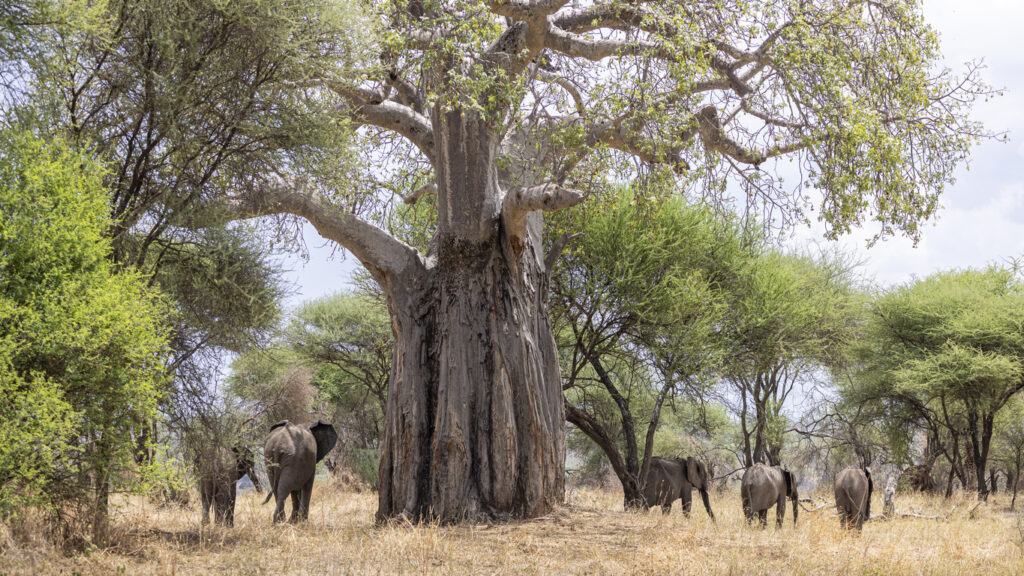
Hollow baobabs create natural cavities that shelter everything from bats and birds to reptiles and insects. The trees support complex ecosystems within their trunks and branches, with some hollows large enough to house entire colonies of animals. Old baobabs often have multiple cavities at different heights, providing diverse microhabitats for species with varying needs. This role as habitat creator makes baobabs keystone species whose presence supports biodiversity far beyond what their numbers alone would suggest.
Climate change is killing ancient baobabs.
In recent decades, some of the oldest and largest baobabs in southern Africa have died suddenly, likely due to changing rainfall patterns and rising temperatures. These deaths are particularly concerning because they’re affecting trees that survived for over a thousand years, suggesting conditions have shifted beyond their tolerance range. Scientists are monitoring remaining ancient baobabs closely and studying why climate change seems to affect the oldest specimens most severely. The loss of these ancient trees represents not just ecological damage, but the disappearance of living links to the deep past.
They hold deep cultural and spiritual significance.
Across Africa, baobabs feature prominently in folklore, spiritual practices, and traditional medicine, often regarded as sacred or magical. Communities hold meetings under their shade, use their hollow trunks for ceremonies, and pass down stories about specific trees through generations. The trees’ extreme age and imposing presence naturally inspire reverence, and many cultures believe spirits inhabit the oldest specimens. Their cultural importance has helped protect baobabs from destruction, as communities recognise their value extends far beyond timber or food to encompass identity and connection to place.