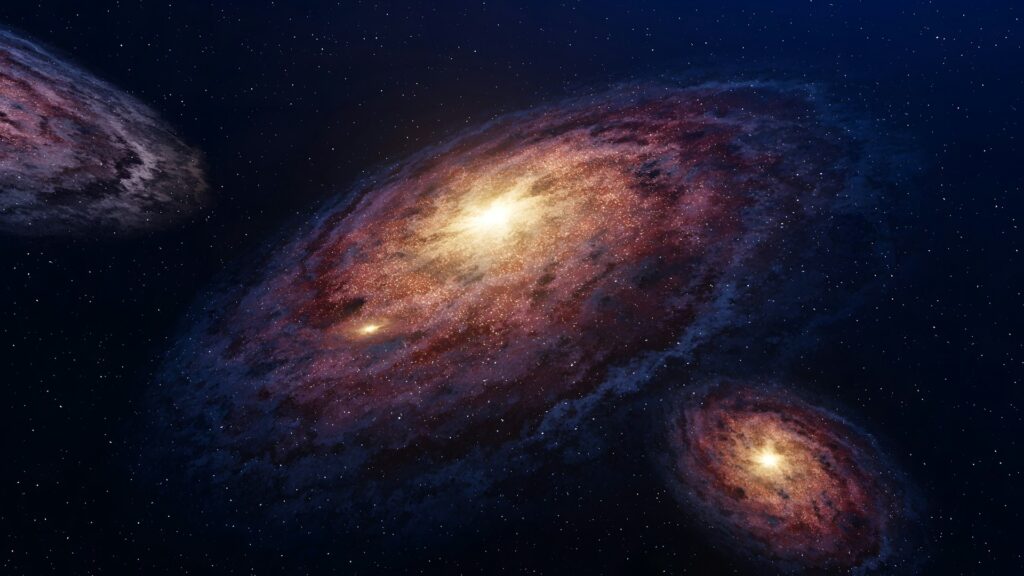
We obviously can’t put the universe on a giant set of scales, but scientists have found astonishingly clever ways to figure out how much it “weighs.” It’s a mix of observation, maths, and cosmic detective work, pulling clues from light, movement, and even the leftover radiation from the Big Bang. The result is one of the most ambitious measurements ever attempted: the total mass of everything that exists.
Here’s how scientists piece together that number from evidence scattered across billions of light-years.
Looking at the cosmic microwave background
The oldest clue comes from the faint glow left behind by the Big Bang: the cosmic microwave background (CMB). This radiation, discovered in 1965, still fills the entire universe like a faint afterglow of its explosive beginning. When satellites such as Planck and WMAP studied this radiation, they detected tiny temperature ripples that hold incredible information.
Those ripples show how matter and energy were distributed just 380,000 years after the Big Bang. By analysing them, scientists worked out how much ordinary matter and dark matter existed back then, giving us one of the most precise snapshots of the universe’s overall composition. It’s a bit like reading a baby photo of the cosmos and using it to estimate how much it weighed as an adult.
Watching galaxies move in clusters
Galaxies don’t just float around randomly; they gather in clusters held together by gravity. By studying how fast galaxies within these clusters move, astronomers can tell how much total mass must be present to keep them bound together.
When scientists first did this in the 1930s, they realised something strange: there wasn’t nearly enough visible matter (stars, gas, or dust) to account for the gravitational pull keeping the clusters intact. This mystery led to the discovery of dark matter, an invisible substance that doesn’t emit light but exerts gravity. It turned out that most of the universe’s weight was hiding in plain sight.
Studying galaxy rotation curves
You can also “weigh” individual galaxies by studying how their stars move. Logic says that stars near the edges of a galaxy should orbit more slowly than those near the centre, just as planets farther from the Sun move more slowly. But when astronomers measured these speeds, they found the opposite: stars on the outskirts were moving far too fast for the visible matter to hold them in place.
The only explanation was that a vast halo of dark matter surrounded each galaxy, adding invisible mass. By mapping how fast these stars spin (known as rotation curves), scientists can estimate how much dark matter sits within and around galaxies, which is another major piece of the puzzle.
Measuring gravitational lensing
Gravity bends light, and the universe uses that to its advantage. When light from a distant galaxy passes by something massive, like another galaxy or a cluster, it’s bent and distorted, creating a cosmic magnifying glass effect known as gravitational lensing.
By studying how much the light bends, scientists can calculate the total mass of whatever caused the distortion, even if most of it can’t be seen. This method allows researchers to literally map dark matter across the sky. The more the light bends, the more mass must be hidden there. It’s one of the most powerful tools we have for weighing the invisible parts of the universe.
Tracking the universe’s expansion
Ever since Edwin Hubble discovered that galaxies are moving away from us, scientists have been measuring how fast the universe is expanding. The rate of this expansion, called the Hubble constant, depends directly on how much matter and energy the universe contains.
By observing distant supernovae and cosmic radiation, cosmologists refine their models of how the universe grows. Comparing those expansion rates with theories of gravity gives clues about the total mass and energy balance. The faster the expansion, the more influence dark energy, the mysterious force pushing the universe apart, must have.
Counting stars and galaxies
While dark matter and dark energy dominate, the visible universe still matters, literally. Astronomers have conducted massive surveys, like the Sloan Digital Sky Survey, to count how many galaxies, stars, and gas clouds exist in the observable universe.
These counts help estimate how much ordinary (baryonic) matter there is, the kind that forms everything we can actually see: stars, planets, people, and pizza. Shockingly, all that visible matter makes up only around five percent of the universe’s total mass. It’s a humbling reminder of how small our familiar world really is.
Weighing hot gas in galaxy clusters
Galaxy clusters don’t just contain stars. They’re surrounded by vast clouds of scorching-hot gas. This gas emits X-rays, which telescopes like Chandra and XMM-Newton can detect. By measuring the brightness and temperature of that X-ray light, scientists can calculate how much mass the gas contains.
Even after counting all the stars and hot gas, there’s still far too much gravitational pull to explain. Once again, the missing weight points straight back to dark matter. The invisible mass outweighs the visible matter by roughly five to one.
Simulating the universe on computers
Modern cosmology wouldn’t exist without powerful computer simulations. Scientists feed supercomputers the laws of physics and test different combinations of matter, dark matter, and dark energy to see which version of the universe looks most like ours.
When these simulations match what telescopes actually observe, such as the large-scale web-like structure of galaxies, it confirms that their mass and energy estimates are probably right. It’s like building a virtual universe to double-check the maths behind reality itself.
Splitting mass into percentages
Instead of trying to express the universe’s weight in kilograms (which gets messy fast), cosmologists describe it in proportions. Based on decades of data, the breakdown looks roughly like this: 5% ordinary matter (everything made of atoms), 27% dark matter (invisible, but with gravitational pull), 68% dark energy (and unknown force driving expansion).
This formula neatly explains the universe’s structure and behaviour. It’s astonishing to realise that most of what exists can’t be seen, touched, or detected directly, but its effects shape everything we know.
Estimating the grand total
When all these measurements come together, from galaxy movements to background radiation, scientists estimate that the observable universe weighs around 10⁵³ kilograms (that’s a one followed by fifty-three zeros).
It’s an almost incomprehensible number, but it reflects how far we’ve come in understanding something we can never physically measure. By combining clues from gravity, light, and expansion, scientists have built one of the most complete pictures of existence itself.
The truth is, we may never know the exact weight of the universe, but that’s not really the point. What’s remarkable is how close we’ve come, all from the faint glow of ancient light and the subtle pull of invisible forces that continue to hold the cosmos together.