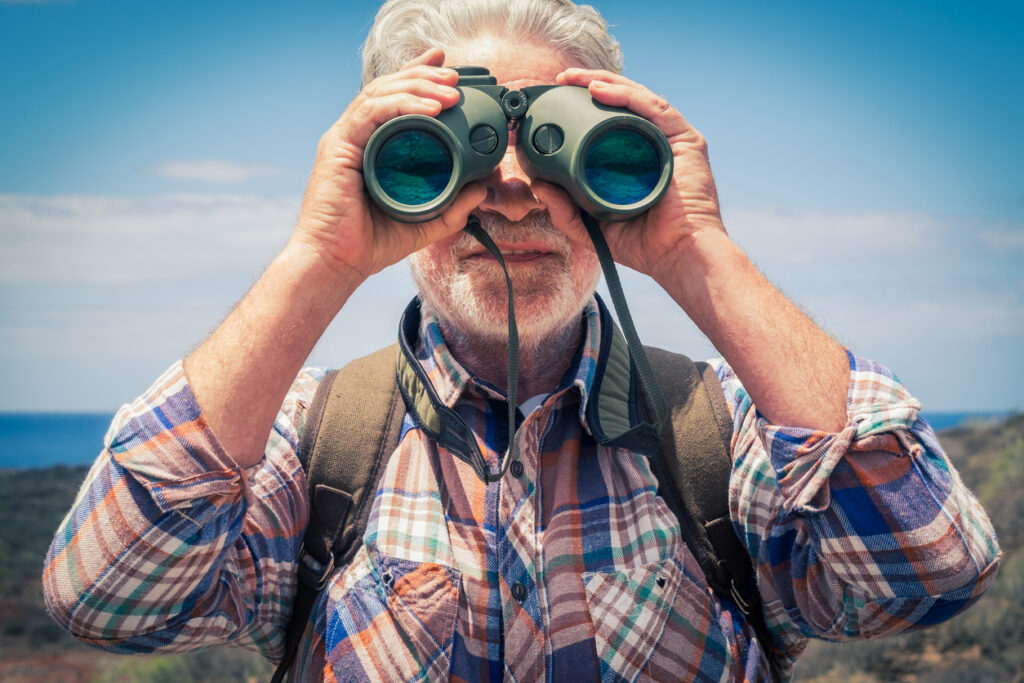
If you’re getting into birdwatching or wildlife spotting, a good pair of binoculars can completely change the experience. Suddenly, everything’s closer, clearer, and easier to identify. However, choosing the right pair can be confusing, and with so many numbers, features, and price ranges thrown at you, it’s hard to know where to start. Here are some expert-backed tips to help you make a choice that actually suits how (and where) you’ll be using them.
Understand the numbers on the binoculars.
When you see something like “8×42” on binoculars, the first number (8) is the magnification. That means the image will appear 8 times closer. The second number (42) is the diameter of the objective lens in millimetres, and it controls how much light comes in. For general birding and wildlife watching, 8×42 or 10×42 is a sweet spot. The magnification gives you enough reach, and the 42 mm lens brings in enough light for a clear, bright image, especially in low light or wooded areas.
Don’t assume higher magnification is better.
It’s tempting to go straight for 12x or higher, but more magnification isn’t always helpful. It makes the image shakier and narrows your field of view, which can actually make it harder to track fast-moving animals like birds. For beginners or general nature walks, 8x is often more stable and forgiving. You’ll get a wider view, which makes it easier to spot movement and keep things in focus without feeling like your hands have to be rock-steady.
Consider weight and comfort.
Binoculars might not look heavy, but when you’re carrying them for hours or holding them up repeatedly, the weight matters. A bulky pair can quickly become a burden, especially on long walks or hikes. Try them out in person if you can; see how they feel in your hands and around your neck. Lighter doesn’t always mean lower quality, but you want a balance between comfort and optical performance.

Choose waterproof and fog-proof options.
If you’re going to be out in the woods, near water, or birding early in the morning, your binoculars need to handle moisture. Waterproof and fog-proof models are sealed and filled with nitrogen or argon gas to stop internal fogging. It’s worth the extra investment. Sudden rain, dew, or even breathing on cold lenses can ruin your view if your optics aren’t weatherproof. You don’t want to be constantly wiping or worrying every time the weather changes.
Look for good eye relief, especially with glasses.
Eye relief is the distance your eyes need to be from the eyepiece to see the full field of view. If you wear glasses, you’ll want binoculars with longer eye relief—usually 15 mm or more—so you don’t miss out on the edges of your view. Most modern binoculars have adjustable eyecups that twist up or down depending on whether you’re wearing glasses. Make sure they’re easy to adjust and comfortable against your face.
Field of view really matters for birding.
The field of view (FOV) tells you how wide an area you can see through the binoculars. It’s measured in degrees or feet at 1,000 yards. A wider FOV makes it easier to spot movement, follow birds in flight, or scan a hedgerow or canopy. Higher magnification usually means a narrower FOV, so again, 8x binoculars often strike a better balance here. Look for an FOV of at least 350 feet at 1,000 yards if you’re mainly birdwatching.
Test the focus wheel.
The central focus wheel should be smooth and responsive, not stiff or jumpy. Wildlife rarely stays still, so being able to quickly adjust focus makes a huge difference when you’ve only got a few seconds to catch a clear look. Some binoculars also have a diopter adjustment, which lets you fine-tune the focus for one eye. Make sure it’s easy to use but not so loose that it slips out of place in your bag or pocket.
Don’t ignore the close focus range.
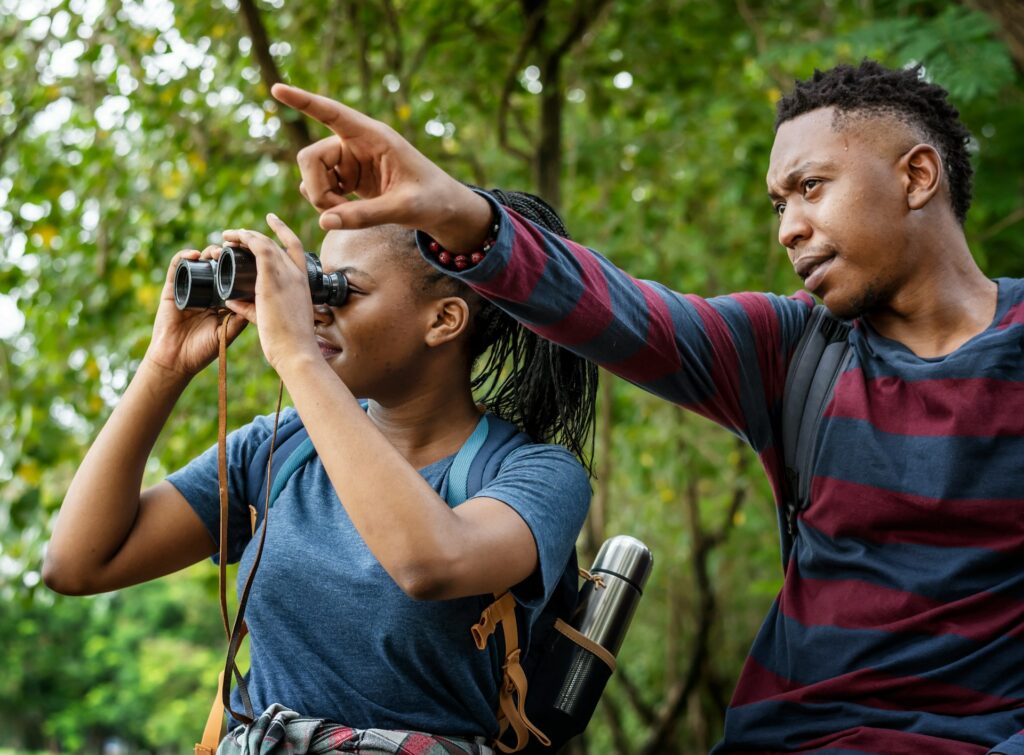
If you’re interested in butterflies, insects, or even watching birds at your feeder, close focus becomes really useful. It tells you how near you can be to something and still get a sharp image. Look for a close focus range of around 6 feet or less if you want to observe detail up close. It might not sound important until you find yourself face-to-face with a robin two metres away and your binoculars can’t handle it.
Go for quality glass and coatings.
Better binoculars use coated or fully multi-coated lenses to improve light transmission and reduce glare. You’ll see sharper images, brighter colours, and better contrast, especially in tricky light conditions. If the specs mention ED (extra-low dispersion) glass, that’s a good sign. It helps reduce colour fringing and makes everything look cleaner and more defined. It’s a noticeable difference, especially in high-contrast scenes.
Try before you buy (if possible).
Specs can only tell you so much. The best way to know if a pair of binoculars suits you is to try them in person. Feel the grip, check the weight, look through them outside, and see how your eyes adjust. Shops with demo models or local birding events are great for this. Everyone’s eyes and hands are different, and what feels great to one person might be completely off for another.

Think about how and where you’ll use them.
If you mostly bird from your garden or local park, you probably don’t need ultra-durable or high-powered binoculars. However, if you’re heading into woodland, coastal areas, or doing lots of travel, features like waterproofing, portability, and wide FOV become more important. Buy for the kind of watching you actually do, not the one you imagine you might do one day. You’ll enjoy the experience more when your gear fits your real habits.
Don’t feel pressured to buy the most expensive pair.
There are excellent binoculars in the mid-range that offer brilliant clarity, comfort, and durability. You don’t need to spend a fortune to get something reliable and enjoyable to use. Start with something well-reviewed in your budget range, and once you’ve built some experience, you’ll get a better sense of what upgrades might be worth it later. The best binoculars are the ones you’ll actually use, and enjoy using often.