In the dinosaur world, few matchups capture the imagination quite like Triceratops versus Tyrannosaurus rex. One had three horns and a massive frilled shield; the other had bone-crushing jaws and was built to kill. So here’s the big question: could Triceratops’ impressive head shield actually protect it from a T. rex attack, or was it more for show than survival? To find out, we need to dig into bone structure, bite force, fossil clues, and the real physics behind one of nature’s most famous prehistoric rivalries.
T. rex had one of the strongest bite forces in Earth’s history.
Tyrannosaurus rex didn’t just bite hard. It bit with a force estimated between 8,000 and 12,000 pounds per square inch. That’s enough pressure to crush bone like it’s dry spaghetti. Compared to modern animals, it easily outbites crocodiles, lions, and even great white sharks.
So any dinosaur on the receiving end of that jaw would need serious defence. Triceratops’ shield would have had to do more than just look intimidating; it needed to be structurally solid to survive a full-force chomp from those banana-sized teeth.
Triceratops’ frill was made of solid bone.
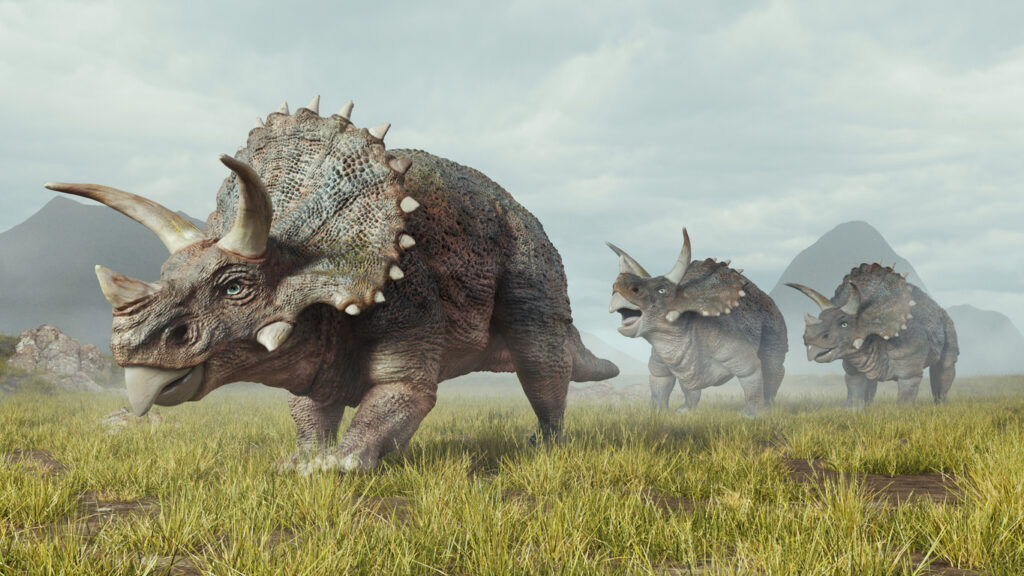
The iconic neck frill of a Triceratops wasn’t flimsy. It was made of thick, solid bone, some parts over 2.5cm thick, and fused with the skull. This provided a reinforced wall between the vulnerable neck area and any attacker coming head-on. But while it was strong, it wasn’t indestructible. Modern reconstructions suggest the frill could absorb a lot of pressure and even deflect some bites, but it likely wouldn’t hold up to repeated, direct hits from a fully grown T. rex.
Some frill bones had holes, but they weren’t necessarily weak spots.
Triceratops had fenestrae, or openings in the frill bones, likely to reduce weight. While this may seem like a vulnerability, not all Triceratops frills had these, and even those that did still had strong outer bone margins that added structure and protection. The placement of these holes meant they didn’t directly line up with the most likely impact zones in a fight. So while they weren’t armour-plated all the way through, the frill still offered a decent barrier against predators aiming for the neck.
Their horns weren’t just decoration; they were weapons.
Those three iconic horns weren’t just for display. Triceratops had a pair of long, forward-facing brow horns, plus a shorter nose horn. These were made of bone and sheathed in keratin, much like modern antelope horns, and they could inflict serious damage. In a confrontation, those horns could be used to jab, gore, or deter a predator before it got close enough to bite. So the shield didn’t have to work alone. If Triceratops got the first strike in, the fight might end before the frill was ever tested.
T. rex may have targeted softer areas.
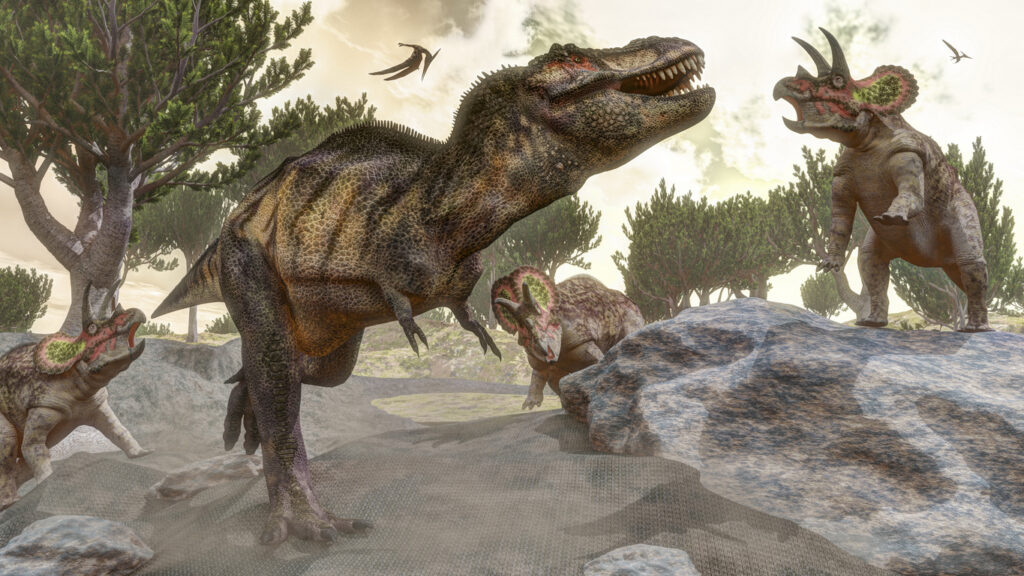
Despite its brute strength, T. rex was likely strategic. Fossil evidence suggests it often went for soft tissue like the underbelly, thighs, or neck, rather than chomping straight into thick skulls or shields where it risked damaging its own teeth. This means Triceratops’ shield might have been effective in deterring bites rather than blocking them outright. If it made T. rex hesitate or forced it to reposition, it gave the herbivore a better shot at surviving or counterattacking.
There’s fossil evidence of battles between the two.
Palaeontologists have found Triceratops bones with puncture wounds that match the spacing and shape of T. rex teeth. In some cases, the wounds had partially healed, suggesting the Triceratops survived the attack, at least for a while. This supports the idea that its frill and horns weren’t just for show. They helped it withstand serious pressure. Surviving a T. rex bite, even once, is proof that its defensive system worked to some degree.
Triceratops’ posture gave it a defensive edge.
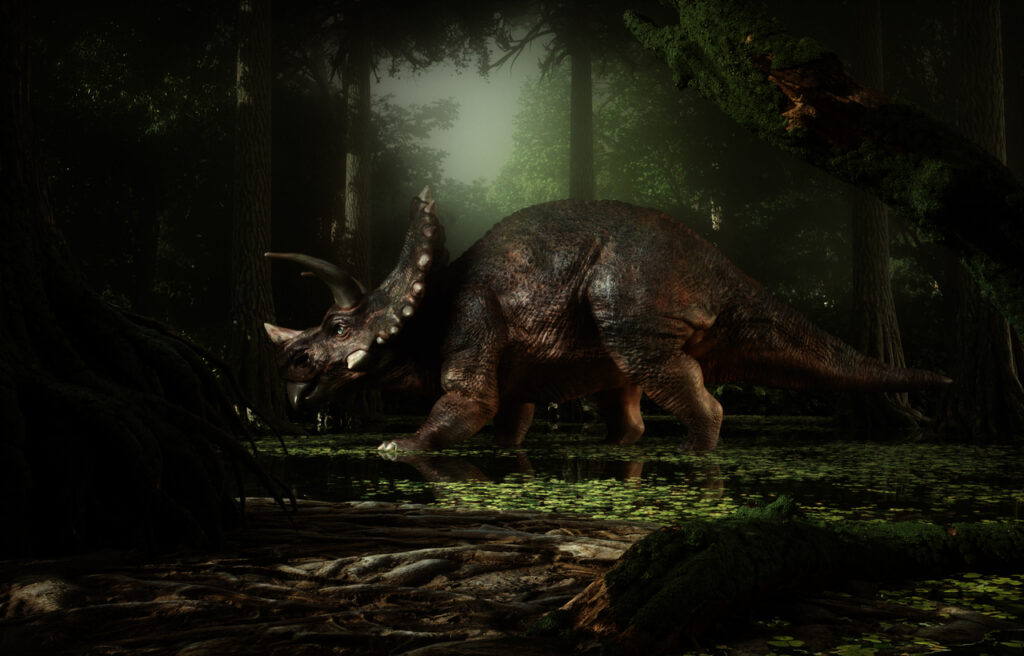
Triceratops had a low, broad stance with strong front limbs. This made it less likely to be toppled in a clash. Its body weight and solid base gave it stability when squaring up against a predator like T. rex. Combined with its forward-facing horns and shield, it could present a tough, spiked front. A charging T. rex would have to get past that without getting gored or blocked, and that wasn’t a guaranteed outcome.
The shield may have redirected force, not just absorbed it.
Modern biomechanics studies suggest that Triceratops’ frill could distribute and deflect force from glancing blows. Instead of taking a hit dead-on, it could move the impact across the broader surface and away from the neck. This kind of passive defence is similar to how helmets or shields work today. They don’t just stop a blow; they spread the energy out, reducing damage to critical areas. In that sense, the frill was smart armour.
T. rex may not have had the best grip on Triceratops’ head.
Even with its massive jaws, T. rex would’ve struggled to get a clean bite on Triceratops’ horned, wide-set head. The angles made it difficult to latch on without risking a horn in the face or jaw. This could mean T. rex avoided attacking from the front unless the Triceratops was injured or cornered. In a straight-up faceoff, that wide shield may have made the predator hesitate or aim for the flanks instead.
Young Triceratops had weaker shields.
It’s likely that younger Triceratops had thinner, less developed frills, meaning they were more vulnerable. Fossil evidence suggests the frill grew thicker and broader with age, possibly as a response to increasing predation risk. So while adults might have held their own in a fight, juveniles were probably easier targets. This adds context to how often T. rex may have picked off the weaker members of the herd rather than challenging the biggest, most armoured ones.
The frill also had a social function.
Some palaeontologists believe the frill evolved partly for display, either to attract mates, signal maturity, or establish dominance. If true, it means the frill wasn’t purely defensive, though that doesn’t mean it couldn’t serve both purposes. Think of it like a stag’s antlers or a peacock’s tail: impressive to look at, but also usable in combat when needed. Natural selection tends to favour traits that serve multiple functions, and Triceratops’ shield fits that mould.
Not every T. rex encounter ended in death.
While it’s tempting to imagine every T. rex vs Triceratops clash ending in carnage, it’s just as likely that many encounters were posturing or ended with the predator backing off. One well-aimed horn jab could seriously injure a T. rex. The shield may not have been a total bite-stopper, but it likely gave Triceratops just enough protection to escape or fight back. That alone would’ve made it valuable in a dangerous world full of hungry giants.

Bone damage shows shields took a beating.
Fossilised Triceratops skulls often show healed lesions and impact damage, especially around the frill area. This tells us they were using their heads actively, either in fights with predators or with each other. That kind of scarring suggests the frill could take a fair amount of abuse and still serve its purpose. It wasn’t just a passive barrier; it was part of an animal designed to throw its weight around when it had to.
In the end, it wasn’t about being invincible, just surviving.
No defence system is perfect. T. rex bites could, and sometimes did, penetrate Triceratops’ armour. But survival isn’t about being unbreakable. It’s about having enough of an edge to make escape or resistance possible. Triceratops’ frill probably didn’t make it untouchable, but it gave it a fighting chance, and in the brutal world of the Late Cretaceous, that was all it needed.