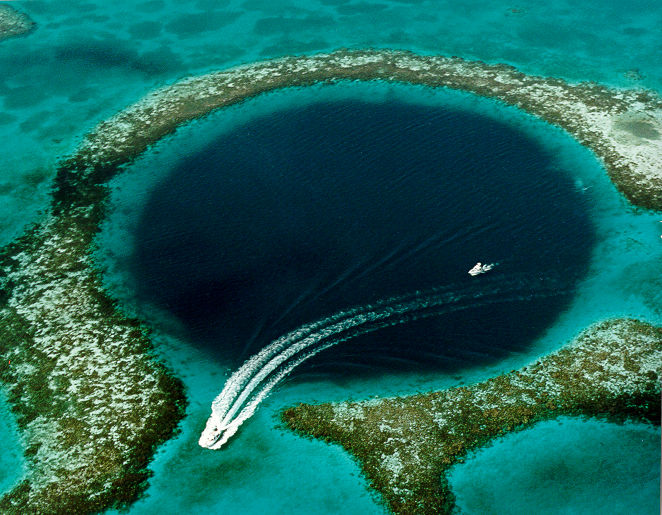
The Great Blue Hole off the coast of Belize looks like someone punched a perfect circular hole straight through the ocean floor, creating a dark blue void that’s so massive and distinct it shows up clearly in satellite photos from space. This underwater sinkhole is basically a time machine that preserves ancient secrets from when sea levels were dozens of metres lower and the area was dry land.
1. It’s a perfectly circular marine sinkhole that’s almost 305 metres across.
The Great Blue Hole measures about 300 metres in diameter and drops down 124 metres deep, making it one of the largest underwater sinkholes on Earth. Its nearly perfect circular shape makes it instantly recognisable from aerial photos and satellite imagery.
The circular formation happened because it was originally a limestone cave system that formed during ice ages when sea levels were much lower. When the ice melted and sea levels rose, the cave ceiling collapsed, creating this massive underwater crater.
2. You can literally see it from space with the naked eye.
Astronauts on the International Space Station can spot the Great Blue Hole without any special equipment because its dark blue colour contrasts so dramatically with the lighter blue-green of the shallow Caribbean waters surrounding it. It appears as a perfect dark circle in the middle of the coral reef.
The colour difference happens because the hole is so deep that sunlight can’t penetrate to the bottom and reflect back up, while the shallow waters around it reflect light from the white sand and coral below, creating that distinctive turquoise colour.
3. Jacques Cousteau put it on the map and called it one of the world’s best diving spots.
The legendary ocean explorer Jacques Cousteau brought the Great Blue Hole to international attention in 1971 when he declared it one of the top ten scuba diving sites in the world. His endorsement helped transform it from a local curiosity into a world-famous diving destination.
Cousteau’s team was among the first to explore the hole scientifically, using submersibles to investigate its depths and document the unique formations and marine life found inside this underwater cathedral.
4. The water inside is crystal clear but eerily empty of most marine life.
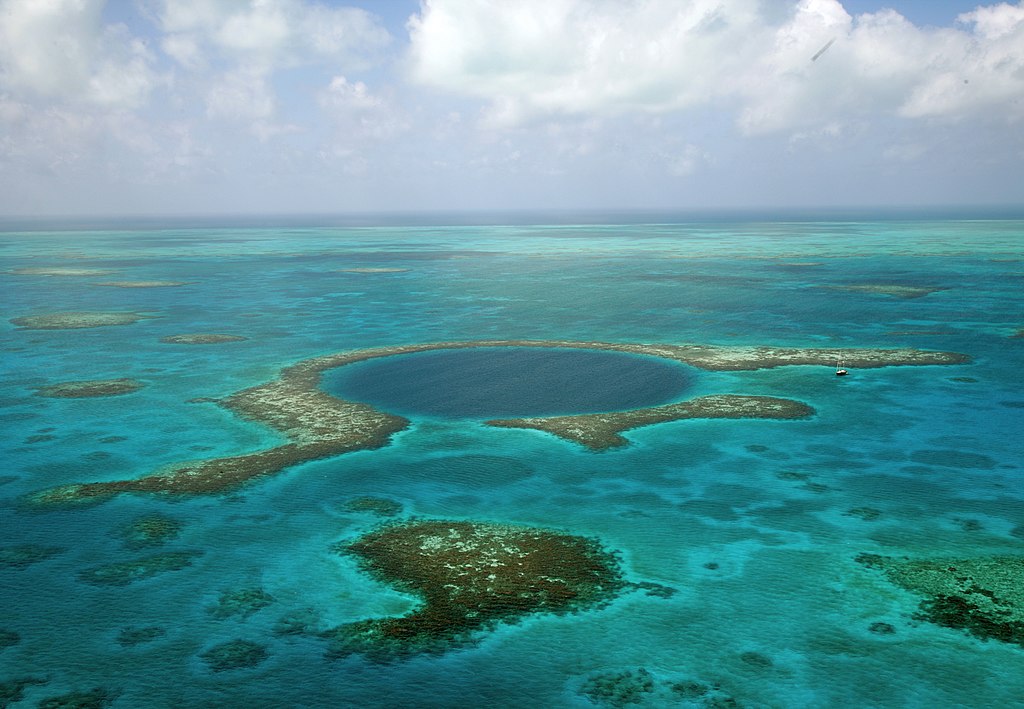
While the reef around the Great Blue Hole teems with colourful tropical fish and coral, the interior of the hole itself is relatively barren. The deep, oxygen-poor water can’t support much marine life, creating an underwater desert in the middle of one of the world’s richest coral reef systems.
The lack of marine life actually makes for incredible visibility. Divers can see for over 30 metres in the crystal-clear water, allowing them to appreciate the massive scale and geological formations without fish and coral blocking the view.
5. Ancient stalactites hang from the ceiling like underwater icicles.
Massive limestone stalactites formed inside the cave when it was dry land during the last ice age, and these formations are still perfectly preserved underwater. Some of these stalactites are over 12 metres long and provide clear evidence that this area was once above sea level.
These stalactites tell the story of Earth’s climate history. They formed slowly over thousands of years when the cave was filled with air instead of water, proving that sea levels have changed dramatically over geological time.
6. The hole drops straight down like an underwater skyscraper in reverse.
Unlike most underwater formations that slope gradually, the Great Blue Hole has nearly vertical walls that plunge straight down into the abyss. Divers describe it as floating next to the wall of an underwater building that disappears into darkness below them.
The vertical walls formed because the original limestone cave had steep sides that collapsed straight down when the ceiling gave way. This creates a unique diving experience where you’re essentially rappelling down an underwater cliff face.
7. It was formed during multiple ice ages over hundreds of thousands of years.
Scientists believe the Great Blue Hole formed in stages during at least four different ice ages, when falling sea levels exposed the limestone and allowed cave formation to occur. Each ice age contributed to carving out more of the massive chamber.
The complex formation process explains why the hole has multiple levels and chambers. It wasn’t created all at once, but slowly carved out over hundreds of thousands of years as sea levels rose and fell with changing climate conditions.
8. The water temperature stays constant year-round in the depths.
While surface temperatures in the Caribbean vary with seasons, the deep water in the Great Blue Hole maintains a constant temperature of about 24 °C throughout the year. This stable temperature creates unique conditions for both geological preservation and the few species that do live there.
The consistent temperature happens because the deep water is insulated from surface weather changes and doesn’t mix much with the warmer surface water, creating a stable underwater environment that’s remained largely unchanged for thousands of years.
9. It’s part of the world’s second-largest coral reef system.
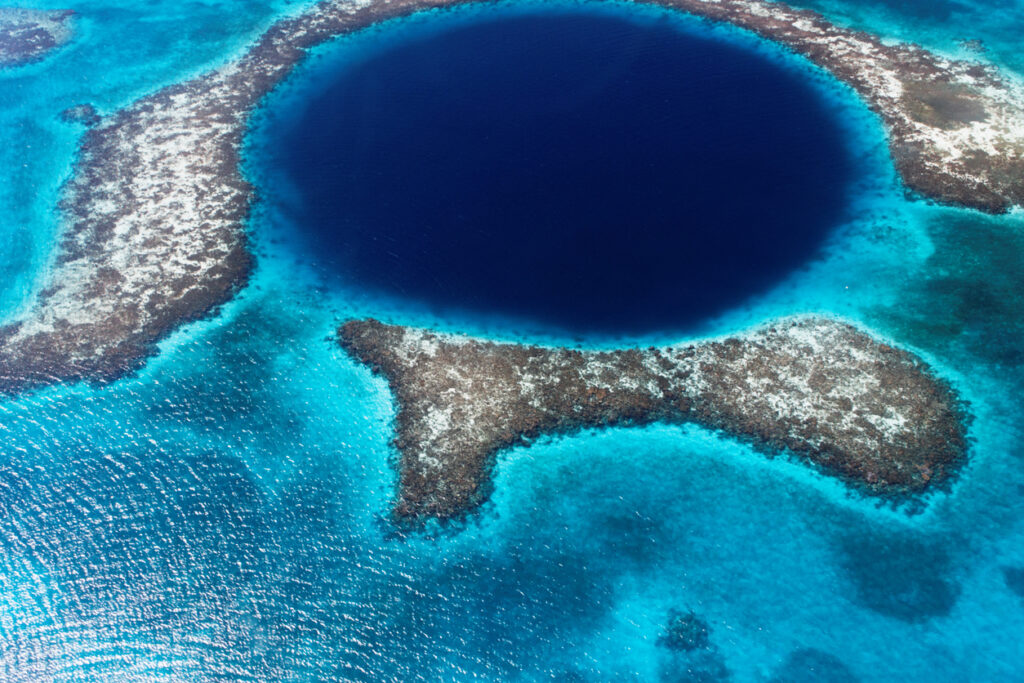
The Great Blue Hole sits within the Belize Barrier Reef Reserve System, which is the second-largest coral reef system in the world after Australia’s Great Barrier Reef. This makes it a unique feature within an already spectacular marine ecosystem.
The surrounding reef system supports incredible biodiversity and helps protect the hole from damage by storms and currents. The reef also provides a dramatic contrast to the barren interior of the hole, showcasing two completely different underwater environments side by side.
10. Recent expeditions discovered new species living in its depths.
Advanced submersible expeditions in recent years have found previously unknown species of bacteria and other microorganisms living in the oxygen-poor depths of the hole. These discoveries show that even seemingly barren underwater environments can harbour unique life forms.
The extreme conditions in the deep parts of the hole—low oxygen, constant temperature, and minimal light—create a unique ecosystem that may help scientists understand how life can survive in harsh environments on Earth and potentially other planets.
11. It’s a UNESCO World Heritage Site protecting ancient history.
The Great Blue Hole and surrounding reef system were designated as a UNESCO World Heritage Site in 1996, recognising both their geological significance and their importance for marine conservation. This protection helps preserve the site for future scientific research and responsible tourism.
The UNESCO designation acknowledges that the hole is essentially an underwater museum that preserves evidence of Earth’s climate history, ancient cave formations, and unique marine ecosystems that can’t be found anywhere else on the planet.
12. Climate change research uses it as a window into Earth’s past.
Scientists study sediment cores from the bottom of the Great Blue Hole to understand how Caribbean climate and sea levels have changed over thousands of years. The hole acts like a time capsule that preserves evidence of ancient environmental conditions.
Research in the hole has provided valuable data about past hurricane activity, rainfall patterns, and sea level changes that help scientists better understand current climate change and predict future environmental conditions in the Caribbean region.