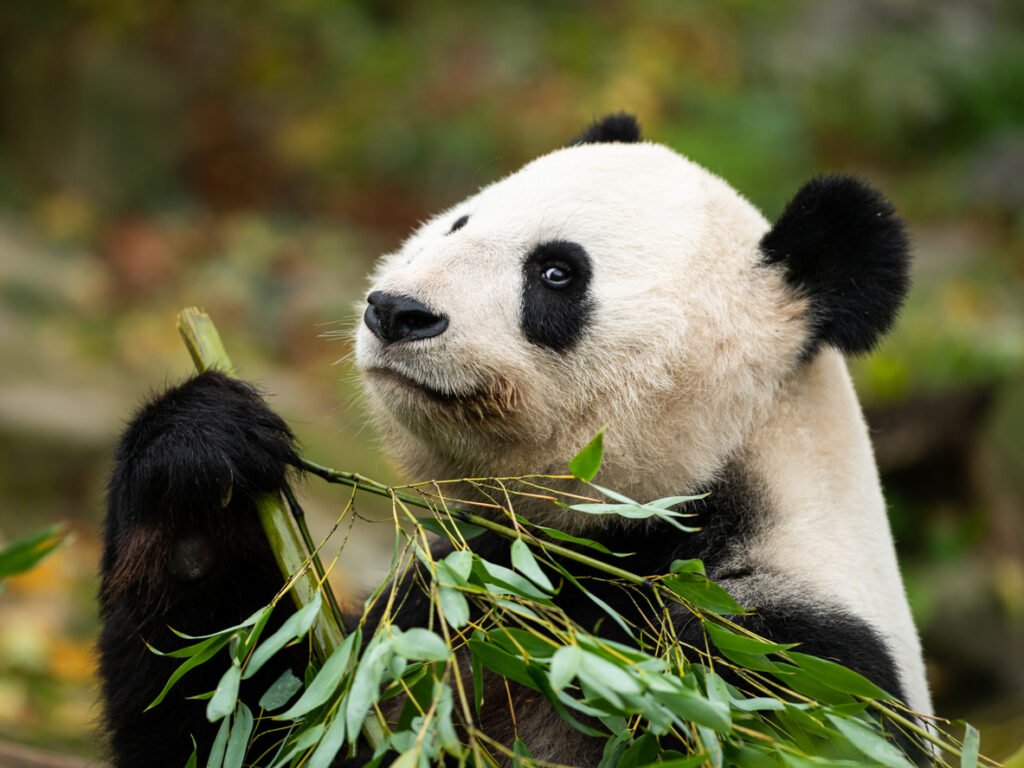
It seems like a massive evolutionary blunder when you look at the facts: you’ve got a bear with a digestive system built for meat that spends 14 hours a day chewing on a woody grass that’s basically nutritional cardboard. They’re stuck in a strange middle ground where they’ve lost the taste for flesh but haven’t actually developed the stomach of a cow to process plants efficiently.
This dietary choice forced them into a lifestyle of extreme energy saving, which explains why they’re not exactly known for their high-speed pursuits. Understanding why they made this odd transition is less about a love for greens and more about a desperate survival strategy that’s left them on a permanent, low-energy loop.
They evolved from meat-eating ancestors.
Giant pandas belong to the bear family, and their ancestors were omnivores who ate both plants and animals. Somewhere along the evolutionary line, pandas changed almost entirely to bamboo, which is one of the stranger dietary pivots in the animal kingdom.
Their digestive system still looks like that of a carnivore, built for processing meat rather than plant matter, which is part of what makes their relationship with bamboo so biologically unusual. They didn’t evolve to eat bamboo so much as they chose it and then adapted around that choice over millions of years.
A genetic change switched off their taste for meat.
Scientists have found that pandas lost the ability to taste umami, which is the savoury flavour associated with meat and protein. This happened because a gene called T1R1, which is responsible for detecting that flavour, became inactive in pandas over time.
Without the ability to taste what makes meat appealing, the motivation to hunt or seek it out effectively disappeared. Bamboo doesn’t require hunting, doesn’t fight back, and is available in enormous quantities in the forests pandas inhabit, which made it an increasingly practical option as their taste preferences changed.
Bamboo is everywhere and it doesn’t run away.

One of the most straightforward reasons pandas eat bamboo is pure abundance. In the mountain forests of central China where pandas live, bamboo covers the ground in dense quantities and grows back quickly after being eaten. There’s no competition for it, no need to chase it, and no risk involved in getting it.
For an animal that needs to consume enormous amounts of food daily just to meet its energy needs, having a reliable, static food source that regenerates constantly is a huge advantage. It removes a lot of the uncertainty that comes with depending on prey.
Their wrist evolved into a makeshift thumb.
Pandas have a modified wrist bone that functions as an opposable thumb, which is a very specific adaptation to their bamboo diet. It lets them grip bamboo stalks firmly, strip leaves efficiently, and eat with a level of dexterity that most other bears simply don’t have.
Their pseudo-thumb isn’t a real finger, it’s an enlarged radial sesamoid bone, but it works well enough for the job. The fact that pandas evolved this structure specifically to handle bamboo is a clear indication of just how deeply embedded this food source has become in their biology over time.
Their skull and jaw muscles are built for it.
Pandas have unusually large, flat molars and powerful jaw muscles relative to their size, both of which are adaptations for grinding through tough bamboo stalks. Bamboo is fibrous and hard, and chewing through large quantities of it daily requires serious mechanical force.
A panda’s skull is broader and more heavily built than you’d expect for an animal of its size, and that structure exists specifically to support the jaw strength needed to process its diet. It’s one of the clearest physical signs that bamboo eating isn’t just a quirky habit, but something that has genuinely shaped their anatomy.
Bamboo has very little nutrition, which is why they eat so much.
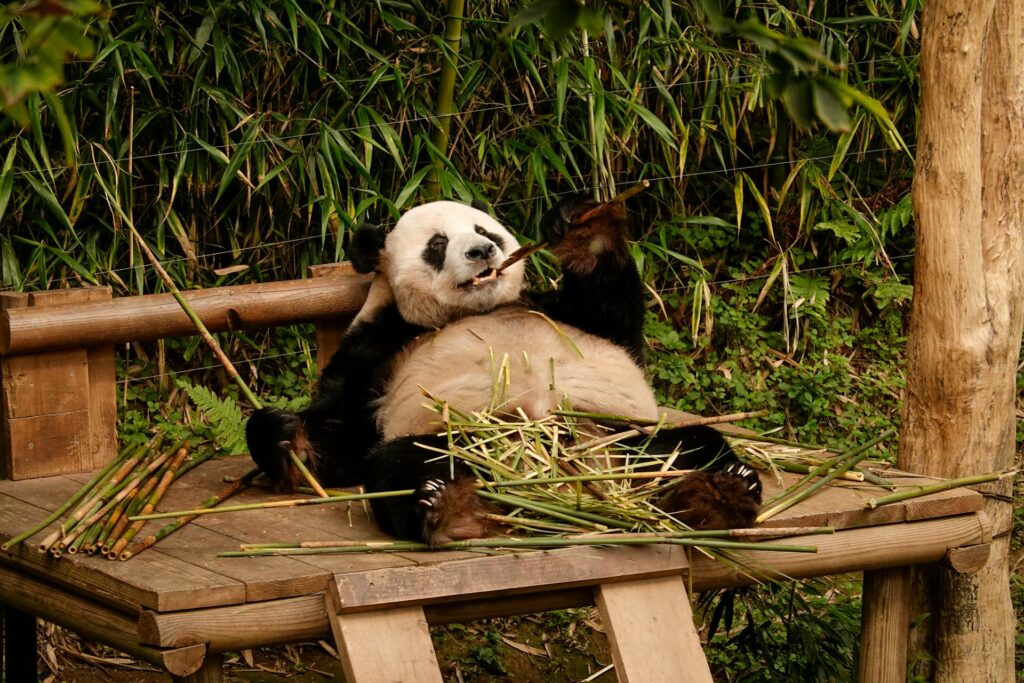
Bamboo is low in calories and difficult to digest, which is why pandas need to eat between 12 and 38 kilograms of it every single day just to get enough energy to function. Their digestive tract is still relatively short, as you’d expect from a carnivore, which means they absorb only a small percentage of the nutrients available in each mouthful before it passes through.
They compensate by eating almost constantly and by spending as little energy as possible on everything else. Pandas are famously inactive not out of laziness, but because conserving energy is an essential part of surviving on such a nutritionally poor diet.
They slow their metabolism down to cope.
Research has shown that pandas have an exceptionally low metabolic rate, comparable in some measurements to a sloth. Their thyroid function is unusually reduced, which keeps their energy expenditure low enough that a bamboo-based diet can actually sustain them.
That metabolic adaptation is rare among bears and is another piece of the puzzle that explains how an animal that size can survive on food with so little caloric density. They’ve essentially adjusted the rate at which they burn energy to match what bamboo can realistically provide.
They move very little to preserve what they take in.
Beyond their slowed metabolism, pandas have adapted their behaviour to make the most of a low-energy diet. They spend most of their time either eating or resting, and they avoid unnecessary exertion wherever possible. Their home ranges are relatively small compared to other bears, which means they’re not burning energy travelling large distances. Even their social behaviour is minimal, with pandas living largely solitary lives outside of mating season. All of this adds up to an animal that has trimmed its energy output down to match what bamboo can provide.
They eat different parts of the plant at different times of year.
Pandas aren’t just eating bamboo randomly. They’re actually quite selective about which part of the plant they eat and when. In spring, they prefer young bamboo shoots, which are higher in protein and easier to digest. In summer and autumn they focus more on leaves, and in winter, they eat the woody stems when little else is available. Such seasonal rotation is a way of maximising the nutritional value they extract from bamboo throughout the year. It suggests a much more calculated relationship with their food source than simply eating whatever’s in front of them.
They need multiple bamboo species to survive.
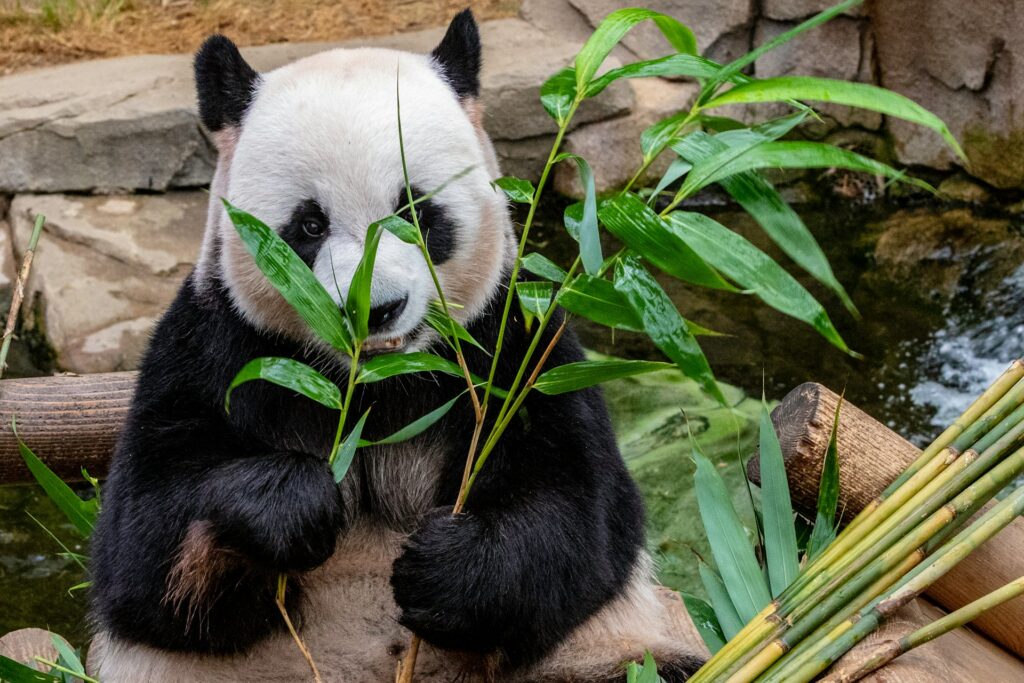
Pandas typically rely on more than one species of bamboo, and this matters enormously for their survival. Individual bamboo species have a strange biological habit of mass flowering and then dying off, sometimes across entire forests simultaneously. When this happens, a panda dependent on just one species would face starvation.
By eating several different types, they have a degree of insurance against these die-offs. Historically, pandas could also move to higher or lower elevations to find different species when one became unavailable, though habitat loss has made that kind of movement increasingly difficult.
Habitat loss has made bamboo more important, not less.
As human development has pushed into panda territory over the past century, the options available to pandas have narrowed considerably. Fragmented forests mean pandas can’t roam freely between bamboo sources the way they once could, which makes their dependence on bamboo both more entrenched and more precarious.
Conservation efforts have focused heavily on protecting bamboo forest corridors specifically because of this, recognising that pandas can’t simply adapt to a different food source. After millions of years of evolution in one direction, bamboo isn’t just what pandas eat. It’s what they are built around.
They still have the gut bacteria of a carnivore.
Despite eating almost exclusively bamboo, panda gut microbiomes contain far fewer of the bacteria typically associated with plant digestion than you’d find in a true herbivore. Studies comparing panda gut bacteria to those of other plant-eating animals found pandas are missing many of the microbial communities that help break down cellulose efficiently.
That means they’re digesting bamboo with a system that was never quite designed for it, which partly explains the low absorption rates and the need to eat such vast quantities. It’s further evidence that the panda’s relationship with bamboo is a relatively recent evolutionary development rather than a long-established biological fit.
Their bamboo dependency makes conservation complicated.
The fact that pandas are so completely dependent on bamboo creates real challenges for conservation. Protecting pandas means protecting large, connected areas of bamboo forest, which requires a lot of land and consistent management over long timescales.
Climate change adds another layer of difficulty because changing temperatures affect where bamboo can grow, potentially moving it out of areas that pandas currently inhabit. Breeding programmes in captivity also have to carefully manage bamboo supply, with different facilities sourcing multiple species to make sure animals have variety throughout the year. The simplicity of their diet on the surface hides a surprisingly complicated set of dependencies underneath it.