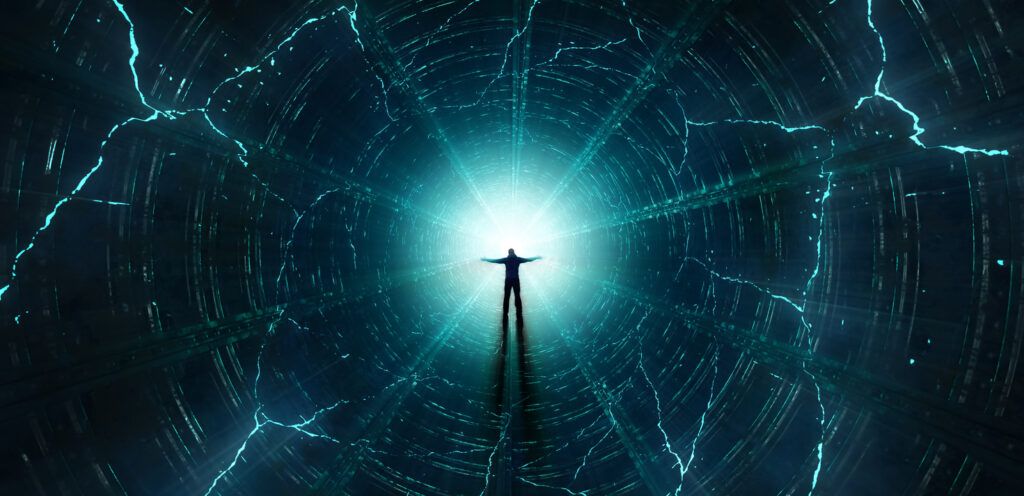
Falling into a black hole is the ultimate point of no return scenario, involving a set of physical laws that defy most of our everyday logic. If you were to drift toward one, the experience would be dictated by the sheer intensity of gravity warping both space and time around you. It isn’t just a matter of falling; it’s a process where the path ahead becomes the only possible direction in existence, as the very fabric of the universe curves inward.
From a distance, the view is deceptive, but up close, the physics become incredibly local and brutal. You’d be dealing with two distinct realities: what an outside observer sees happening to you, and the much more immediate, physical reality of what happens to your body as you cross the event horizon.
You wouldn’t fall in the way you’d expect.
Most people picture falling into a black hole the way you’d fall off a cliff: a sudden drop into darkness. In reality, the gravitational pull builds gradually as you approach, and from a distance, it would feel more like being slowly drawn towards something you can’t stop. The point of no return is called the event horizon, and crossing it wouldn’t necessarily feel like hitting a wall. It might not feel like anything at all at first.
Time would start behaving strangely.
As you fell closer to a black hole, time would begin to slow down relative to someone watching from a safe distance. To them, you’d appear to freeze at the event horizon and gradually fade, stretched across the boundary for what would look like an eternity. From your own perspective, though, you’d cross the event horizon without noticing a dramatic moment. Instead, you’d just keep falling.
@clevacox What if you fell into a black hole? It depends on the black hole’s size. Small one (a few solar masses) → spaghettified by tidal forces before reaching the event horizon. Supermassive one (like M87*) → you cross the horizon without noticing, then spaghettified later at the singularity. From outside, possibly incinerated due to Hawking radiation debates. Physics remains uncertain for the largest ones. #blackhole #space #astrophysics ♬ Last Hope (Over Slowed + Reverb) – Steve Ralph
The tidal forces would stretch you apart.
Physicists have a brilliantly grim term for what happens to a body near a black hole: spaghettification. The gravitational pull on your feet would be so much stronger than the pull on your head that your body would be stretched vertically and compressed horizontally into a long, thin strand. For a smaller black hole, this would happen before you even reached the event horizon, which is as unpleasant as it sounds. For a supermassive black hole, you might cross the event horizon intact before the tidal forces became fatal.
Radiation would be a serious problem.
In 1974, physicist Stephen Hawking proposed that black holes aren’t completely black. They emit a faint form of radiation now known as Hawking radiation, caused by quantum effects near the event horizon. For a stellar-mass black hole, this radiation would be intense enough to be lethal well before you got close. For a supermassive black hole the radiation is far weaker, meaning it’s actually the less immediately deadly option, which is a strange sentence to write about something that would still absolutely kill you.
You’d be bombarded with blue-shifted light.
As you fell inward, light from the universe behind you would become increasingly compressed and blue-shifted, appearing more intense and energetic the deeper you went. At the same time, any light coming from further inside the black hole would be stretched and red-shifted almost out of existence. The view looking inward would effectively be pure darkness, while the universe behind you would shrink to a bright, distorted disc of light.
Once past the event horizon, nothing gets you out.
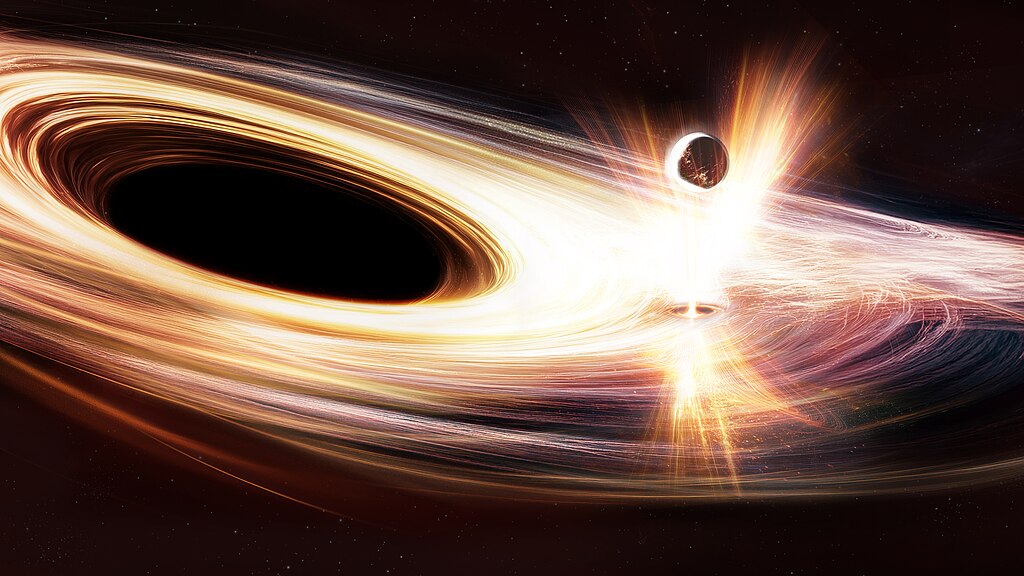
The event horizon is the point at which the escape velocity exceeds the speed of light, meaning that nothing—not even light, not even information—can travel back out once it’s crossed that threshold. It’s not just a practical limitation, it’s a fundamental one. There’s no engine powerful enough, no force in physics as we currently understand it that could reverse your trajectory once you’ve passed that point.
You’d hit the singularity.
At the centre of a black hole sits what’s called a singularity — a point where the known laws of physics simply break down and stop being useful. The density there is considered infinite in our current models, and general relativity can’t tell us what actually happens to matter at that point. Whether the singularity is a true physical feature of reality or a sign that our current understanding of physics is incomplete is still an open question.
It might look different depending on the type of black hole.
Not all black holes are the same shape inside. Rotating black holes, which are thought to be far more common than non-rotating ones, are described by different mathematics and may contain a ring-shaped singularity rather than a point. Some theoretical models suggest that inside a rotating black hole you might encounter regions where time and space behave in deeply counterintuitive ways, though what this would actually mean for anything falling in remains deeply uncertain.
@blitzphd This lesson on Penrose diagrams brought to you by repeatedly answering the same misconception in the comments! Do note that in reality you wouldn’t survive to look at stuff by the time you get to the singularity (which probably doesn’t exist anyway). #science #tiktoklearningcampaign #blackhole #penrosediagram #explained ♬ original sound – Dr. Blitz
The information paradox makes it even weirder.
One of the biggest unsolved problems in physics is what happens to the information contained in matter that falls into a black hole. Quantum mechanics insists that information can’t be destroyed, but general relativity seems to suggest the black hole takes it with it permanently. The contradiction between two of the most successful theories in physics is known as the black hole information paradox, and it hasn’t been resolved yet, despite decades of serious effort from some very clever people.
Nobody really agrees on what you’d experience.
There’s a genuine and ongoing debate among physicists about what crossing the event horizon would actually feel like from the inside. One proposal, called the firewall hypothesis, suggests that instead of a smooth crossing, you’d be instantly incinerated by a wall of high-energy radiation at the horizon. Others argue this can’t be right because it violates other principles, and the argument is still very much alive in theoretical physics circles. The honest answer is that we don’t know, and we probably won’t know until we have a theory that properly combines quantum mechanics and general relativity.
It’s one of those topics where the more you dig into it, the more obvious it becomes that the universe is far stranger than everyday life prepares you for — and that black holes, more than almost anything else, sit right at the edge of what human understanding can currently reach.