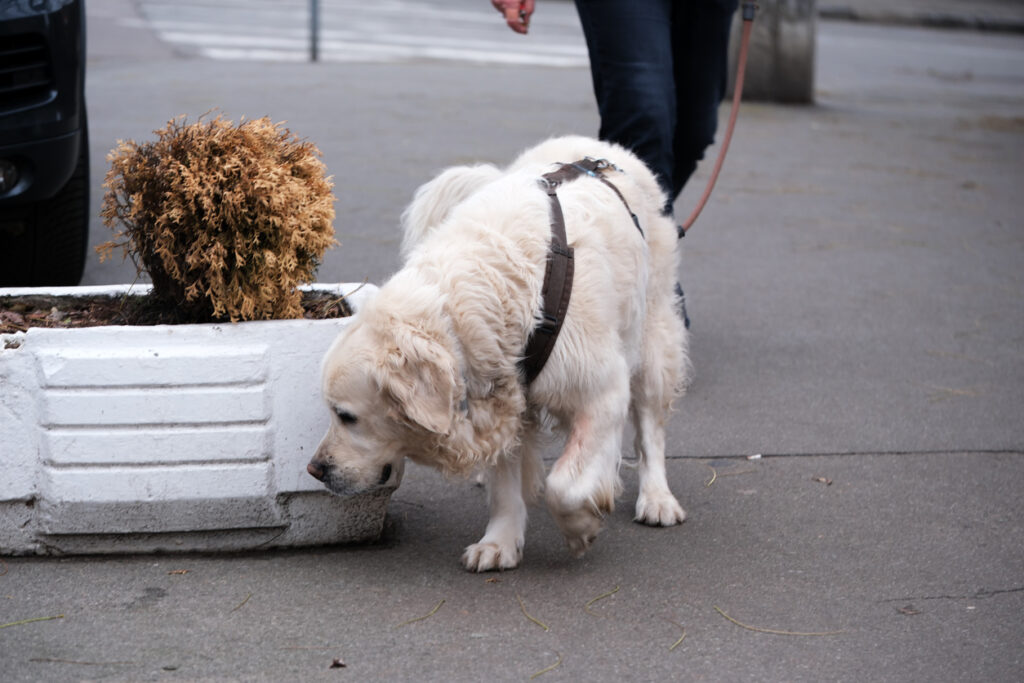
Every dog owner has stood on a pavement while their dog spends four minutes intensely investigating a patch of grass that looks completely empty. It feels random and slightly baffling, but there’s nothing random about it at all. Your dog is doing something far more purposeful than it appears.
Their nose is processing a completely different world to the one you’re seeing.
A dog’s sense of smell is somewhere between 10,000 and 100,000 times more sensitive than a human’s, depending on the breed. Where you see a lamp post or a bit of wall, your dog is reading a detailed record of every animal that has passed by, what they ate, whether they were stressed, their sex, their reproductive status, and roughly when they were there. It’s less like sniffing and more like reading a noticeboard that gets updated constantly throughout the day.
Urine is basically a full social profile.
When your dog stops to smell another dog’s wee, they’re not being gross, they’re gathering specific information. Dog urine contains chemical signals called pheromones that communicate age, sex, health, emotional state, and whether a female is in season. Your dog can tell a great deal about an animal they’ve never met just from a small patch on a wall and will often leave their own mark on top, adding their own entry to the ongoing record. It’s a social network that operates entirely through smell.
@pawforwarddogtraining Ever wondered why dogs love sniffing so much? Here are just some of the ways sniffing impacts our dogs👇🏼 🌎 Exploring the environment – helps dogs learn all sorts about their surroundings 🧘♀️ Calming – helps your dog reduce their heart rate and self-soothe 😆 Mood – triggers the release of dopamine, which helps dogs feel happy 🌳 Natural – sniffing is a natural instinct for dogs 🗣️ Communication – dogs can express when they’re feeling overwhelmed by sniffing What have I missed on this list (oooo that rhymes)?🤔 #dogowners #dogtraining #enrichmentfordogs #dogenrichmentactivities #doginstincts #dogbehavior #dogknowledge #helpingdogs #doghealth #creatorsearchinsights ♬ Calm Music Background (Live) – Zen music
The weird patch of grass might be genuinely fascinating to them.
Something that appears to be an unremarkable bit of pavement to you could contain traces of a fox that passed at 3am, a cat that sat there this morning, a dropped piece of food from days ago, or another dog that rolled in something interesting last week. All of those scent layers are still present and readable to your dog even when they’re invisible and odourless to you. The weirder the spot looks to you, the more likely it is that something actually happened there.
Sniffing is genuinely mentally tiring in the best possible way.
Research into canine behaviour has found that allowing a dog to sniff freely during a walk tires them out more effectively than the same distance covered at a brisk pace without stopping. The mental effort of processing complex scent information is significant and a dog that’s been allowed to sniff properly tends to be noticeably calmer afterward. Pulling them away from every interesting smell to keep moving is the equivalent of someone walking you through a museum at speed and not letting you look at anything.
They’re checking for danger as much as for interest.
Sniffing unfamiliar objects, corners, and gaps in fences isn’t just curiosity. Dogs use scent to assess whether something poses a risk before they get close enough for it to matter. The smell of a predator, an unfamiliar dog with aggressive tendencies, or something that triggered fear in another animal all leave chemical traces that your dog can detect and respond to. What looks like dawdling is often your dog doing a quick security sweep of the environment.
Dead things and strong smells are irresistible for reasons rooted in their ancestry.
The reason your dog is inexplicably drawn to something revolting, a dead bird, a pile of fox poo, something unidentifiable in a hedge, goes back to behaviour that made sense long before domestication. Rolling in strong smells and investigating dead animals were ways for wild canines to mask their own scent from prey or gather information about what was around. Your dog doesn’t need to do any of that but the drive to investigate is still fully intact. It’s ancient instinct operating in a world that no longer requires it.
Other dogs they know leave trails they can follow through a neighbourhood.
Dogs that regularly walk the same routes build up a detailed scent map of the area over time. Your dog knows which dogs live nearby, where they walk, what their current health status is, and roughly what their routine looks like, all from the traces they leave behind on regular routes. Stopping to check a familiar spot isn’t repetitive behaviour, it’s checking for updates. The information changes daily, and your dog is aware of that.
Human smells are just as interesting to them as animal ones.
Your dog is not exclusively focused on other animals. Dropped food, skin cells, perfume, stress hormones left behind by a person who was anxious or frightened, traces of medication, all of these are readable to your dog from the pavement, a bench, or a doorway. Police dogs and medical detection dogs are trained to use exactly this capability in a structured way, but every dog is doing a version of it all the time on every walk, completely unsupervised.
@southenddogtraining1 Stop doing this when dogs sniff you #dogs #dogtraining ♬ original sound – SouthendDogTraining
Allowing them to sniff improves their emotional wellbeing measurably.
Studies looking at dog behaviour and stress indicators have found that dogs given freedom to sniff during walks show lower stress levels and greater overall contentment than those kept moving at a consistent pace. Sniffing appears to engage the reward pathways in the brain and produces a state of calm focus that has a genuinely positive effect on mood. A dog that’s regularly allowed to investigate their environment properly tends to be more settled at home and less prone to anxiety-driven behaviour.
The really prolonged stops usually mean something significant was there.
When your dog plants themselves somewhere and absolutely refuses to move on, it’s almost never nothing. That level of focus usually indicates a strong, recent, or unfamiliar scent that warrants more investigation than a passing sniff. Another dog in season, a wild animal that crossed the path recently, or a particularly compelling combination of smells can hold their attention for an extended period. From your end, it looks stubborn. From their end they haven’t finished reading yet and being dragged away from something that interesting is genuinely frustrating for them.