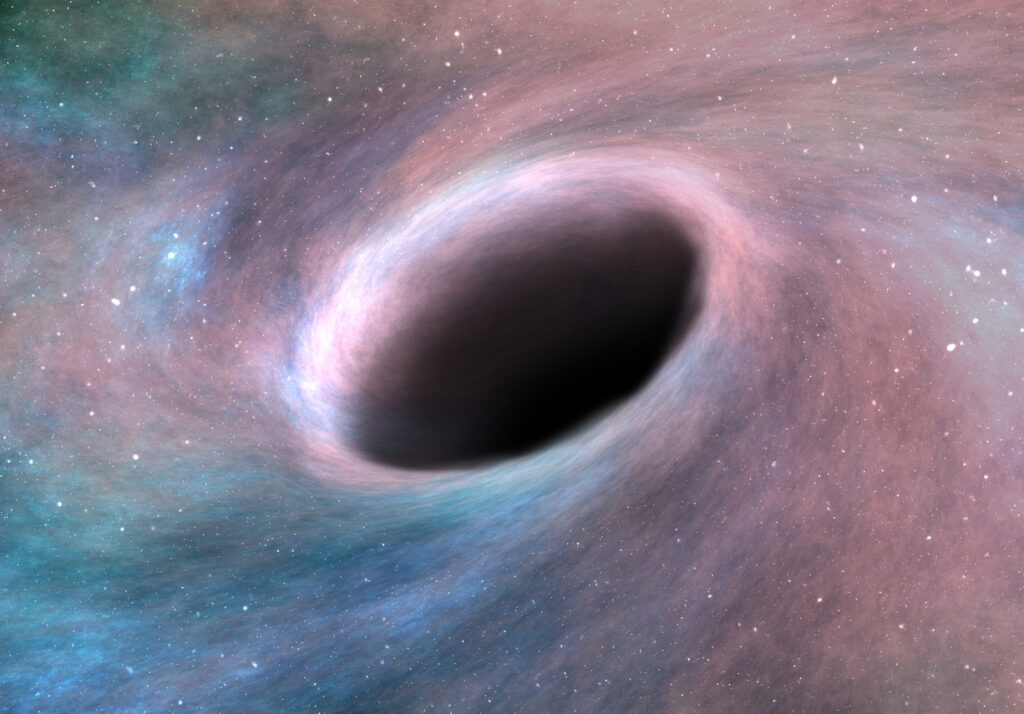
When two black holes collide, it’s one of the most violent events in the universe, releasing energy that dwarfs anything we can comprehend on Earth. These cosmic crashes happen more often than you might think, creating ripples in space itself that we can now detect from millions of light years away.
The collision takes millions of years from start to finish.
Black holes don’t just smash into each other suddenly, they spiral towards one another over incredibly long timescales as gravity pulls them together. They might orbit each other for millions of years, gradually getting closer as they lose energy.
The final moments happen quickly by cosmic standards, but the entire process from when they start approaching to when they merge is unimaginably slow. During most of this time, they’re circling each other like water going down a drain, losing orbital energy through gravitational waves. Only in the very last seconds does the pace pick up dramatically, and by then they’re moving at significant fractions of the speed of light.
They create ripples in spacetime that travel across the universe.
When black holes spiral together, they distort the fabric of space and time itself, sending out waves that spread in all directions. These gravitational waves stretch and squeeze everything they pass through, including Earth, though the effect is incredibly tiny by the time they reach us.
@space.gum What happened if two black holes collide together? 🕳️ Crazy space videos every day! 👽 #space #galaxy #blackhole #collide #cosmos ♬ original sound – Space Gum
Scientists can detect these ripples using incredibly sensitive instruments that measure changes smaller than an atomic nucleus. The waves carry information about the collision, telling us how massive the black holes were and how far away the event happened. It’s the universe’s way of announcing that something catastrophic has occurred, sending out a signal that travels at the speed of light.
The final merger happens incredibly fast once they get close enough.
After spiralling for ages, the last moments of the collision happen in fractions of a second. The black holes are moving so fast at this point that they complete their final orbits in milliseconds before finally touching and merging. During these final moments, they’re releasing more energy than all the stars in the observable universe combined.
The gravitational waves peak in intensity right as they merge, creating the loudest signal we can detect. This sudden violent merger is what our detectors actually pick up because the earlier slow approach is too quiet to register over cosmic distances.
You end up with one bigger black hole, not two separate ones.
Once black holes merge, they become a single larger black hole with a mass roughly equal to the sum of the two original ones. They can’t bounce off each other or stay separate because gravity is too strong and there’s no force that can push them apart. The event horizon of the new black hole swallows both of the original ones completely.
Some mass does get converted to energy and radiated away as gravitational waves, so the final black hole is slightly less massive than the two that went in. This is Einstein’s famous equation in action, with mass turning into pure energy during the collision.
@cleoabram This is the biggest black hole collision ever! And scientists just spotted it. Two black holes with masses over 100 times our sun collided into each other billions of light years away…creating ripples in the fabric of the universe that we detected here on earth. To go inside the places that detected these ripples, follow along! #science #gravitationalwaves #blackhole ♬ original sound – Cleo Abram
The new black hole wobbles and rings like a bell afterwards.
Right after merging, the resulting black hole isn’t perfectly spherical and smooth, it’s distorted and vibrating from the violent collision. These vibrations, called ringdown, gradually settle over time as the black hole radiates away the excess energy and returns to a stable shape.
The ringing produces its own gravitational waves that scientists can detect and analyse. This ringdown phase tells us about the properties of the final black hole, confirming that what we’re seeing matches Einstein’s predictions about how black holes should behave. Within seconds, the vibrations fade, and you’re left with a calm, spherical black hole.
Any matter near the collision gets heated to extreme temperatures.
If there’s gas, dust, or other material around the black holes when they merge, it gets whipped around at tremendous speeds and heated to millions of degrees. This superheated matter glows brightly across the electromagnetic spectrum, potentially creating visible light, X-rays, and gamma rays.
Scientists think some black hole mergers might produce detectable flashes of light alongside the gravitational waves, though this is still being researched. The material doesn’t survive in any recognisable form, it’s either ejected into space at high speeds or falls into the newly formed black hole. The energy released can be so intense that it affects the surrounding galaxy.
The collision can kick the new black hole out of its galaxy.
If the two black holes were spinning or orbiting each other asymmetrically, the merger can produce a recoil kick that sends the resulting black hole flying through space. This happens because gravitational waves carry momentum, and if they’re emitted more strongly in one direction than others, the black hole gets pushed in the opposite direction.
The kick can be powerful enough to fling the black hole completely out of its home galaxy at speeds of thousands of kilometres per second. This means there might be rogue black holes wandering through intergalactic space, ejected by ancient collisions. It’s rare but possible, and would leave the host galaxy missing its central black hole.
@galactic.insights6 Black hole collisions create literal ripples in space and time 🤯 Physics is wild! Wait for the storm analogy… #science #space #physics #science #space #physics #astronomy #blackhole ♬ original sound – Galactic Insights
We can hear these collisions happening across the universe.
Gravitational wave detectors like LIGO and Virgo have detected dozens of black hole mergers since 2015, turning these cosmic events into audio signals we can listen to. The signals sound like chirps, with the frequency increasing as the black holes spiral faster before merging.
Each collision has a unique signature based on the masses and spins of the black holes involved. Scientists can work backwards from the detected signal to figure out exactly what happened, where it happened, and when. We’re essentially listening to the universe’s most violent events from billions of years ago because the signals take that long to reach us.
Most collisions happen between black holes of similar size.
The black holes we’ve detected merging are typically within the same mass range, usually between 10 and 100 times the mass of our Sun. Collisions between vastly different sized black holes are rarer, though they do happen. When a small black hole merges with a supermassive one at the centre of a galaxy, the smaller one essentially gets swallowed without much drama.
The most dramatic mergers happen when two black holes of comparable mass come together because they orbit each other for longer and produce stronger gravitational wave signals. The exact mass ratios tell us about how black holes form and grow over cosmic time.
These collisions help explain how supermassive black holes grew so large.
The supermassive black holes at the centres of galaxies, millions or billions of times heavier than our Sun, likely grew partly through mergers with other black holes. When galaxies collide and merge, their central black holes eventually find each other and combine.
This process has been happening throughout cosmic history, gradually building up the monsters we see in galaxy centres today. Each merger adds mass and allows the black hole to grow bigger than it could through swallowing gas and stars alone. Understanding black hole collisions helps us piece together the history of how these cosmic giants formed and evolved over billions of years.