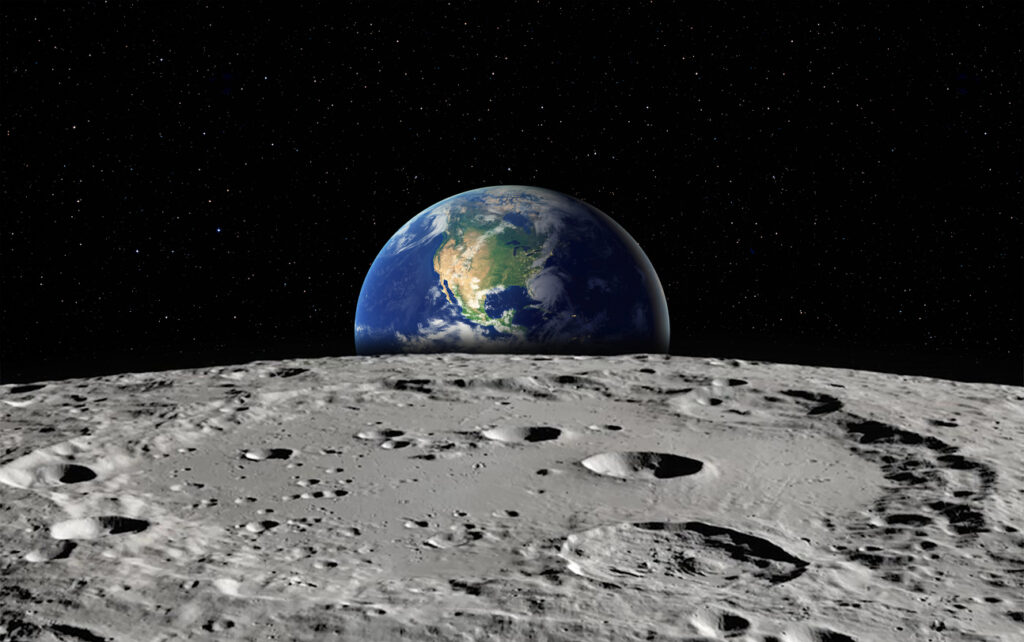
The Moon is gradually drifting away from Earth at a rate you could measure with a ruler if you waited long enough, and this isn’t some random cosmic accident. The process is driven by the same tidal forces that create our ocean tides, and it’s been happening since the Moon formed billions of years ago. Here’s why our closest celestial neighbour is slowly abandoning us.
Tidal forces are constantly transferring energy from Earth to the Moon.
The Moon’s gravitational pull creates bulges in Earth’s oceans that we experience as tides, but Earth’s rotation drags these bulges slightly ahead of the Moon’s position. That misalignment means the tidal bulges pull on the Moon gravitationally, which gradually speeds up the Moon’s orbit. When an orbiting object speeds up, it moves to a higher orbit, so the Moon slowly spirals outward. The process is incredibly gradual but relentless, and it’s been going on for billions of years. The energy driving it comes from Earth’s rotation, which is why the planet is also slowing down.
The Moon is moving away at about 3.8 centimetres per year.
Scientists can measure the distance to the Moon incredibly precisely using laser reflectors left on the lunar surface by Apollo astronauts. By timing how long it takes for laser pulses to bounce back from these reflectors, they’ve determined the Moon moves away roughly 3.8 centimetres annually. That’s about the rate your fingernails grow, which sounds tiny but adds up significantly over millions of years. In a human lifetime, the Moon moves about 1.5 metres further away, and over geological timescales it creates dramatic changes in the Earth-Moon system.
@davedisci.stories We need to talk about the moon drifting from earth and what that is about #moon #earth ♬ original sound – DAVE DISCI
Earth’s rotation is slowing down as a result.
The same tidal interaction that pushes the Moon away also acts as a brake on Earth’s rotation. The gravitational pull of the tidal bulges creates friction that gradually slows our planet’s spin. It happens so slowly that you’d never notice it in daily life, but over long periods it’s measurable. Earth is losing rotational energy to the Moon, and that energy transfer is what causes the Moon to move outward. The two processes are directly linked through the conservation of angular momentum in the Earth-Moon system.
Days are getting longer, but incredibly slowly.
As Earth’s rotation slows, each day becomes slightly longer, but the change is about 1.7 milliseconds per century. You’d need extremely precise atomic clocks to measure this, and it’s nowhere near enough to affect your daily schedule. Over millions of years, though, it adds up to substantial differences in day length. When dinosaurs walked the Earth 100 million years ago, a day was roughly 23 hours long instead of 24. Eventually, billions of years in the future, Earth’s day will equal the Moon’s orbital period, creating a situation where the same side of Earth always faces the Moon.
The Moon used to be much closer and more dramatic in the sky.
When the Moon first formed about 4.5 billion years ago, possibly from debris created when a Mars-sized object crashed into Earth, it was much closer than it is now. Early in its history, the Moon might have been just 20,000 to 30,000 kilometres away compared to the current 384,000 kilometres. It would have made it appear massive in the sky, perhaps 10 to 20 times larger than it looks today. The tides would have been enormously powerful, possibly hundreds of metres high, which would have had profound effects on Earth’s early geology and climate.
Ancient coral records confirm the Moon’s recession.
Corals and other marine organisms create growth rings that record daily and monthly cycles, and fossilised specimens from hundreds of millions of years ago show there were more days in a year back then. This happens because days were shorter when Earth rotated faster, which means more days fit into one orbit around the Sun. The patterns in ancient corals match exactly what we’d expect if the Moon has been steadily moving away and Earth’s rotation has been steadily slowing. These biological records provide independent confirmation of the astronomical calculations.
Solar eclipses will eventually become impossible.
Total solar eclipses happen because the Moon is currently almost exactly the right size and distance to cover the Sun’s disc perfectly when alignment occurs. It’s a cosmic coincidence that won’t last forever. As the Moon moves away, it will appear smaller in our sky, and eventually, it won’t be large enough to completely block the Sun during eclipses. In about 600 million years, total solar eclipses will become impossible and all solar eclipses will be annular, where the Moon appears as a dark disc inside the Sun’s bright ring. We’re living in a brief geological moment when perfect total eclipses are possible.
Ocean tides will become less extreme over time.
The strength of tides depends on how close the Moon is, so as it moves away, tidal ranges will gradually decrease. The difference between high and low tide will become less dramatic over millions of years. It’ll have eventual consequences for coastal ecosystems that depend on tidal zones and for marine species that use tidal cycles for reproduction and feeding. The change is so slow that evolution can adapt to it, but it represents a fundamental shift in how Earth’s oceans behave. Tides also help mix ocean waters and distribute heat, so weaker tides could affect ocean circulation patterns.
@astro_alexandra Reply to @perplexed_puzzler here’s why the moon is moving away from earth! #WhatILearned #space #science #astronomy #Welcome2021 #womeninSTEM ♬ original sound – ASTRO ALEXANDRA 🪐
The Moon won’t escape Earth’s gravity completely.
Despite moving away, the Moon will never leave Earth’s orbit and drift off into space. The recession will eventually stop when Earth’s rotation slows enough that both Earth and Moon are tidally locked to each other, always showing the same faces to one another. At that point, the tidal bulges will be aligned directly with the Moon and won’t drag it forward anymore, so the outward movement will cease. This will happen in tens of billions of years, long after the Sun has died, so it’s not something to worry about. The Earth-Moon system will remain bound together essentially forever.
The Moon helps stabilise Earth’s tilt, but that’s slowly changing.
Earth’s axial tilt of about 23.5 degrees gives us our seasons and has remained relatively stable thanks to the Moon’s gravitational influence. As the Moon moves away, its stabilising effect weakens slightly, which could eventually allow Earth’s tilt to vary more dramatically over long timescales. Some planets without large moons experience wild tilting that would create extreme climate variations. Earth’s tilt won’t become unstable in any human-relevant timeframe, but over tens of millions of years, the reduced lunar influence could contribute to larger variations in axial tilt that affect climate patterns.
The Sun will destroy both Earth and Moon before tidal locking completes.
The process of the Moon moving away and Earth slowing down takes so long that the Sun will become a red giant and engulf both bodies before they reach their final tidally-locked state. In about 5 billion years, the Sun will expand dramatically as it runs out of hydrogen fuel, and Earth’s orbit might be swallowed by the expanding solar atmosphere. Even if Earth survives outside the red giant’s edge, the intense heat will make both Earth and Moon uninhabitable. The Moon’s slow recession is a process that would naturally continue for tens of billions of years, but external factors will interrupt it.
We only discovered this recession in the 1970s.
Although scientists theorised about the Moon moving away based on tidal physics, actual measurements only became possible when Apollo astronauts placed laser reflectors on the lunar surface. The Lunar Laser Ranging experiment has been bouncing laser beams off these reflectors since 1969, and by the early 1970s scientists had collected enough data to confirm the Moon is definitely receding. Before this, the idea was just a theoretical prediction from physics equations. The ability to measure the distance to the Moon within millimetres represents one of the most precise measurements in all of science and provides ongoing data about how the Earth-Moon system evolves.