
Condors are absolute giants of the bird world, and once you learn what they’re capable of, it’s hard not to be in awe. These massive vultures have survived for millions of years and continue to dominate the skies with abilities that seem almost impossible for something that heavy to pull off.
They have the largest wingspan of any land bird in North America.
California condors can stretch their wings nearly three metres from tip to tip, which is genuinely staggering when you see one up close. Andean condors are even bigger, reaching wingspans over three metres. That enormous wing surface lets them stay airborne for hours without flapping, riding thermal currents with barely any effort. The sheer size means they can cover massive distances whilst searching for food, sometimes travelling over 250 kilometres in a single day. When a condor spreads its wings fully, it’s an unforgettable sight that makes you realise just how extraordinary these birds are.
They can live for over 60 years in the wild.
Condors have one of the longest lifespans of any bird, regularly reaching 50 to 60 years, and sometimes even longer. Such longevity is rare among birds, especially large ones that face constant environmental pressures. They don’t reach sexual maturity until they’re about six years old, which means they invest heavily in surviving long enough to reproduce. Their slow life cycle makes each individual incredibly valuable to the population. A single condor can contribute to the species for decades, raising multiple chicks over its lifetime if conditions are right.
@jhkfgky The largest flying land bird on earth 🔥 #nature #wild #facts #DidYouKnow #mindblowingfacts ♬ original sound – Until
They were brought back from the brink of extinction.
In 1987, there were only 27 California condors left in the entire world. Every single one was captured for a captive breeding programme in a desperate last attempt to save the species. That programme worked, and now there are over 500 California condors alive, with more than half flying free in the wild. It represents one of conservation’s most remarkable success stories, proving that even when things look hopeless, dedicated effort can reverse catastrophic decline. The fact that condors exist today is down to people refusing to let them disappear.
They’re masters of soaring flight.
Condors barely flap their wings once they’re airborne because they’ve perfected the art of riding thermals and updrafts. They use rising columns of warm air to gain altitude, then glide for enormous distances whilst gradually descending until they find another thermal. Their flying style is incredibly energy-efficient, allowing them to search vast territories for food without exhausting themselves. Watching a condor soar is mesmerising because they make it look effortless, barely adjusting their wing position as they sail through the sky. Their flight is so efficient, they can spend most of the day in the air on practically no energy.
Their bald heads serve a crucial purpose.
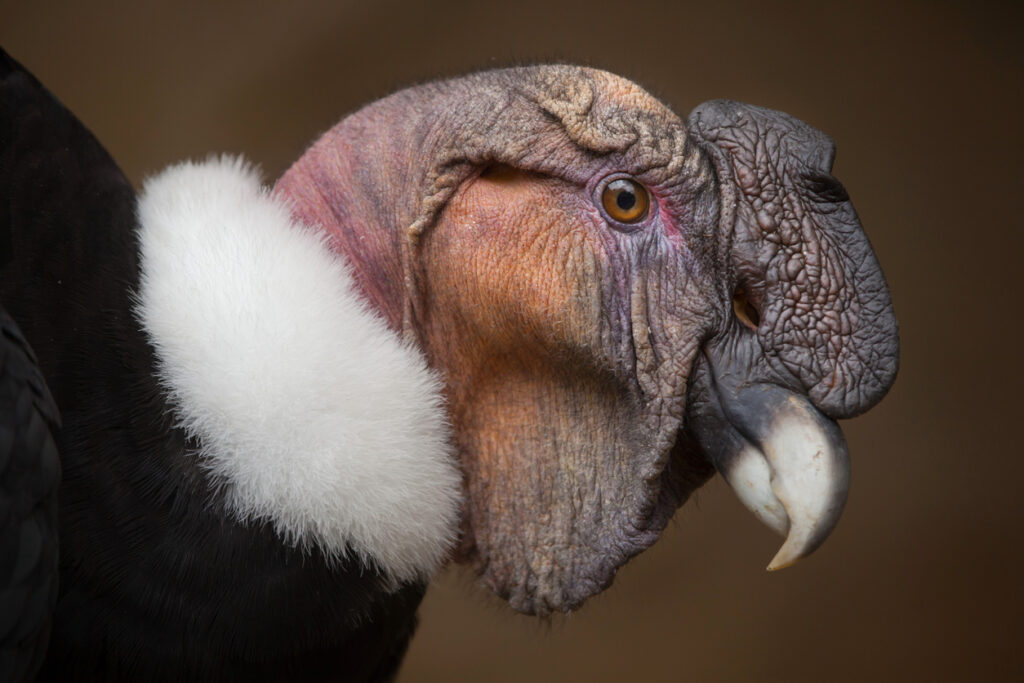
Condors have bare, featherless heads for a very practical reason related to their diet. As scavengers that feed on dead animals, they often stick their heads deep inside carcasses to reach meat. Feathers would become matted with blood and bacteria, creating hygiene problems and potential infection risks. The bare skin can be easily cleaned and dries quickly in the sun. It’s not the prettiest adaptation, but it’s brilliant design for their lifestyle. The head colour also changes with their mood and health, shifting from grey to bright yellow, orange, or red depending on blood flow.
They play a vital ecological role as nature’s clean-up crew.
Condors help prevent the spread of disease by quickly consuming dead animals before they rot and contaminate water sources or soil. Their incredibly strong stomach acid can digest toxins and pathogens that would kill most other animals, including anthrax and botulism. This makes them essential for maintaining ecosystem health, especially in remote areas where dead livestock or wildlife might otherwise become disease vectors. By efficiently disposing of carcasses, they prevent the spread of illness to other scavengers and predators. Their role might seem grim, but it’s absolutely crucial for environmental health.
They’re surprisingly social birds.
Condors often feed in groups and maintain complex social hierarchies at carcasses and roosting sites. Younger birds watch and learn from older, experienced condors about where to find food and how to navigate their territory. They communicate through body language, hisses, and grunts, and can be quite expressive despite not having the vocal range of songbirds. Condors also form long-term pair bonds and share parenting duties, with both parents taking turns incubating their single egg and feeding the chick. Their social nature means they benefit from being part of a population rather than living in isolation.
They raise their chicks incredibly slowly.
A condor chick stays with its parents for a full year, which is extraordinarily long for a bird. The parents invest enormous time and energy teaching their offspring how to find food, where thermals are reliable, and what dangers to avoid. Condors only breed every other year because raising a chick is such an intensive process. The slow reproduction rate makes population recovery challenging, but it also means young condors are exceptionally well-prepared for survival by the time they’re independent. The extended parental care is a big part of why condors can live so long, they start life with a huge advantage.
@dougiesharpe 15 California Condors got together and destroyed a home in Tehachapi, California #californiacondor #california #endangeredspecies #endangeredbirds #interestingfacts #interestingfactshub #interestingfactsforyou #amazingfacts #amazingfactsministries #amazingfactsforyou #coolfacts #coolfactsforu #coolfactz #randomfactstiktok #randomfacts #randomfactsforyou #facts #factsdaily #factsoftheday #factsoftiktok #factz #factsoftheworld #funfacts #funfactstoknow #funfactsoftiktok #funfactsoftheday ♬ original sound – Dougie
They can spot food from extraordinary distances.
Condors have exceptional eyesight that lets them detect carcasses from several kilometres away whilst soaring at high altitudes. They also watch other scavengers like ravens and smaller vultures, using them as indicators that food is available below. The combination of sharp vision and behavioural observation makes them highly efficient at finding meals across enormous territories. Once one condor spots something, others often follow, which is why you might see several appear seemingly out of nowhere. Their ability to cover huge areas and spot tiny details from the sky is genuinely remarkable.
They’re living links to the Ice Age.
Condors evolved to feed on the massive animals that roamed North and South America during the Pleistocene epoch. Mastodons, ground sloths, and ancient camels provided abundant food for these giant scavengers. When those megafauna went extinct about 10,000 years ago, condors had to adapt to smaller food sources but managed to survive. They’re one of the few remaining species from that era, making them living fossils that connect us to a dramatically different world. The fact that they’ve persisted through such massive environmental changes shows just how resilient and adaptable they truly are.