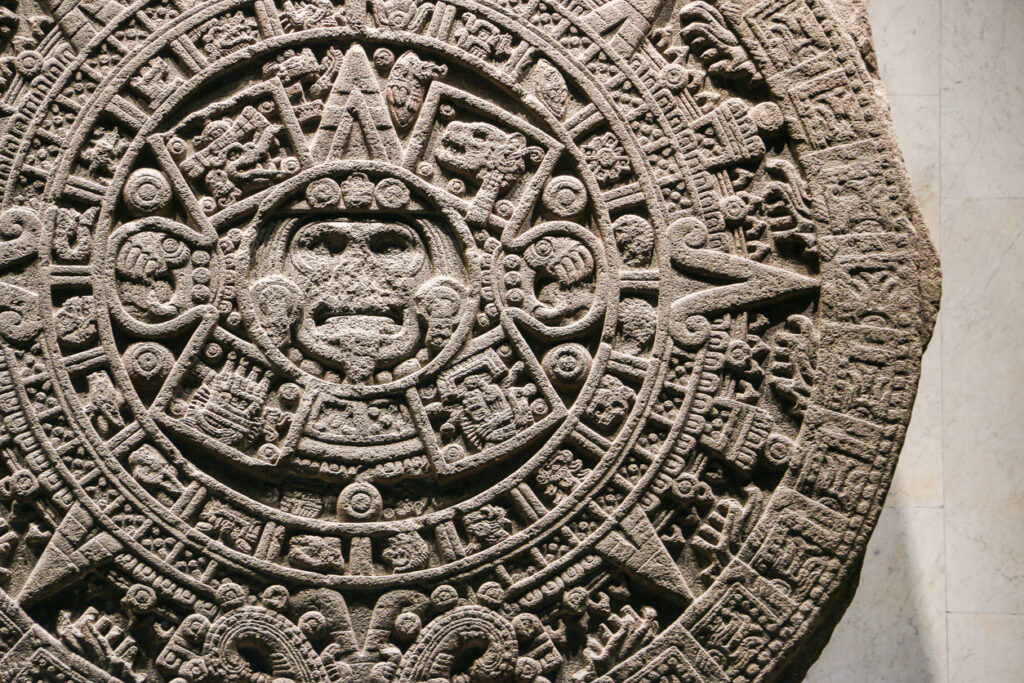
The Aztec calendar stone is one of the most recognisable artifacts from ancient Mexico, plastered on t-shirts, tourist tat, and basically anything marketed as “authentic Aztec culture.” Most people think they know what it is because the name seems straightforward enough, but almost everything the average person believes about this massive carved disc is either incomplete or flat-out wrong. It’s not really a calendar in the way we understand calendars, it wasn’t used for timekeeping in daily life, and it definitely didn’t predict the world ending in 2012, despite what the internet tried to claim.
The stone itself is absolutely massive, weighing about 24 tons and measuring nearly 12 feet across. It’s covered in intricate carvings that look mysterious and mathematical, which is partly why people assume it must be some sophisticated astronomical calendar. The circular design and obvious symbolic divisions make it seem like something you’d consult to know what day it is or when to plant crops. But calling it a calendar stone is a massive oversimplification that misses the point of what this object actually was and what it meant to the Aztecs who created it.
It’s actually a sacrificial stone, not a calendar.
The stone’s real name is the Sun Stone or Stone of the Five Eras, and it was primarily a monument to Aztec cosmology and religion, not a functional timekeeping device. The face in the centre isn’t a friendly sun god smiling at you, it’s Tonatiuh, the sun deity, with his tongue sticking out in the form of a sacrificial flint knife. That tongue represents the constant need for human blood and hearts to keep the sun moving across the sky, which was central to Aztec religious belief.
The Aztecs believed they were living in the fifth era of creation, and that the previous four eras had each ended in catastrophic destruction. The stone depicts these previous eras in the carved sections surrounding the central face, showing how the world had been destroyed by jaguars, wind, fire, and water in previous cycles. This wasn’t a calendar telling you it’s Tuesday, it was a cosmic monument explaining the structure of time and existence itself, with the very real implication that this current era would also end violently unless the gods were properly fed through sacrifice.
The stone likely sat in the main temple complex in Tenochtitlan where sacrificial rituals took place. Blood from sacrificed humans would have run across its surface, feeding the sun god depicted at its centre. Calling this a calendar is like calling a cathedral a clock just because it has the time displayed on it. Yes, there are calendar elements incorporated into the design, but that’s not what it was for or why it existed.
The actual Aztec calendars were different systems entirely.
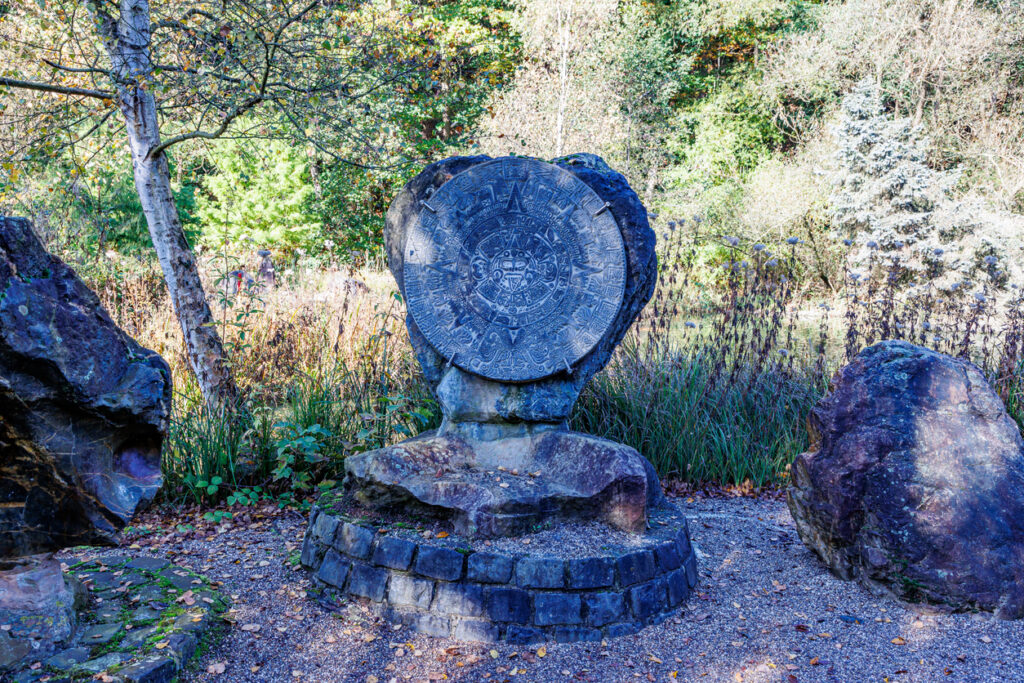
The Aztecs used two separate calendar systems that worked together, and neither of them required this massive stone to function. The first was the xiuhpohualli, a 365-day solar calendar used for agriculture and civil purposes, divided into 18 months of 20 days each plus 5 unlucky days at the end. The second was the tonalpohualli, a 260-day ritual calendar used for divination and religious ceremonies, which meshed with the solar calendar to create 52-year cycles.
These calendars were recorded in books called codices, not consulted on massive temple stones. Priests and scholars kept track of the days using these written records, making calculations and predictions about auspicious times for various activities. The calendar stone does incorporate symbols from these systems, showing the 20-day signs around the central face, but it’s depicting the calendars as part of a larger cosmological picture, not functioning as a working calendar itself.
The confusion comes partly from the name that Spanish colonizers and later scholars gave it. When the stone was rediscovered in 1790 buried beneath Mexico City’s main square, people saw the day signs and cyclical divisions and assumed it must be for telling time. The name “calendar stone” stuck, and now that’s what everyone calls it, even though actual Aztec calendar specialists would have used completely different tools for their timekeeping work.
The 2012 apocalypse myth was complete nonsense.
Remember when everyone was panicking about the world ending in December 2012 because the Aztec calendar supposedly predicted it? That whole thing was based on fundamental misunderstandings piled on top of each other until they created a viral doomsday myth. First off, the calendar in question wasn’t even Aztec, it was Mayan, which is an entirely different civilisation. Second, the Mayan Long Count calendar didn’t predict an apocalypse, it just completed a cycle, like a car’s odometer rolling over.
The Aztec calendar stone got dragged into this mess because people couldn’t tell the difference between Mesoamerican cultures and assumed all pre-Columbian calendar systems were basically the same. The stone became a symbol of ancient prophecy in popular culture, featured in disaster films and conspiracy theories, when it had absolutely nothing to do with any specific date predictions. The Aztecs believed their era would end eventually through earthquake and famine, but they didn’t carve a specific date for it on this stone.
This whole episode shows how easily ancient artifacts get misinterpreted when people project modern concerns onto them. The stone became whatever people wanted it to be, a mysterious ancient prophecy about our times, when it was actually a religious monument about Aztec cosmology that had nothing to do with future civilisations or specific apocalypse dates.
The symbolism is incredibly complex and violent.
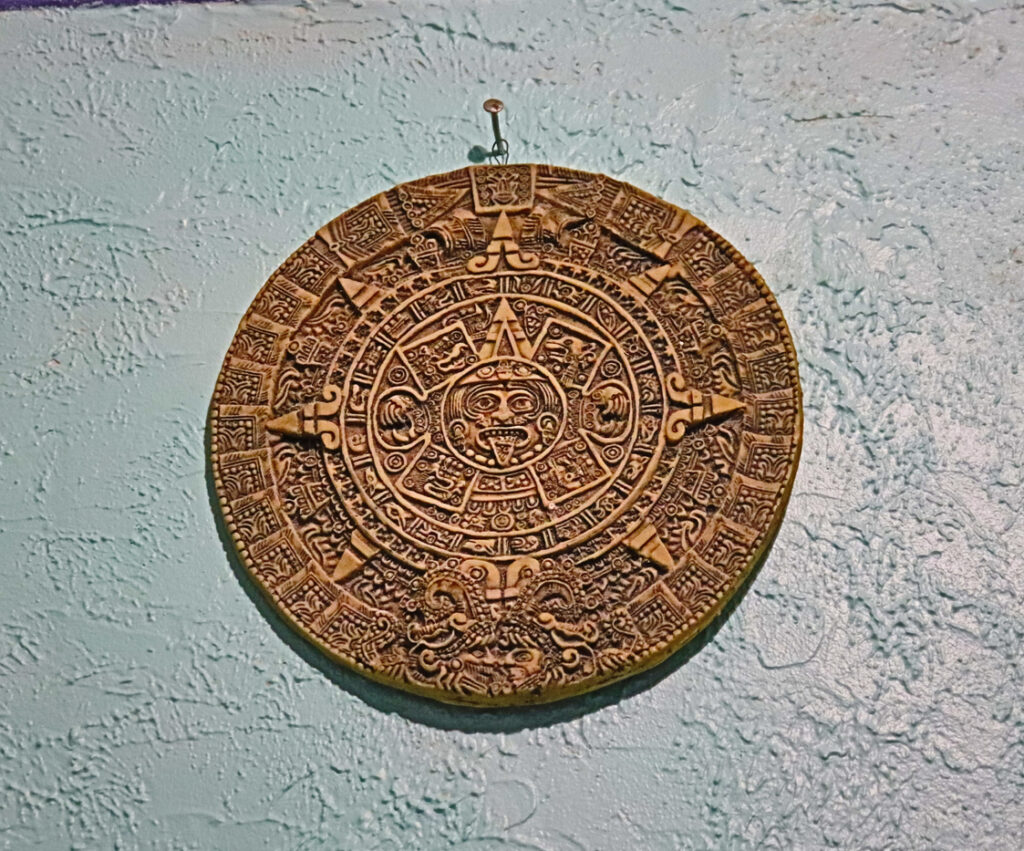
Looking at the stone properly, the imagery is dense with meaning that goes way beyond simple timekeeping. The central face of Tonatiuh has clawed hands on either side grasping human hearts because the sun required constant nourishment through sacrifice. The tongue-knife pointing down represents the weapon used to cut out those hearts. This isn’t decorative, it’s a direct representation of the brutal reality of Aztec religion, where human sacrifice was essential to cosmic survival.
Surrounding the central face are symbols representing the four previous eras of creation, each destroyed in different cataclysmic ways. There are also symbols for the 20-day signs of the ritual calendar, eagle and jaguar warriors, precious jade and blood, and various deities. The outer rings contain serpents representing the cosmos and day and night. Every element ties into a complex web of mythology, astronomy, and religious practice that scholars are still working to fully understand.
Reducing all this symbolism to “it’s a calendar” misses the theological and philosophical depth encoded in the stone. It’s like looking at the Sistine Chapel ceiling and saying “oh, it’s just some Bible pictures” without acknowledging the artistic, religious, and cultural significance. The calendar elements are there, but they’re part of a much larger statement about how the Aztecs understood time, existence, sacrifice, and humanity’s relationship with the divine.
It was deliberately buried and nearly lost forever.
After the Spanish conquered the Aztec empire in 1521, they systematically destroyed Aztec religious monuments and temples. The calendar stone was either buried by Spanish authorities who saw it as pagan idolatry, or possibly hidden by Aztecs trying to preserve it. Either way, it ended up buried beneath what became Mexico City’s main plaza, forgotten for over 250 years while the city was built on top of the ruins of Tenochtitlan.
When workers accidentally uncovered it in 1790 during plaza renovations, it caused a sensation. By this point, nobody remembered what it was or what it meant because the Spanish had successfully wiped out much of Aztec cultural knowledge. Scholars had to piece together its meaning from surviving codices and indigenous accounts, working backwards to understand a monument whose original context had been deliberately destroyed.
The stone was initially mounted on the exterior wall of the Mexico City cathedral, which is deeply ironic considering it’s a monument to religions the Catholic Church spent centuries trying to eradicate. Later it was moved to the National Museum of Anthropology, where it remains today, having become a symbol of Mexican national identity and indigenous heritage. However, the modern symbolic use is also a kind of misunderstanding, turning a specific religious object into a general representation of pre-Columbian culture.
Modern interpretations keep missing the point.
@googleartsculture did you know The Aztects had a 20 day month? 📆 this enormous, intricately carved stone is an ancient Aztec calendar 🔎 discover more by searching 'Piedra del Sol' or 'The Sunstone' ☀️ #GoogleArtsandCulture #PiedradelSol #AztecHistory #TheSunstone #learnonTiktok #historytok ♬ original sound – googleartsculture
Today the calendar stone appears on Mexican currency, government buildings, and tourist merchandise, usually stripped of its violent sacrificial context and presented as an impressive example of ancient astronomy and mathematics. People admire the precision and symmetry without engaging with what it actually represented to the people who made it. It’s been sanitised into a symbol of indigenous achievement, while ignoring that it glorified practices modern people find horrifying.
New age spiritualists have also adopted it, claiming it contains secret knowledge or cosmic wisdom, while completely ignoring actual Aztec beliefs. These interpretations project modern spiritual seeking onto an object from a culture that had very different concerns and worldviews. The Aztecs weren’t thinking about personal enlightenment or universal consciousness, they were worried about keeping the sun moving and the world from ending through ritual bloodshed.
Even academic discussions sometimes fall into the trap of focusing on the mathematical and astronomical sophistication while downplaying the religious violence. Yes, the Aztecs had complex calendar systems and astronomical knowledge, but that knowledge was inseparable from their understanding that the cosmos required constant human sacrifice. You can’t honestly discuss the calendar stone without acknowledging it’s fundamentally a monument to that worldview, not just an impressive piece of ancient science.
The calendar stone is extraordinary and deserves its status as one of the most important artifacts from pre-Columbian America. However, understanding it properly means accepting that it’s not what most people think it is. It’s not a giant calendar for daily use, it’s not a prophecy about the future, and it’s not a whitewashed symbol of indigenous wisdom. It’s a massive sacrificial monument that expressed the Aztec understanding of cosmic time, religious obligation, and humanity’s violent relationship with the divine. Getting that wrong means missing what makes it actually significant, replacing the real artifact with a comfortable fiction that’s easier to put on a t-shirt.