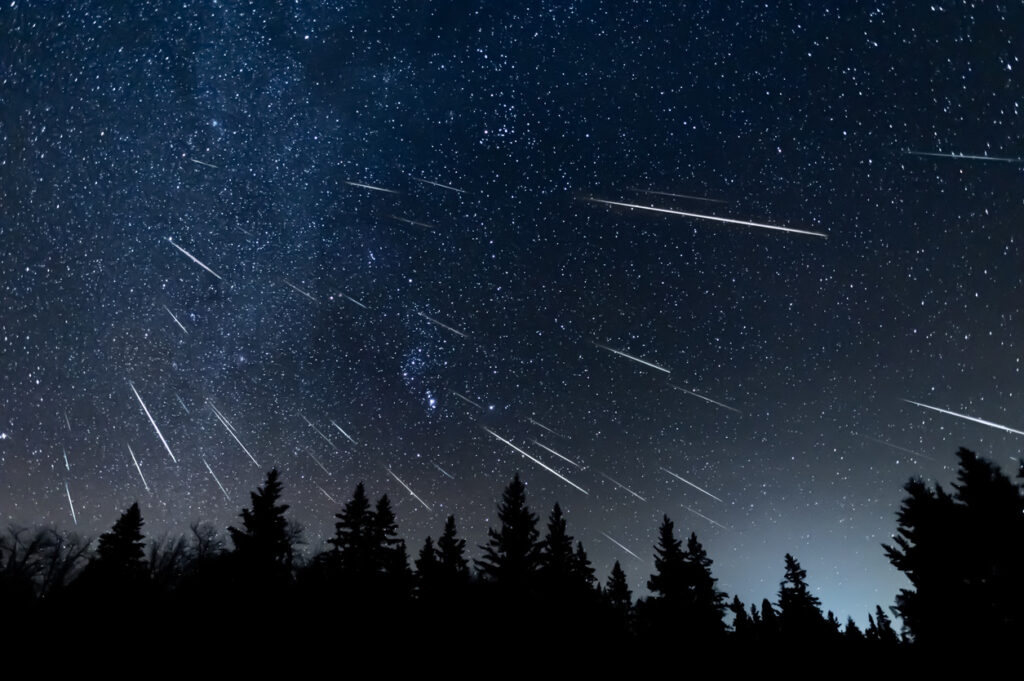
The Geminid meteor shower is one of the best astronomical events of the year, putting on a proper show, with up to 120 meteors per hour at its peak. Unlike some meteor showers that promise loads and deliver about three shooting stars if you’re lucky, the Geminids actually turn up and perform However, even though this shower is reliable and bright, there are loads of things that can completely wreck your viewing experience, turning what should be an amazing night into a frustrating waste of time staring at an empty sky.
Light pollution is your biggest enemy.
The single worst thing for meteor watching is light pollution, and most people massively underestimate how much it affects what you can see. If you’re in a city or town with streetlights, house lights, and general orange glow everywhere, you’re already fighting a losing battle. Those bright meteors everyone talks about seeing loads of? You might spot the occasional really bright one, but you’ll miss the fainter streaks that make up most of the show.
Even if you think your area isn’t that bright, you’d be surprised how much light is bouncing around. Security lights from neighbouring houses, car headlights passing by, even your phone screen checking the time will completely ruin your night vision that you’ve spent ages building up. Your eyes need about 20–30 minutes to properly adjust to darkness, and one flash of bright light resets that whole process. This means every time you check your phone or someone drives past with their headlights on, you’re starting from scratch with your ability to see faint meteors.
The solution is getting properly away from lights, which for most people means driving out into the countryside. But even then, you need to pick your spot carefully because light pollution travels for miles. Those distant orange glows on the horizon from nearby towns will still wash out a chunk of the sky. You want somewhere dark enough that you can see the Milky Way clearly because if you can see that band of stars across the sky, you’re in a good spot for meteors too.
The moon ruins everything when it’s around.

The moon is basically a massive streetlight in the sky, and when it’s bright and high up during the Geminids, it washes out all but the brightest meteors. Some years you get lucky and the shower peaks during a new moon when the sky’s properly dark, but other years the moon is nearly full and hanging around all night like an unwelcome guest at a party. There’s nothing you can do about the moon phase, it is what it is, but it massively affects how many meteors you’ll actually see.
Even a half moon can be bright enough to cause problems, especially if it’s high in the sky. The light it reflects from the sun illuminates the atmosphere and makes fainter meteors invisible against the brightened background. You’ll still see the really bright fireballs that occasionally streak across, but you’ll miss all the smaller ones that would normally be visible on a moonless night. If the forecast shows a bright moon during the peak viewing nights, you might want to try watching a night or two before or after when the moon sets earlier or rises later, giving you a proper dark window.
Weather obviously wrecks your plans.
This seems obvious, but it’s worth saying because December weather in the UK is absolutely rubbish for astronomy most of the time. Clouds are the meteor watcher’s nemesis because you can have perfect dark skies, no moon, and be miles from any light pollution, but if there’s cloud cover you’re seeing absolutely nothing. The Geminids peak in mid-December when British weather is typically overcast, drizzly, and generally miserable, which means loads of years you don’t get to see the shower at all despite it being active.
Partial cloud cover can be frustrating because meteors are quick flashes that could happen anywhere in the sky. If half the sky is blocked by clouds, you’re missing half the potential meteors, and the ones you do see might be partially obscured. There’s also the problem that clouds often come with moisture and haze that scatters light even more, making the sky brighter than it should be. You might check the weather forecast and see it’s not raining so assume you’re fine, but thin high clouds or haze can still completely ruin visibility for something as faint as meteors.
Looking in the wrong direction wastes your time.
@hvmlti15807 Geminid meteor shower #space #astronomy #nasa #science #news ♬ original sound – hvmlti15807
A lot of people hear the Geminids radiate from the constellation Gemini and think they need to stare directly at that spot. That’s actually the worst thing you can do because while meteors appear to come from that radiant point, they streak across the whole sky. If you’re staring at Gemini, you’re only watching a small portion of sky and missing loads of meteors happening in your peripheral vision or behind you.
The best approach is to lie down so you can see as much sky as possible and just let your eyes wander rather than focusing on one spot. Meteors can appear anywhere, and your peripheral vision is actually better at catching movement than your central vision anyway. If you’re sitting in a chair or standing and only looking at one patch of sky, you’re dramatically reducing the number of meteors you’ll catch. You want to be comfortable enough to stay out for a while because meteor watching requires patience, but positioned so you’ve got a wide view of the whole sky dome above you.
Watching at the wrong time cuts your numbers.
The Geminids are active for days around the peak, but the timing of when you watch during the night makes a massive difference to how many you’ll see. A lot of people go out early evening, watch for half an hour, see nothing, and give up. The problem is that the radiant point in Gemini rises in the east around sunset, but the shower gets better as the night goes on, and the radiant gets higher in the sky. The best viewing is usually after midnight and into the early morning hours when the radiant is high overhead.
Watching too early means you’re looking through more atmosphere because the radiant is low on the horizon, and meteors appearing from a low radiant have to travel through more air before burning up. Later in the night, when the radiant is high, meteors are coming more directly down through the atmosphere, and you see more of them. It’s frustrating because it means staying up late or getting up stupidly early, but that’s when the show is actually good. Going out at 8pm, freezing for an hour, seeing maybe two meteors, and going back inside means you’ve missed the actual peak activity.
Being impatient kills the experience.
Meteor watching isn’t like fireworks where there’s constant action. Even during a good shower like the Geminids, you might see several meteors in quick succession then nothing for five minutes, then another flurry. People expect continuous streaks across the sky and get bored when that’s not what happens. They give it 10 minutes, don’t see anything spectacular, and pack it in, missing the good bits that come with patience.
Your eyes need time to adjust, the meteors come in sporadic bursts, and you need to be out there long enough to catch those moments when several come close together. Proper meteor watching means committing to at least an hour, preferably more, and being okay with periods of nothing happening. It’s meant to be relaxing, lying there looking at stars, and the meteors are brilliant bonuses when they appear rather than constant entertainment. If you’re out there getting frustrated every minute nothing happens, you’re doing it wrong, and you won’t enjoy it even when meteors do show up.
Unrealistic expectations from photos won’t do you any favours.
Social media and astronomy websites show these incredible photos of Geminid meteors with loads of bright streaks across dramatic starry skies, and people expect that’s what they’ll see with their eyes. Those images are composites of hours of watching, with all the best meteors combined into one photo, or they’re long exposures that make everything look brighter and more dramatic than reality. When you’re actually out there, meteors are quick flashes, often faint, and you’ll never see that many at once.
Setting yourself up with these photo-based expectations means you’ll be disappointed by the real thing, which is actually still brilliant but just different. Real meteor watching is quieter and more subtle, with occasional bright streaks that make you gasp but loads of smaller ones that are just gentle flashes. If you go out expecting the Instagram version, you’ll think it’s rubbish when actually you’re seeing a normal, good meteor shower. The experience is about being outside in the dark, seeing nature do something interesting, and catching those unexpected moments when a bright one shoots across, not recreating some composite image someone spent hours creating.
The Geminids are genuinely worth watching if you can sort out these problems, and they’re more reliable than most meteor showers because they’re debris from an asteroid rather than a comet. But you’ve got to give them a proper chance by getting away from lights, checking the moon phase and weather, watching at the right time of night, and being patient enough to let the show develop. Most people who say they tried to watch meteors and saw nothing made at least a few of these mistakes, then decided meteor showers are overhyped when really they just didn’t set themselves up for success.