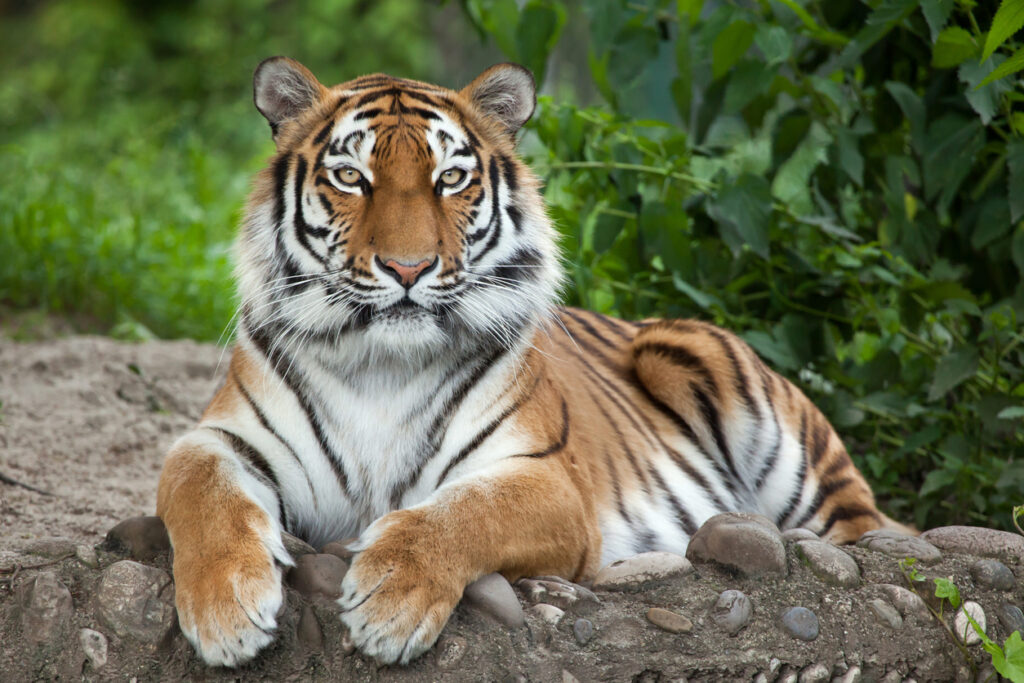
The Siberian tiger stands as the largest and most powerful cat on the planet, roaming the frozen forests of Russia’s Far East in numbers so small that seeing one in the wild is extraordinarily rare. These massive predators have adapted to survive in one of the harshest environments on Earth.
They’re significantly bigger than other tiger subspecies.
Male Siberian tigers can weigh up to 300 kilograms and measure over 3 meters from nose to tail, making them noticeably larger than Bengal tigers or any other big cat species. Their impressive size developed as an adaptation to their cold environment, where larger body mass helps retain heat and allows them to take down bigger prey. Females are smaller but still massive compared to other cats, typically weighing around 180 kilograms. The sheer physical presence of a Siberian tiger is difficult to comprehend until you see one in person, where their muscular build and thick frame make even lions look relatively slight.
Their fur changes with the seasons.
Siberian tigers grow a thick winter coat that’s paler and longer than the fur of tigers living in tropical climates, helping them blend into snowy landscapes and survive temperatures that drop below minus 40 degrees. Their seasonal fur can be up to 10 centimetres long on their belly and sides, providing insulation that allows them to sleep in the snow without issue. In summer, they shed this heavy coat for a shorter, darker version that’s more practical for warmer months. The pale orange colouring with fewer stripes compared to other subspecies gives them better camouflage in their specific habitat of birch forests and snow.
They can eat 40 kilograms of meat in one sitting.
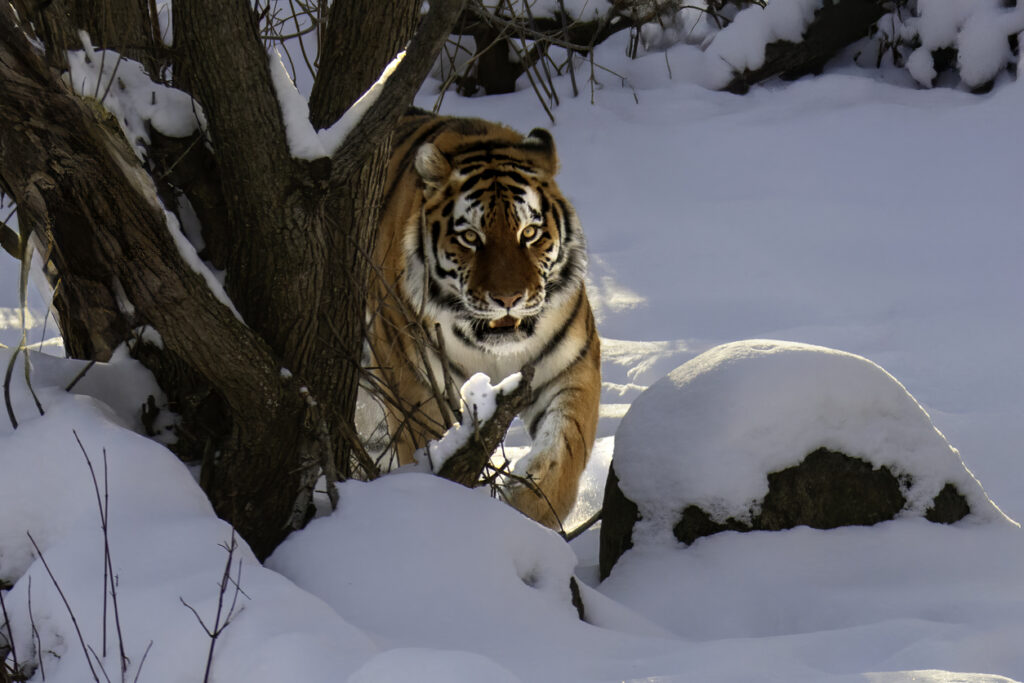
After a successful hunt, a Siberian tiger will gorge itself on an enormous amount of meat because their next meal might be weeks away. Their primary prey includes wild boar, red deer, and elk, with adult tigers needing roughly 9 to 10 kilograms of meat daily to maintain their body weight. The feast-or-famine nature of hunting in sparse forests means they’ve adapted to consume and digest massive quantities when food is available. Between kills, they can survive on their fat reserves, going up to two weeks without eating if necessary, though this is physically taxing.
They have enormous territories.
A single male Siberian tiger requires a territory of up to 1,000 square kilometres to find enough prey, making them one of the most space-demanding big cats. Females need smaller ranges of around 400 square kilometres, but even this is vast compared to the territories of tigers in prey-rich areas. They mark their boundaries with scent, scratch marks on trees, and will defend these areas against other tigers, though actual fights are rare. The need for such massive territories is one of the main reasons their population remains critically low, as habitat loss directly impacts how many tigers an area can support.
They’re incredibly solitary.
Unlike lions, Siberian tigers live and hunt alone, only coming together briefly to mate before separating again. Adult males and females occupy overlapping territories but actively avoid each other outside of breeding, with males showing no involvement in raising cubs. Their solitary nature is an adaptation to their environment, where prey is too scattered to support group living and hunting alone is more efficient. Cubs stay with their mother for around two years, learning to hunt and survive before striking out to find their own territories.
Their hunting success rate is surprisingly low.
@natgeoanimals Talk about earning your stripes! 🐯❄️ For thousands of years, Siberian tigers have occupied the southeastern corner of Russia, where winter temperatures of –20 degrees Fahrenheit are not unusual 😳😱 🎥: #RussiasWildTiger ♬ original sound – Nat Geo Animals
Despite being apex predators, Siberian tigers only successfully catch prey in about one out of every ten attempts, meaning they fail far more often than they succeed. The dense forest provides cover for both hunter and hunted, and prey species like deer are fast and alert, making stalking extremely difficult. Tigers rely on getting very close before attacking, typically within 20 to 30 meters, and if the initial ambush fails they rarely pursue for long distances. This low success rate means they spend most of their time searching and stalking rather than actually eating.
They can leap over 9 metres horizontally.
The muscular build of Siberian tigers gives them explosive power for jumping, allowing them to clear obstacles or close distance on prey with single enormous bounds. That leaping ability is crucial for their ambush hunting style, where they need to cover the final gap between hiding spot and target in a split second. They can also jump vertically over 3 meters, making fences less effective barriers than you’d expect. The combination of size and athleticism makes their physical capabilities almost difficult to believe until witnessed.
There are only around 500 left in the wild.
The entire wild population of Siberian tigers exists in a small region of Russia’s Far East, with occasional individuals spotted across the border in China. Their critically endangered status comes from decades of hunting, habitat loss, and prey depletion that pushed them to the edge of extinction by the 1940s. Conservation efforts have slowly increased numbers from a low of around 40 individuals, but they remain vulnerable to poaching, human conflict, and the fragmentation of their forest habitat. Every individual tiger matters for the survival of the subspecies, making conservation work incredibly focused and urgent.
They avoid humans whenever possible.
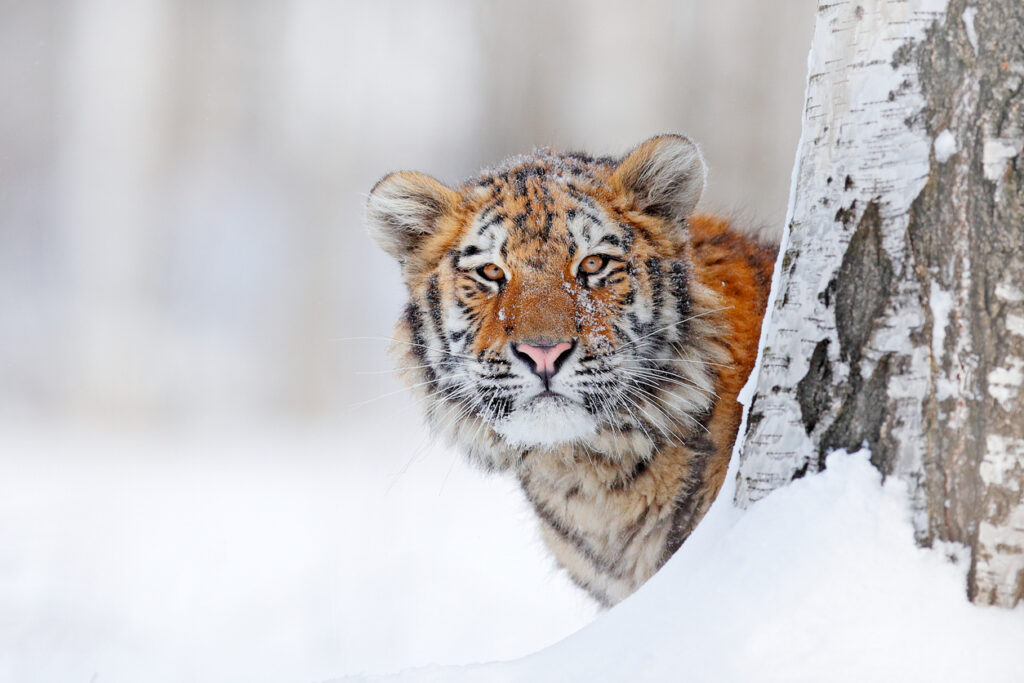
Despite their size and power, Siberian tigers generally want nothing to do with people and will avoid human settlements and activity when they can. Attacks on humans are extremely rare and usually involve tigers that are old, injured, or unable to catch their normal prey. Most people living in tiger territory never see one, despite the cats moving through the same forests. Their avoidance behaviour is learned, as tigers that lose their fear of humans typically get into trouble and don’t survive long.
Their roar can be heard 3 kilometres away.
The vocalization of a Siberian tiger is deep and powerful, designed to communicate across their vast territories and warn other tigers to stay away. They also produce a range of other sounds including chuffing when greeting, hissing when threatened, and a prusten sound made by blowing air through their nostrils as a friendly gesture. Cubs mew like domestic kittens when young, but develop the full roar as they mature. The roar itself is created by specialized vocal cords and is one of the most recognizable and unsettling sounds in nature.
They’re excellent swimmers.
@carriescritteradventures Tigers love to swim The also love time with their favorite zookeepers Our tigers are our a part of our family❣️ They recongize us and love attention What’s that vocalization: Tigers don’t purr they Chuff 💖 Chuffing is an affectionate , or friendly, vocalization that can only be produced by big cats. It is used between a mother and her cubs as well as toward a mate and of course their a favorite keeper ⭐️ #bigcat #tiger #amurtiger #siberiantiger #cat #catsoftiktok #catlover #swim #whatsthatsound #chuff #critterconnections #bigcatcarrie #concervationcarrie #animalsoftiktok #toocute #bathtime #hihaters #itsawildlife #mylifeisazoo #animalhumanbond #love ♬ original sound – Carrie’s Critter Adventures
Unlike most cats, Siberian tigers are comfortable in water and will swim across rivers or even hunt in lakes and streams when necessary. They’re capable swimmers who can cover several kilometres if needed, using water to cool down in summer or to access different parts of their territory. Being so comfortable with water gives them an advantage when hunting prey that takes to rivers to escape, as deer and boar often make this mistake. The thick fur that keeps them warm in winter can become waterlogged and heavy, so swimming is more common during warmer months.
Climate change threatens their habitat.
Rising temperatures are shifting the composition of Siberian forests, with coniferous trees giving way to different vegetation that may not support the same prey populations. Changes in snow patterns affect both the tigers’ hunting success and the movement of prey species that they depend on. Increased frequency of wildfires in the region destroys habitat and displaces both tigers and their food sources. These environmental pressures add to existing threats, making the long-term survival of Siberian tigers increasingly uncertain despite current conservation gains.