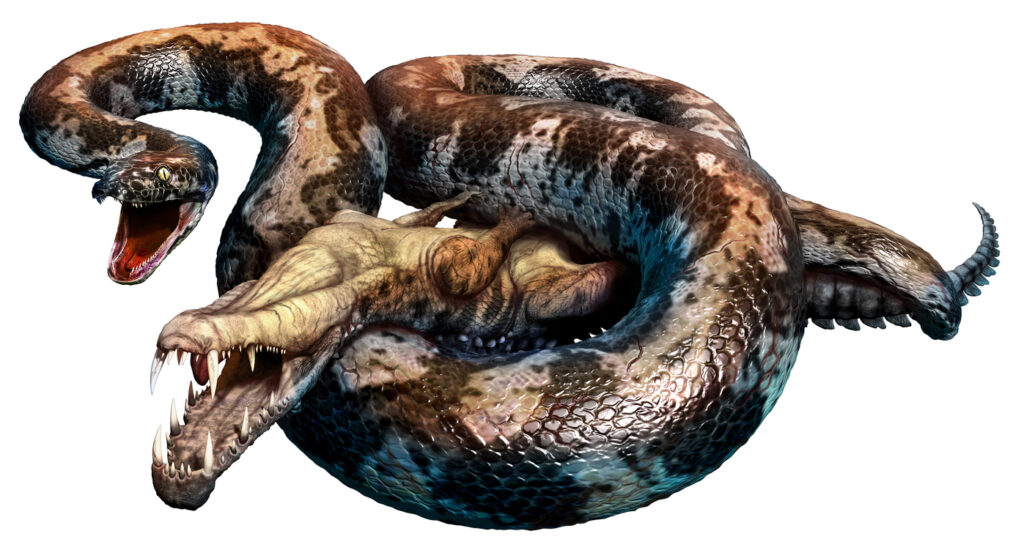
Imagine a snake so massive it would have to squeeze through your office door to get at you. That was Titanoboa, the largest snake that ever slithered across our planet. Discovered in a Colombian coal mine in 2009, this prehistoric monster rewrites what we thought possible for reptiles.
It was absolutely enormous, beyond modern comparison.
Titanoboa measured between 42 and 50 feet long, which is about as long as a school bus. It weighed over a tonne, somewhere around 1,135 kilograms or roughly 2,500 pounds. To put that in perspective, the biggest anacondas today max out at around 29 feet, and no living snake has ever been verified longer than 31.5 feet. Titanoboa was a third larger than anything we have today.
The snake was about three feet wide at its thickest point, which means it was as wide as a doorway. If it wanted to come into a room, it would literally have to squeeze through the entrance. This wasn’t just a big snake, it was the largest predator on the entire planet for about 10 million years following the extinction of the dinosaurs.
It lived 60 million years ago in prehistoric Colombia.
Titanoboa ruled the earth during the Paleocene Epoch, roughly 58 to 60 million years ago. This was about five million years after the dinosaurs were wiped out by the asteroid impact. The fossils were discovered in the Cerrejón Formation, one of the world’s largest open-pit coal mines in northeastern Colombia. Scientists found 186 fossils from about 30 different individuals at the site.
What made this discovery particularly exciting was that it opened a window into South America’s first tropical rainforest. The coal mine preserved ancient remnants of a rainforest ecosystem, showing scientists for the first time what animals ruled this part of the world after the dinosaurs vanished. Titanoboa shared its habitat with 13-foot crocodiles and giant turtles the size of small cars.
The climate was much hotter back then.

Scientists use Titanoboa as a giant thermometer to understand prehistoric climate. Snakes are cold-blooded, which means their body size is limited by the temperature of their environment. For a snake to grow this massive, the climate would need to be significantly warmer than today. Researchers calculated that Colombia must have had average yearly temperatures between 86 and 93 degrees Fahrenheit.
That’s about 10 degrees warmer than the hottest tropical rainforests we have today. The whole planet was experiencing greenhouse conditions during the Paleocene. This extreme heat is what allowed Titanoboa and other giant reptiles to thrive. As the earth cooled over millions of years, snakes got smaller, which is partly why we don’t have anything close to this size alive today.
It primarily ate fish, not what you’d expect.
You’d think a snake this size would eat anything it fancied, but research suggests Titanoboa’s diet consisted mainly of fish. Scientists worked this out by examining the snake’s skull, particularly the shape of its palate and the number and design of its teeth. These adaptations closely resemble modern fish-eating snakes, rather than those that eat mammals or other reptiles.
The fish in question were massive lungfish and bony fish that are now mostly extinct. Some of these lungfish could grow up to three metres long, so they’d provide a substantial meal. However, Titanoboa was an opportunistic predator, which means it wouldn’t turn down other prey like crocodiles, giant turtles, or even smaller snakes if the opportunity presented itself.
It killed by constriction,, like modern boas.
Titanoboa wasn’t venomous. Instead, it used the same killing method as modern boa constrictors and anacondas. It would ambush prey, grab it with its powerful jaws, then wrap its muscular coils around the victim and squeeze. The prey wouldn’t be crushed to death but would suffocate as the snake prevented its lungs from expanding to take in air.
The snake’s teeth were recurved, curving backwards to lock prey in place. As it squeezed, it would slowly work the prey backwards into its throat, swallowing it whole. With a body this massive and muscular, Titanoboa could easily overpower crocodiles that would be terrifying predators in their own right. Modern anacondas are known to eat caimans, so this ancient giant doing the same makes perfect sense.
It spent most of its time in water.
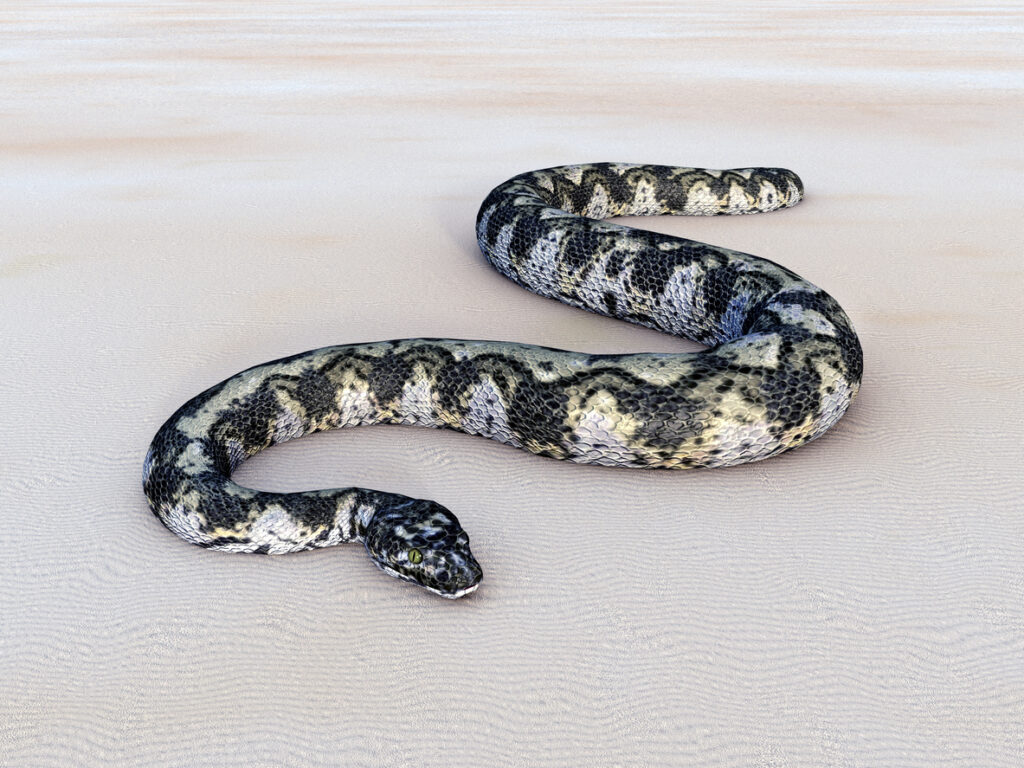
Despite being able to move on land, Titanoboa was probably semiaquatic, spending most of its life in rivers and swamps. The prehistoric Colombian landscape was a coastal plain covered in wet tropical forests with extensive river systems, similar to the Mississippi River delta or Florida’s Everglades, only much hotter. The water would have supported the snake’s enormous weight, making movement easier.
On land, the snake’s 2,500-pound body would have been difficult to support and move. It’s debated whether Titanoboa could climb trees or how fast it moved on land. Most scientists believe it was an ambush predator that would sit motionless in the water, sometimes for days, waiting for prey to swim close enough to strike. This behaviour mirrors how anacondas hunt today.
It had over 250 vertebrae.
Most of what we know about Titanoboa comes from vertebrae and ribs, which is typical for snake fossils. Scientists estimate Titanoboa had more than 250 vertebrae running the length of its body. In constrictors like boas and pythons, increased body size comes from larger vertebrae rather than more bones, which is how researchers calculated the snake’s massive length.
Later expeditions to the coal mine recovered three partial skulls, making Titanoboa one of the few fossil snakes with preserved cranial material. This was tremendously important because skulls tell scientists about diet, hunting behaviour, and evolutionary relationships. The skull discoveries confirmed that this enormous creature was indeed a snake and showed its adaptations for catching fish.
It was related to boas, not anacondas.
Despite behaving more like today’s anacondas, Titanoboa is actually more closely related to boa constrictors. It belongs to the family Boidae and specifically the subfamily Boinae. Interestingly, it’s the only extinct member of this subfamily, as all other boine genera are still alive today. Research suggests it’s closely related to boine species from Madagascar and the Pacific Islands.
The snake’s full scientific name is Titanoboa cerrejonensis. The name comes from “Titan” for its enormous size, “boa” for its family relationship, and “cerrejonensis” referring to the Cerrejón coal mine where it was discovered. When scientists first found the vertebrae, they initially thought they belonged to a crocodile because they couldn’t imagine snake bones being that large.
Climate change probably killed it off.
@zekedarwinscience A new “largest snake ever”? Vasuki indicus #sciencetok #giant #snake #titanoboa #extinct #animals #animal #learnontiktok #edutok #stem #fossils #paleontology #herpetology ♬ original sound – Zeke Darwin
Nobody knows exactly when or why Titanoboa went extinct, but the leading theory involves climate change. As the earth began cooling after the Paleocene, conditions became less favourable for such massive, cold-blooded reptiles. Snakes need warmth to maintain their metabolism, and a cooling climate would have made it impossible for Titanoboa to sustain its enormous size.
The tropical rainforests also gradually gave way to grasslands, changing the entire ecosystem. This habitat loss, combined with cooler temperatures and possibly increased competition with emerging large mammals, likely created conditions where Titanoboa couldn’t survive. It’s also possible the species just naturally went extinct and gave rise to the smaller snake species that inhabit rainforests today.
A warming planet won’t bring them back.
People often ask scientists whether global warming could create conditions for giant snakes like Titanoboa to evolve again. Theoretically, yes, warmer temperatures could support larger snakes. However, it’s highly unlikely to actually happen. Building such a massive snake from something like a modern anaconda would require not just heat but appropriate habitat and millions of years of evolution.
The bigger problem is that humans have already destroyed vast amounts of the tropical rainforest habitat where such a creature would need to live. Titanoboa thrived in an untouched world with extensive river systems and abundant prey. Even if temperatures climbed high enough, the ecological conditions that supported Earth’s largest snake simply don’t exist anymore. We’ve made sure of that.