
Most plants rely on wind, animals, or gravity to spread their seeds. They play the long game and hope something carries their future somewhere useful. Ecballium elaterium, better known as the squirting cucumber, does none of that. It takes a far more direct route.
This plant stores energy inside its fruit until it reaches a tipping point, then releases everything in one sudden burst. Seeds are launched outward with surprising force, landing well away from the parent plant. It’s one of the strangest seed-spreading methods in the natural world, yet most people have never heard of it. These are the details that make this exploding cucumber such an oddity.
It builds pressure inside the fruit until it’s ready to burst.
As the fruit develops, it slowly fills with liquid that has nowhere to escape. The walls of the fruit stretch tighter and tighter as this fluid builds up inside. Nothing dramatic happens at first, which makes the end result even more surprising.
The plant is essentially turning its fruit into a sealed container under stress. Everything about its structure is working toward that final release. It’s not designed to open gently or age gracefully. It’s designed to hold on until the pressure becomes impossible to contain.
A light touch is enough to trigger the explosion.
By the time the fruit is fully ripe, it doesn’t take much to set it off. A brush of a hand, a curious animal, or even movement from nearby plants can be enough. When triggered, the fruit detaches from its stalk and releases its contents instantly.
There’s no warning and no gradual build-up you can see from the outside. People who encounter it for the first time are often startled because it feels sudden and forceful. Once ripe, the fruit is basically waiting for the slightest excuse to let go.
The seeds shoot out at surprising speed.
@pbsdigitalstudios “Squirting cucumbers” can launch its seeds up to 40ft! But it’s not actually a cucumber, so what is it?🤔 Be Smart host Dr.Joe Hanson explains the science. Learn more with Dr. Joe Hanson by heading to Be Smart on YouTube! #cucumber #science #experiment ♬ original sound – PBS Digital Studios
When the fruit bursts, seeds are fired outward with real force, travelling several metres away from the parent plant. They don’t scatter randomly at the base. They’re launched far enough to clear the immediate area, and that distance matters. By landing further away, the seeds avoid competing directly with the parent plant and each other. It’s an effective way to spread without relying on animals or environmental conditions lining up just right.
The fruit collapses instantly after releasing its seeds.
The moment the pressure releases, the fruit completely gives up its shape. What looked solid and swollen just seconds earlier becomes soft and empty almost immediately. There’s no gradual fading or slow breakdown. It’s a sudden transition from purpose-built to finished.
That collapse tells you a lot about how narrowly focused the fruit’s role is. All its energy goes into that single release. Once the seeds are out, the structure has nothing left to do and no reason to stay intact.
The liquid inside helps push the seeds out.
Inside the fruit is a thick, slippery liquid that does most of the work when the explosion happens. When the stalk breaks, this liquid rushes out first, dragging the seeds along with it and giving them extra force. It’s less like seeds falling out and more like being carried by a sudden surge.
What’s clever here is how little the plant needs to achieve this. There’s no moving part, no external trigger beyond pressure. Just fluid, containment, and timing working together in a way that’s remarkably effective.
It grows naturally in dry, rocky places.
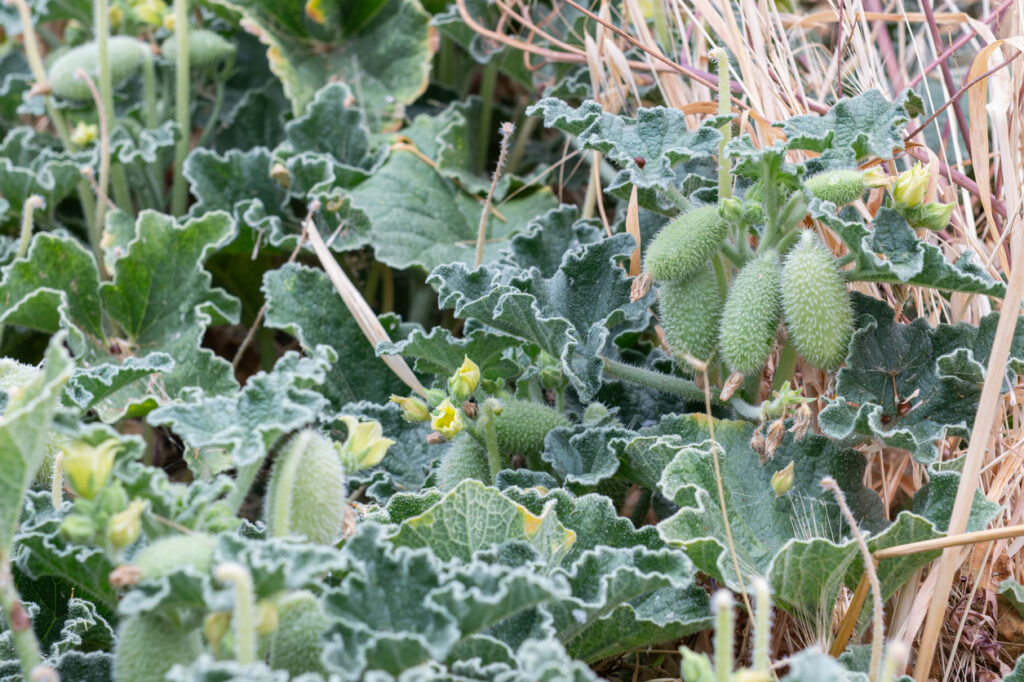
The environments where this plant grows are not forgiving. Soil tends to be shallow, water doesn’t stick around, and competition for space can be fierce. In those conditions, dropping seeds straight down would be a poor strategy. By throwing seeds outward, the plant increases the chance that some will land where water collects or where cracks in the ground offer shelter. The explosive release isn’t a quirk. It’s a practical response to a landscape that doesn’t offer many second chances.
Animals rarely help it spread, so it evolved its own system.
Many plants rely on animals without much control over where their seeds end up. The squirting cucumber doesn’t have that luxury. Animals don’t eat it, and even brushing against it can be unpleasant. Rather than depending on outside help, the plant took the problem into its own hands. Seed dispersal became something it actively manages, not something it waits around for. That independence is part of what makes it so unusual.
The plant is mildly toxic to humans and pets.
@bsjslgv Squirting Cucumber Facts #dndx1 ♬ original sound – haha461
The chemicals in the fruit and sap are irritating enough to discourage curiosity. Skin contact can cause discomfort, and swallowing parts of the plant leads to unpleasant reactions. It’s a quiet deterrent rather than an aggressive defence. That toxicity likely helps the plant complete its life cycle without interference. Combined with its explosive behaviour, it explains why the squirting cucumber is more at home in wild spaces than cultivated gardens.
The explosion helps prevent overcrowding.
Plants that release seeds nearby often end up competing with their own offspring. The squirting cucumber avoids that entirely. Its seeds land well away from the parent plant, spreading the risk across a wider area. Even if only a few seeds find suitable ground, the strategy works. It’s about improving odds, not guaranteeing success for every seed. The wide scatter makes sure the next generation isn’t fighting for the same patch of soil.
It’s one of the most dramatic seed dispersal methods in nature.
There are other plants that use force to release seeds, but few do it with this combination of speed, distance, and precision. The squirting cucumber’s method feels abrupt and decisive, which is part of why it sticks in people’s minds. Once you know how it works, it’s hard not to admire the efficiency of it. What looks like a strange party trick is actually a tightly tuned survival strategy, refined to suit a tough environment.