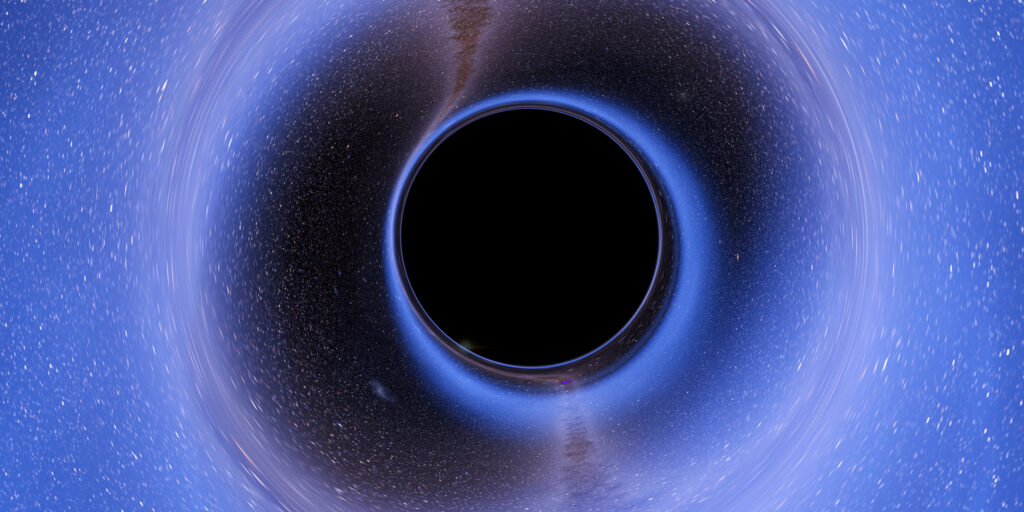
Black holes are some of the strangest and most powerful objects in the universe, and for all our advances in science, we still don’t fully understand them. They bend space and time, swallow light, and challenge everything we think we know about physics. Even with decades of research and the help of supercomputers, they remain as mysterious as ever.
Scientists can describe what black holes do, but not always how they do it. From the way they form and grow to what really happens beyond the event horizon, many of their behaviours defy logic and explanation. Each new discovery raises even more questions, keeping black holes at the centre of some of science’s biggest cosmic debates.
What really happens at the singularity
At the centre of every black hole is a singularity, a point where all known laws of physics seem to collapse. Matter gets crushed into an infinitely small space, and even time behaves differently. The problem is that our current understanding of physics can’t describe what happens there in detail.
Einstein’s equations predict this infinite density, but quantum theory suggests something else must happen. Until we find a theory that connects gravity and quantum mechanics, the heart of a black hole will remain a mystery.
How they form so quickly
Some supermassive black holes already existed less than a billion years after the Big Bang. That’s incredibly fast, considering how long it should take for something to grow that large. Scientists aren’t sure whether they started as smaller black holes that grew unusually fast, or if they were born massive from the start.
Whatever the process, it challenges our understanding of how galaxies and cosmic structures formed in the early universe. It suggests that black holes might have shaped the universe sooner than anyone thought.
What powers their enormous jets
Many black holes eject narrow beams of matter and energy called jets, which shoot out at nearly the speed of light. These jets can stretch across thousands of light years, yet scientists still don’t fully understand how they form. It’s believed that powerful magnetic fields near the event horizon play a role, but how falling matter turns into outward energy remains unclear. It’s one of the biggest puzzles in astrophysics.
What happens to the information that falls in
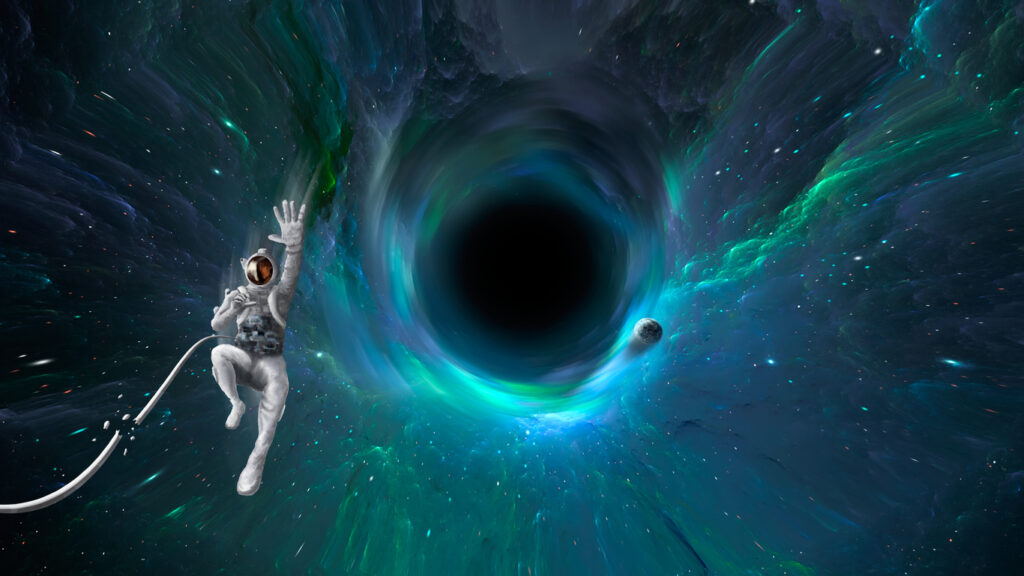
When something crosses a black hole’s event horizon, it disappears forever, but does the information about what it was vanish, too? According to the laws of quantum mechanics, information can’t be destroyed, and yet black holes seem to do exactly that.
This is known as the information paradox, and scientists have debated it for decades. Some theories suggest the information might be encoded in Hawking radiation or somehow preserved on the event horizon, but no one knows for sure.
How time and space behave inside
Inside a black hole, the normal flow of time and space breaks down. The closer something gets to the singularity, the more time slows compared to the outside universe. Eventually, time and space swap roles entirely, which defies ordinary logic. Physicists can describe this mathematically, but not practically. What it would feel like or how it would actually unfold is beyond what we can observe or imagine.
Whether Hawking radiation really exists
In theory, black holes emit faint radiation known as Hawking radiation, discovered through Stephen Hawking’s calculations. This radiation would mean that black holes slowly lose mass and could eventually evaporate completely. The issue is that no one has ever observed it. If proven, it would link general relativity with quantum mechanics, but until we detect it, Hawking radiation remains one of science’s boldest unconfirmed ideas.
How they grow so large
Some black holes weigh billions of times more than the Sun, and it’s unclear how they reach such enormous sizes. They might merge with others, pull in gas clouds, or even form differently from smaller ones altogether. The rate at which they grow seems too fast for current models, especially for those seen in the early universe. Something about our understanding of cosmic growth is still missing.
Why their spins behave unpredictably
Black holes can spin at different speeds, sometimes almost as fast as light. But scientists don’t know why some spin faster or how their rotation affects their surroundings. Even stranger, their spin axes don’t always align with their galaxies. This misalignment could reveal something about their violent origins or the way they interact with nearby matter, but no one has worked out the full picture yet.
What happens when matter falls in
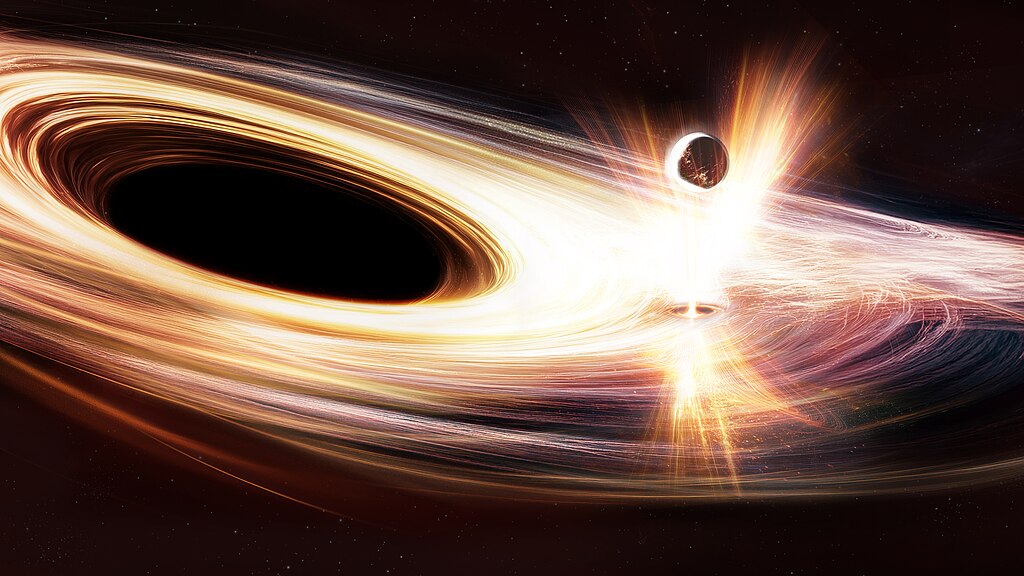
When stars, gas, or even planets get too close to a black hole, they’re stretched and shredded in a process called spaghettification. Scientists understand the basics, but the details of what happens just before matter crosses the event horizon are still unclear. We can observe the light emitted as material heats up on the edge, but what happens after that point is impossible to see. The final moments before disappearance remain one of astronomy’s biggest blank spots.
What occurs when black holes collide
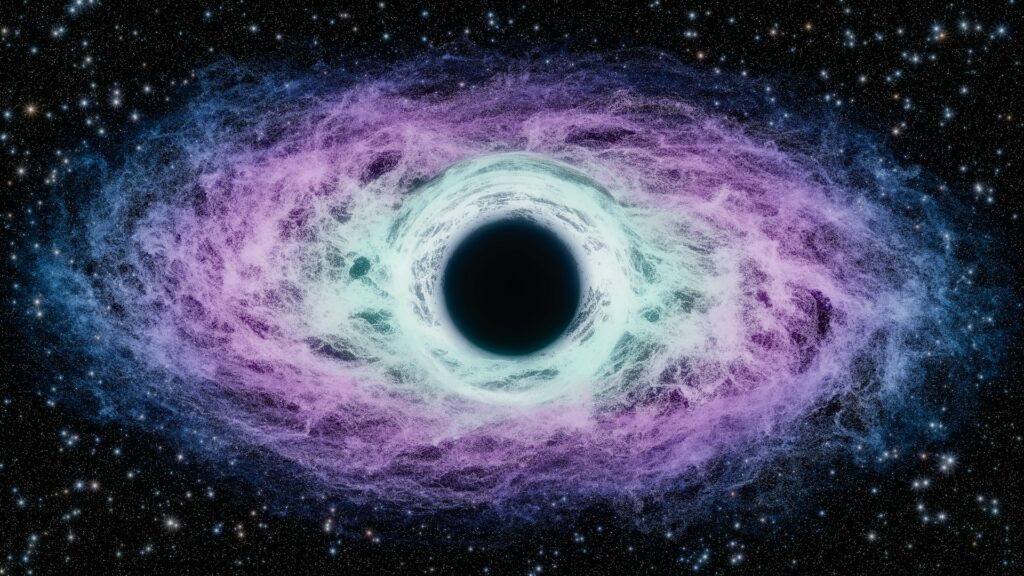
When two black holes merge, they create ripples in space-time known as gravitational waves. We can detect those waves, but the full physics of the collision is still not understood. The energy released is immense, yet how that energy distributes and what happens inside the merged black hole is uncertain. Each detected merger gives us more clues, but these events are so extreme that even our best models might not capture everything happening in those final moments.
What lies beyond the event horizon
Once something crosses a black hole’s boundary, the event horizon, it’s gone for good. What happens after that point is completely unknown. Some scientists think matter simply collapses to the singularity, while others suggest it could travel through a “wormhole” to another universe. Since no information can escape, we’ll likely never observe it directly. The event horizon marks the ultimate limit of human knowledge.
Whether they connect to dark matter
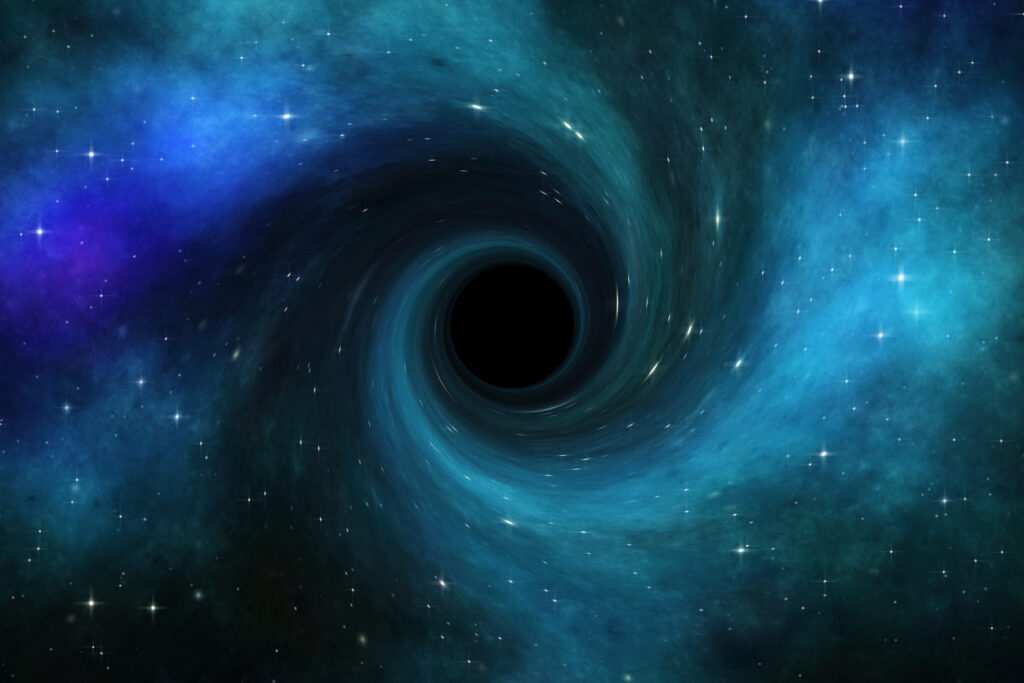
Some theories suggest black holes could be linked to dark matter or even made partly from it. Others think ancient black holes from the early universe might explain the mysterious dark matter that makes up most of the cosmos. There’s no solid evidence yet, but understanding this link could solve two of physics’ greatest mysteries at once: the nature of black holes and dark matter itself.
Why some defy predictions
Every time scientists think they understand black holes, new discoveries prove otherwise. Some act more active than expected, some emit more radiation, and others appear where theory says they shouldn’t. These contradictions remind researchers that we’re still only scratching the surface. Black holes aren’t just cosmic monsters; they’re the ultimate test for human knowledge. The more we learn about them, the more they remind us how much of the universe still refuses to be explained.