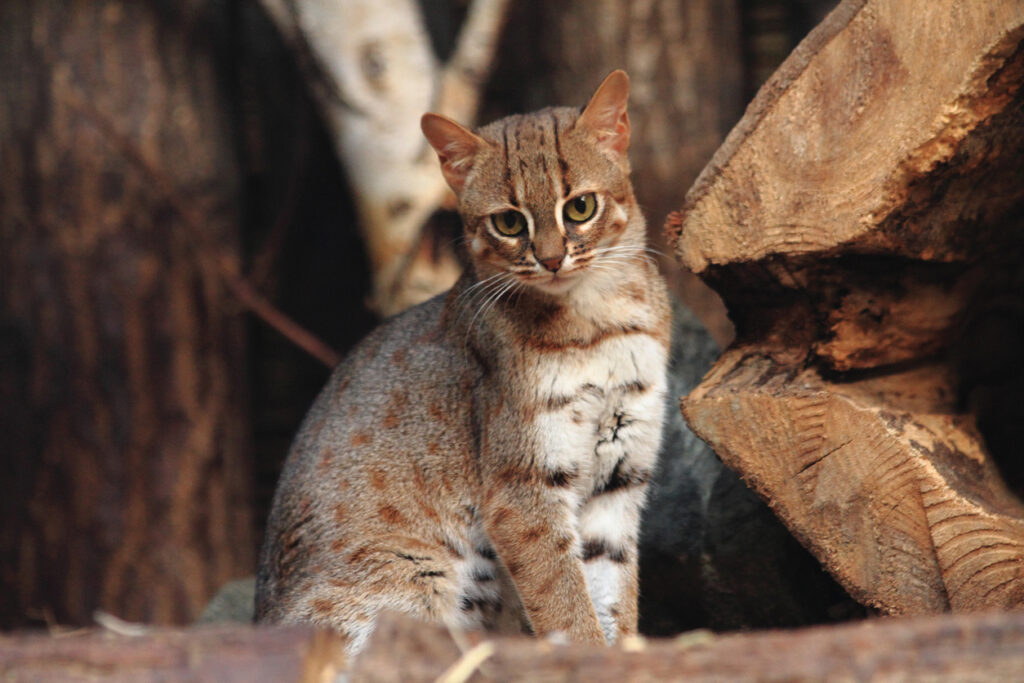
At first glance, you might mistake the rusty-spotted cat for a kitten that never grew up. With its huge eyes, delicate paws and compact frame, it looks impossibly small to be a true predator. However, this tiny wild cat is every bit as fierce and capable as its larger relatives.
Found only in India and Sri Lanka, the rusty-spotted cat is the smallest wild cat in the world, and one of the hardest to see in the wild. For decades, it was almost a myth, known mostly from scattered sightings and camera traps. Now, researchers are beginning to uncover how this miniature marvel has managed to carve out a life in some of the toughest landscapes on Earth.
It’s barely bigger than a guinea pig.
An adult rusty-spotted cat is only about 35 to 48 centimetres long, with a tail that adds another 15 to 30 centimetres. Most adults weigh less than a bag and a half of sugar, so around 1.5 kilograms. That small frame isn’t a weakness; it’s an advantage. It lets the cat slip through tangled vegetation, hide in crevices and move unnoticed in places where larger animals simply can’t go.
For something so small, it’s surprisingly confident, taking on prey almost its own size and standing its ground when needed. The phrase “small but mighty” has never been more accurate.
Its name comes from its subtle markings.
The rusty-spotted cat’s name comes from the faint reddish speckles scattered across its soft grey fur. These spots, combined with faint streaks on the head and back, give it a washed, almost dusted look, like a shadow among dry leaves. The camouflage is extraordinary.
When the cat crouches low to the ground, it blends so completely into the forest floor that even trained researchers have walked right past it. Those delicate markings aren’t for decoration; they’re an evolutionary survival tool.
It prefers forests and grasslands.
This cat’s home range stretches across a mix of landscapes, from dry scrub and rocky hillsides to damp forests and thick grasslands. It thrives where it can hide easily and find small prey. You might even find it near farmland, where rodents and small birds are plentiful. Unlike big cats that require large, untouched territories, the rusty-spotted cat has learned to coexist quietly alongside people.
Its adaptability is one of the reasons it’s still hanging on while larger species are disappearing.
It’s mostly nocturnal.
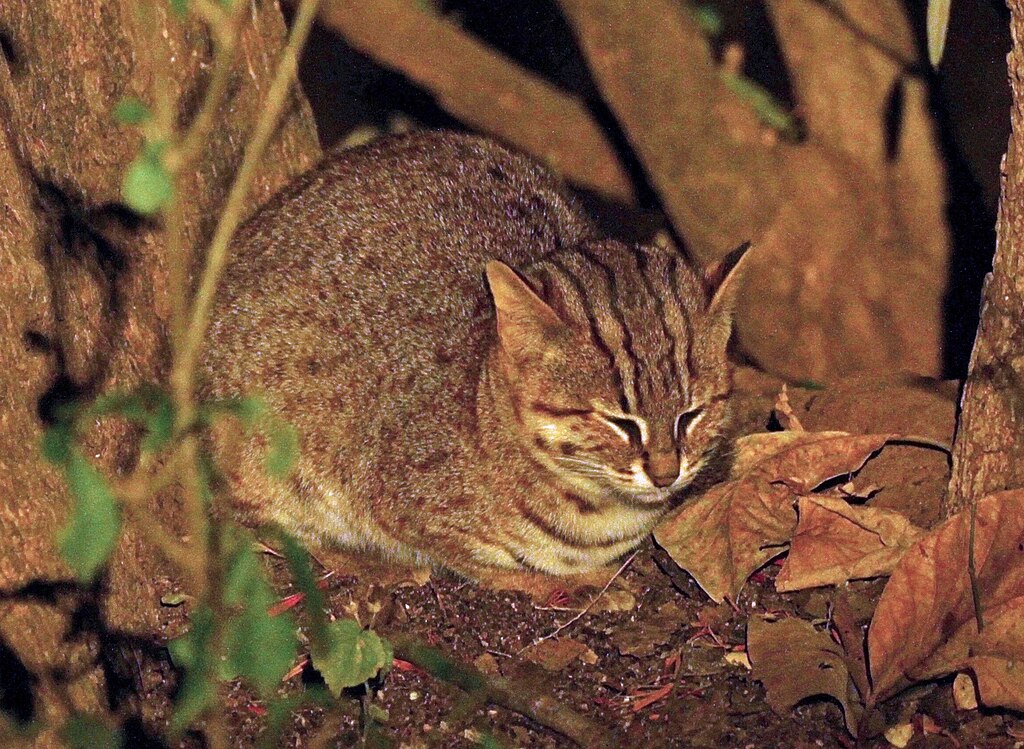
By night, the rusty-spotted cat becomes a shadow with purpose. It hunts under cover of darkness, slipping between branches and shrubs in total silence. Its large eyes and keen hearing make it perfectly suited to low-light conditions, while its soft, padded paws allow it to move almost soundlessly.
During the day, it hides away in tree hollows, under rocks or deep in vegetation to avoid larger predators. For such a tiny creature, surviving alone requires clever timing, and this cat has perfected it.
It’s an expert climber.
The rusty-spotted cat’s agility is something to admire. It can scale trees, clamber up rocky slopes, and leap several times its body length with ease. It often rests high up in the branches or hunts among the trees for birds and small mammals. Those sharp claws and light body make it incredibly nimble, helping it stay out of danger and access food sources most ground-dwellers can’t reach.
It hunts tiny prey with big precision.
For a predator this small, every meal counts. The rusty-spotted cat feeds mostly on mice, small lizards, frogs, and insects, and it hunts with the stealth and focus of a much larger feline. Its speed and accuracy are astonishing. It can pounce with lightning-fast precision, taking down prey almost its own size. Watching one in action feels like watching instinct at its sharpest, honed over thousands of years of survival in tough conditions.
It communicates through scent and sound.
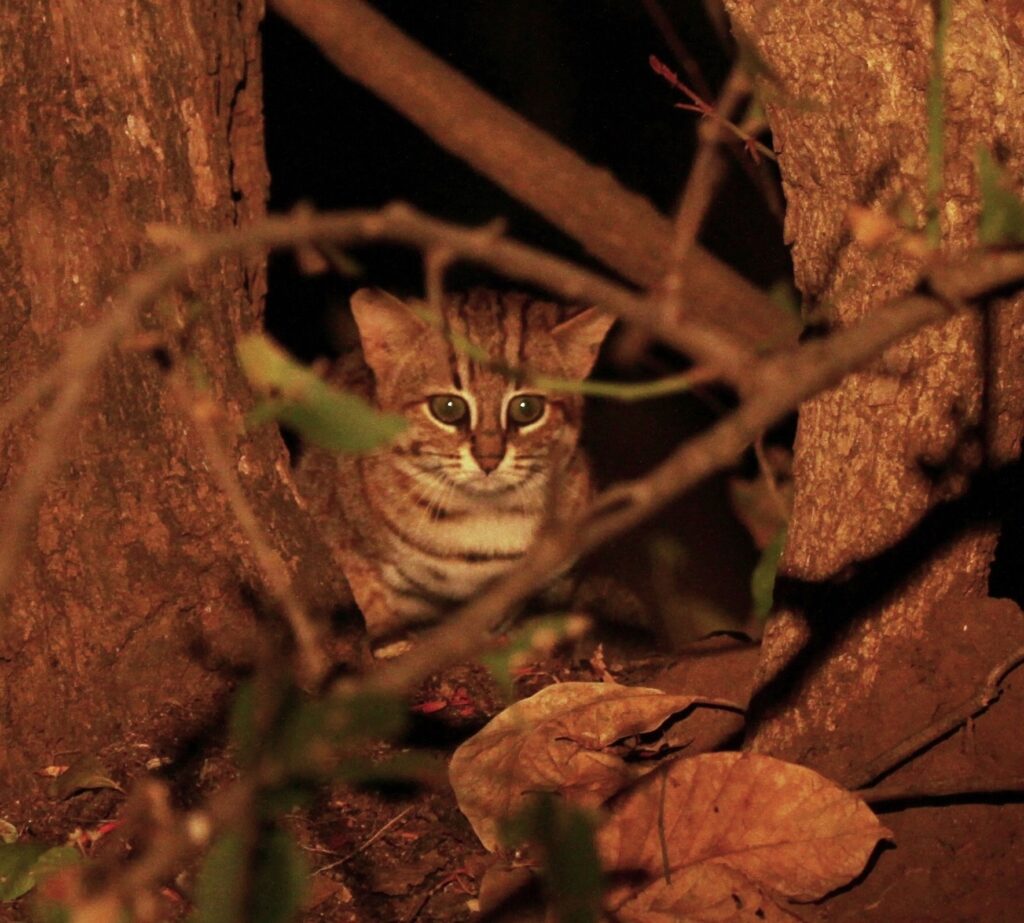
Living a solitary life means the rusty-spotted cat rarely crosses paths with its kind, so it relies on scent marking to communicate. It uses glands on its face and paws, as well as urine marking, to define territory and signal readiness to mate. Its vocalisations are quiet and rare; they come in the form of gentle purrs, chirps, and mews that few people ever hear. These small, subtle cues keep them connected without confrontation, maintaining the fragile balance of their solitary lives.
It lives alone most of the time.
Like most wild cats, the rusty-spotted cat values solitude. Adults live alone except during breeding season, when a male and female briefly come together. Each has its own range, carefully maintained through scent trails and silent avoidance. This independence keeps conflict to a minimum and helps the species spread out across suitable habitats. It’s a solitary existence, but one that clearly works.
Kittens are born blind and tiny.
Females usually give birth to one or two kittens after a short pregnancy of about two months. The newborns are tiny, blind, and entirely dependent on their mother, weighing less than 70 grams at birth. For several weeks, the mother hides them in a sheltered den, feeding and grooming them constantly.
By around six weeks, they start to explore outside the nest, learning to stalk, pounce, and survive on their own. Within a few months, they’re independent. They’re still small, yes, but already formidable.
It’s found only in a few parts of the world.
The rusty-spotted cat’s world is remarkably small. It’s native to India and Sri Lanka, though a few have been spotted just across the border in Nepal. It prefers dry forests and rocky hills rather than wide-open plains, where it would be too exposed. This limited range makes the species particularly vulnerable to habitat loss. As farmlands expand and forests shrink, these little cats are being squeezed into smaller and smaller spaces.
It faces growing threats that shouldn’t be ignored.

Deforestation and road expansion are destroying the dense cover this species relies on. Many are also killed accidentally near villages while hunting rats and birds. Because they’re small and quiet, their decline can go unnoticed, even in areas where they once thrived.
Conservation groups in India and Sri Lanka are now working to protect remaining forests and educate farmers, but the rusty-spotted cat is still listed as “near threatened.” Without proper protection, it could easily slip closer to extinction.
It’s a symbol of natural resilience, for sure.
Despite the challenges, the rusty-spotted cat continues to survive where few others can. It adapts, hides, and persists, showing just how finely tuned nature can be. In a world that often rewards size and strength, this tiny predator is a reminder that power also exists in precision and patience. It’s proof that being small doesn’t mean being fragile. It means being efficient, alert, and perfectly designed for the life you lead.