
Rainbows might pop up spontaneously, but one thing about them remains consistent: they never shuffle their colours. Every time, it’s red on top, fading down to violet at the bottom. That’s not random; it’s how light, water, and our eyes interact. Here’s why the pattern always stays the same, no matter what.
Sunlight hides all the colours inside it.
What looks like plain white light actually contains every colour mixed together. You only see that hidden spectrum when something, like a raindrop, teases the colours apart so they can be seen individually. That’s the starting point of the rainbow. The colours are already there, lined up inside the light, waiting to split in their natural sequence once conditions allow.
Raindrops bend light at precise angles.
When light enters a raindrop, it slows down and bends. The bending doesn’t happen randomly; it follows predictable rules that depend on the shape of the drop and the properties of light itself. Because each droplet bends the light the same way, they all release the same colour order. With millions of drops acting together, the pattern becomes crystal clear.
Each colour bends by a different amount.
Red, orange, yellow, green, blue, indigo, and violet don’t all bend equally. Red bends the least, violet bends the most, and the other shades naturally fall between those two extremes. The difference in bending locks the sequence into place. Once the light is split, the order is fixed. There’s no way for violet to suddenly leap above red.
The drop shape makes it predictable.
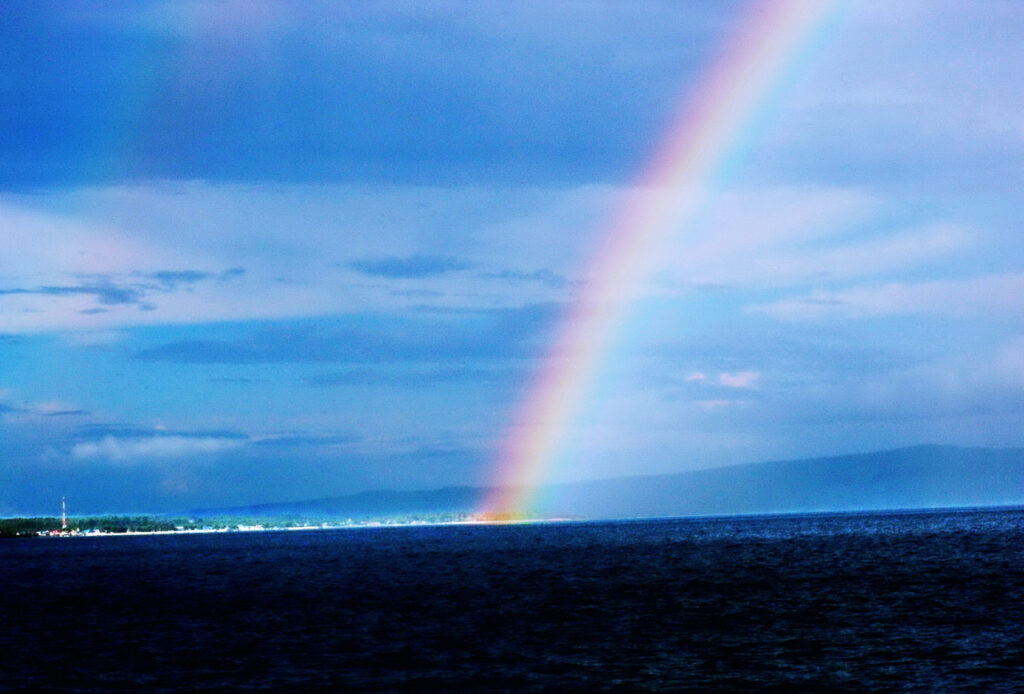
Raindrops aren’t perfect spheres, but they’re close enough to give a consistent result. Their rounded shape bends and reflects light in the same steady pattern every time it rains. That reliable geometry means the rainbow can’t shuffle. As long as drops stay roughly round, the colours will always fall into their familiar positions.
The angle decides what reaches your eyes.
Only light leaving the drop at a very specific angle reaches you as a rainbow. Red light exits at around 42 degrees, violet at around 40, and the others slot neatly between. It’s a tiny difference, but it explains the stacking. Each colour leaves at its set angle, so your eyes always catch them arranged from red to violet without variation.
Millions of drops reinforce the order.
One raindrop only gives off a speck of colour, but when millions of drops line up under sunlight, their combined beams build the rainbow in full. The repetition cements the sequence across the sky. That sheer scale makes the order impossible to miss. Every droplet adds its slice, and together they create a giant, coordinated spectrum that never scrambles itself.
Your eyes sort the light into a curve.
We see rainbows as arcs because of the angles light makes with our eyes. The curve isn’t painted in the sky. It’s how our brains piece together the incoming light from countless droplets. The order comes through clearly because your vision arranges the beams as a continuous band. Without your perspective, the rainbow would just be scattered colours.
Double rainbows prove the rule.
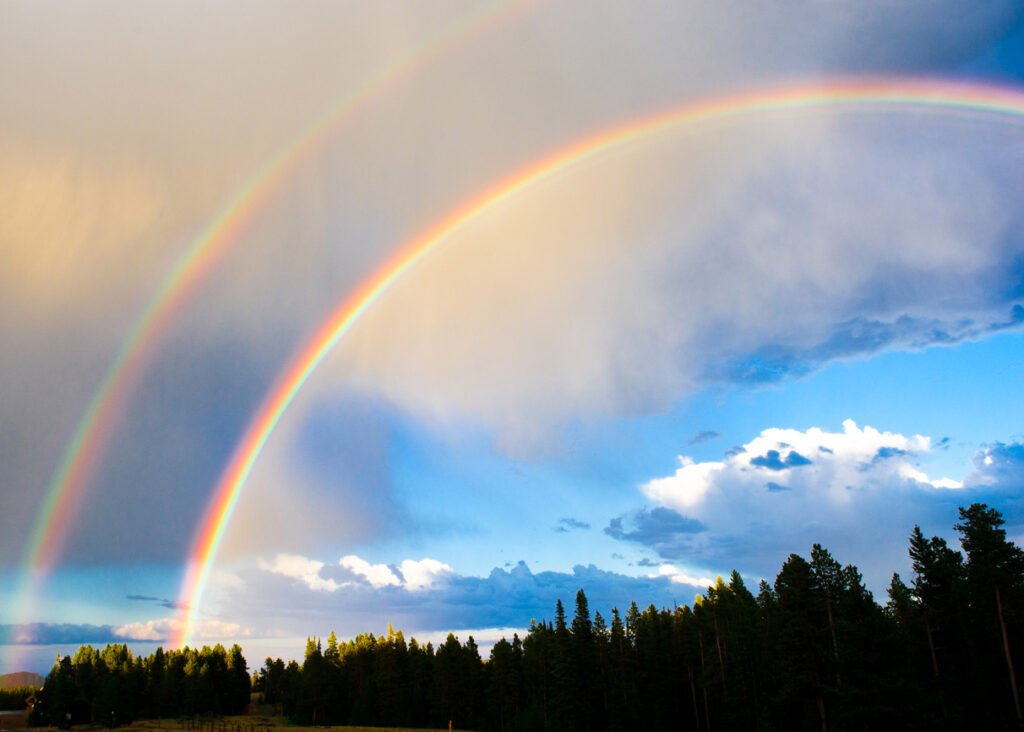
When a second rainbow appears, its colours run backwards. That happens because the light bounces twice inside the drop, flipping the order on exit. The reversal actually proves the consistency of the physics. Even in this rare twist, the bending rules remain firm, so the second bow is predictable too.
Brightness doesn’t change the order.
Some rainbows shine bold, others are pale. That depends on how strong the sunlight is and how many drops are in the right place, not on any change to the sequence itself. No matter how faint the bow looks, the colours always sit in the same alignment. It’s intensity that varies, not the order of the spectrum.
The sequence reflects the visible spectrum.
Rainbows only show the colours our eyes can detect. The human eye sees from red through violet, so that’s the part of the spectrum that displays itself in the sky. The order matches the way light naturally spreads. If our eyes worked differently, we might see more or fewer bands, but the underlying progression would still run the same way.
The science works anywhere on Earth.

Rainbows aren’t tied to one location. Anywhere there’s sunlight and raindrops, the same pattern will appear. That’s because light and water obey the same physics everywhere. Its universality is why the rainbow never surprises you with a new arrangement. It’s always the same spectrum following the same rules, no matter where you’re standing.
The order is nature’s constant signature.
It can feel magical that the rainbow never slips out of line. But it’s really nature showing us one of its most dependable patterns: light always bending into colour the same way. That’s why rainbows are so reassuring. You know exactly what you’ll see, as in the same red to violet arc every time, but it never stops feeling extraordinary when it appears.