
Most of us notice the moon changing shape in the sky, but most people don’t ever stop to think about why it happens (except maybe the science geeks among us). Of course, those changing shapes in the night sky aren’t random at all. They’re part of a steady cycle that’s been guiding human life for centuries. If you were ever curious about how moon phases work, this should clarify things.
The moon reflects sunlight.
The moon doesn’t create its own light. What we see shining in the night sky is sunlight bouncing off its surface. Because the moon moves around Earth, the angle between the sun, moon, and Earth keeps changing, which alters how much of the moon looks lit from where we stand. Sometimes it looks full and bright, sometimes like a thin slice. These changes are what we call phases, and they repeat in a set pattern every month.
The solution to confusion is remembering that the moon is always half lit by the sun, but we only see part of that lit surface depending on where the moon is in its orbit. Once you grasp this, the changing shapes make perfect sense, and you can predict them without needing a chart.
The new moon starts the cycle.
The cycle begins with the new moon. At this point, the moon is between Earth and the sun, so the side facing us is in shadow. To us, it looks like the moon has disappeared. This is why nights around the new moon are darker and stars look brighter. Sailors and farmers once used this stage to plan work because darkness brought different advantages compared to moonlit nights. Even though the moon is still there, it’s hidden in plain sight.
The answer here is patience. Within a few days, the moon slips further along its orbit, and a tiny sliver of light appears. Knowing the cycle starts at “invisible” helps you track the rest more easily. It’s the reset point that puts everything else in motion.
The waxing crescent brings the first light.
After the new moon, a slim crescent of light appears. This is the waxing crescent, where “waxing” means growing. It hangs low in the evening sky, curving like a smile. In many cultures, this phase symbolised beginnings or renewal because it marked the return of light after darkness. It’s a stage that often inspires people to start new projects or reflect on fresh intentions, simply because it feels like the moon is growing again.
The key is to see this crescent as a signal of change. If you watch closely, the lit slice changes position each night as the moon climbs higher. It’s a reminder that even small steps forward matter because they lead to something bigger. That’s as true for us as it is for the moon’s journey.
The first quarter shows half the moon.

Roughly a week into the cycle, we reach the first quarter. Half the moon looks bright, the other half dark. It’s called “first quarter” not because it looks quartered, but because the moon has moved a quarter of the way around its orbit. The split look is striking, like a coin cut in half. Ancient watchers used it as a marker for timekeeping, as it was easy to notice the sudden change in shape compared to earlier phases.
The way to understand this is that we’re seeing half of the lit side from our angle. The moon itself is still half in sunlight and half in shadow, but we’re only catching part of it. Knowing this helps clear up why the names don’t always match what your eyes see.
Next, waxing gibbous builds towards full.
After the first quarter, the bright portion grows larger each night. This stage is called waxing gibbous, which means bulging. The moon looks almost full, but not quite. The extra light in the evening sky made this phase useful for travellers and workers in the past, as they could rely on brighter nights. It’s a reminder that the moon doesn’t jump from half to full but takes steady steps along the way.
The solution is to watch the growing bulge with curiosity. Once you know this stage comes right before the full moon, you’ll find it easier to spot. Instead of wondering if it’s “full yet,” you’ll know to wait just another day or two for the peak.
The full moon shines brightest.
The full moon is the stage everyone notices. It’s hard to miss since it’s pretty obvious. Here, Earth is between the sun and the moon, so we see the entire sunlit side glowing back at us. Nights are brightest, and the moon looks larger and more commanding. Cultures worldwide gave special meaning to this phase, from harvest festivals to rituals because its light shaped how people lived and gathered. Its pull on imagination has lasted for thousands of years.
The answer is balance. While the full moon is dramatic, it’s also the halfway point of the cycle, not the end. Knowing that reminds us to see it as part of a larger rhythm, not a one-off event. The brightness will fade, and the cycle will carry on.
The waning gibbous starts the decline.
After the full moon, the light begins to shrink. This is the waning gibbous stage, where “waning” means reducing. The moon still looks big and round, but each night a little less is lit. For many, this phase feels quieter, as though the peak has passed and things are winding down. It’s often overlooked, yet it’s a key part of the steady rhythm that keeps repeating month after month.
The answer here is acceptance. Watching the waning gibbous helps you realise that nothing stays at its peak forever. The moon doesn’t fade suddenly; it eases back. Seeing this can be a reminder that endings are gradual and natural rather than abrupt.
The last quarter halves the moon again.
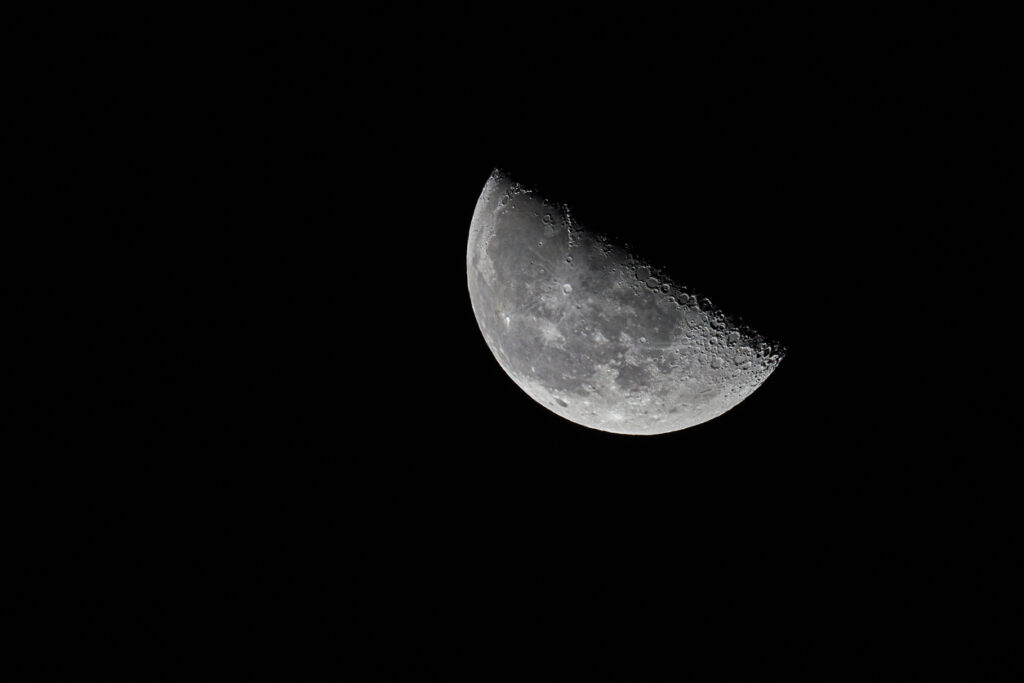
Two weeks after the new moon, we reach the last quarter. Once again, half the moon appears lit and half dark, but the opposite side compared to the first quarter. It marks the three-quarter point in the orbit, so the cycle is already on its way back towards the start. This phase is another strong visual cue, making it easy to notice the transition from fullness towards shadow.
The practical step is to see it as a checkpoint. The moon has come most of the way around its path, and only one stage remains. Understanding this makes the rhythm easier to follow and shows how predictable the whole cycle really is.
The waning crescent closes the loop.
In the days before the next new moon, the moon thins into a waning crescent. It’s a faint curve in the early morning sky, sometimes barely visible. This stage has long been linked with rest, reflection, and preparing for renewal, since the next step is the reset of darkness. Farmers, sailors, and storytellers all used this phase to mark endings and beginnings.
The way to see it is as a gentle close. The moon doesn’t disappear suddenly; it eases into shadow. Once you recognise this as the final step, the cycle feels more complete. It makes the return of the new moon more satisfying because you’ve seen the journey through.
The cycle repeats endlessly.
Every 29 and a half days, the moon completes this cycle. New, crescent, quarter, gibbous, full, and back again. This rhythm has guided calendars, agriculture, and culture for thousands of years. While science explains the mechanics, the fascination comes from how steady it is. No matter what happens on Earth, the moon keeps turning through its phases without fail.
The solution is to pay attention. Watching the phases over a month connects you to a cycle people have relied on for centuries. It’s a reminder that change is constant, but it’s also patterned. Understanding that pattern makes the night sky feel more familiar and less mysterious.