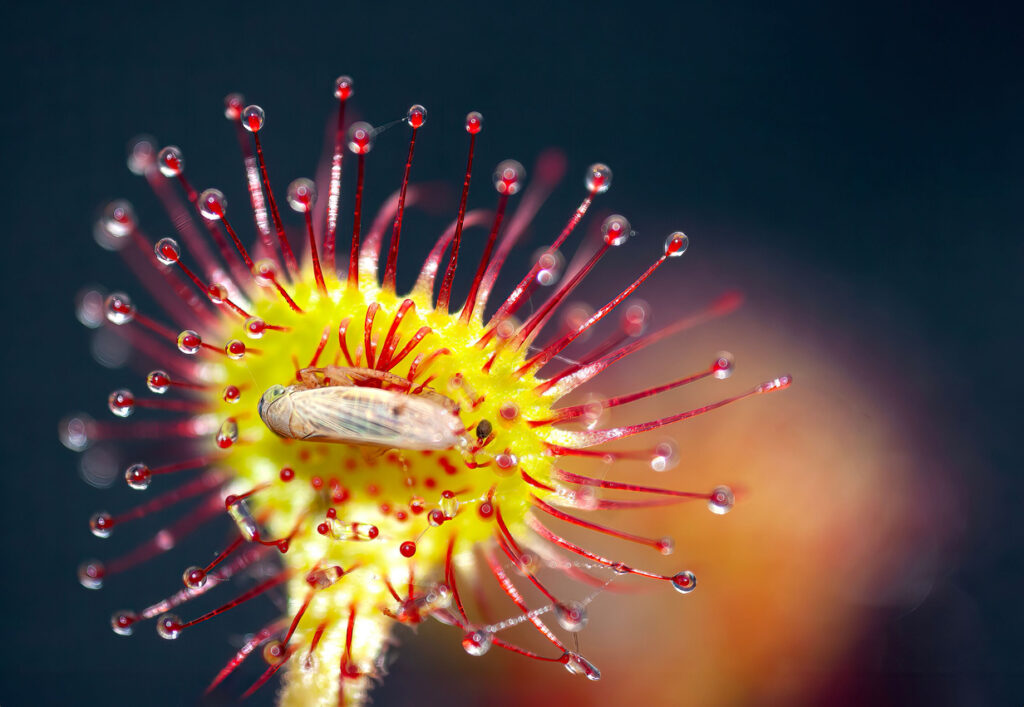
Plants that eat animals sound like something from a horror movie, but carnivorous plants are actually sophisticated hunters that have evolved wildly different strategies for catching prey. Some use sticky death traps that work like flypaper, while others employ spring-loaded mechanisms that snap shut faster than you can blink, proving that plants can be just as ruthless as any predator.
Sticky trap plants coat themselves in deadly glue.
Sundews and butterworts cover their leaves with tiny droplets of sticky mucilage that looks like harmless morning dew but acts like superglue for insects. Small flies and gnats get stuck on contact and the more they struggle, the more entangled they become in the adhesive coating.
The sticky droplets aren’t just passive glue—they’re actively produced by specialised glands that can increase secretion when prey is detected. This means the plant literally makes more glue when it senses a potential meal has landed on its surface.
Snap trap plants are basically living mousetraps.
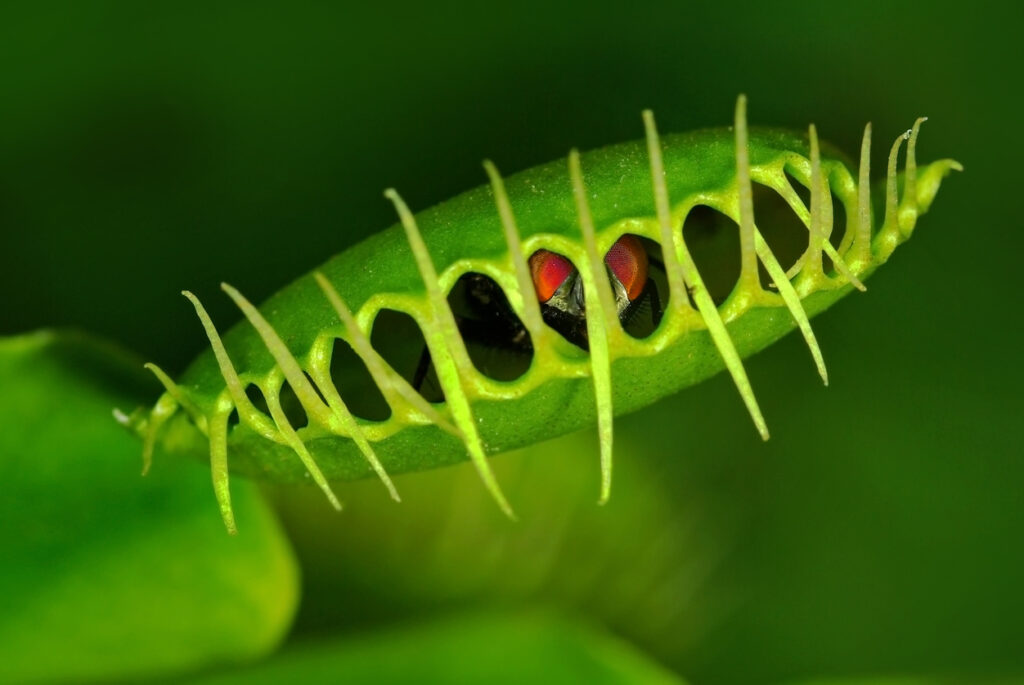
Venus flytraps use a completely different approach, with modified leaves that form hinged traps with trigger hairs inside. When an insect touches multiple trigger hairs within a few seconds, the trap snaps shut in less than a second, creating a sealed chamber for digestion.
The snap mechanism is so fast that high-speed cameras are needed to capture the full closing sequence. The plant stores energy in the leaf structure like a compressed spring, then releases it all at once when triggered by prey movement.
Sticky traps work best on small, weak prey.
Sundews and other sticky trap plants typically catch tiny insects like gnats, fruit flies, and small mosquitoes that can’t generate enough force to break free from the adhesive. Larger insects might escape if they’re strong enough to overcome the glue before the plant can secure them.
The size limitation isn’t a bug, but a feature. These plants have evolved to specialise in catching abundant small prey, rather than gambling on occasionally catching larger meals that might escape and waste the plant’s energy investment.
Snap traps can handle bigger, stronger prey.
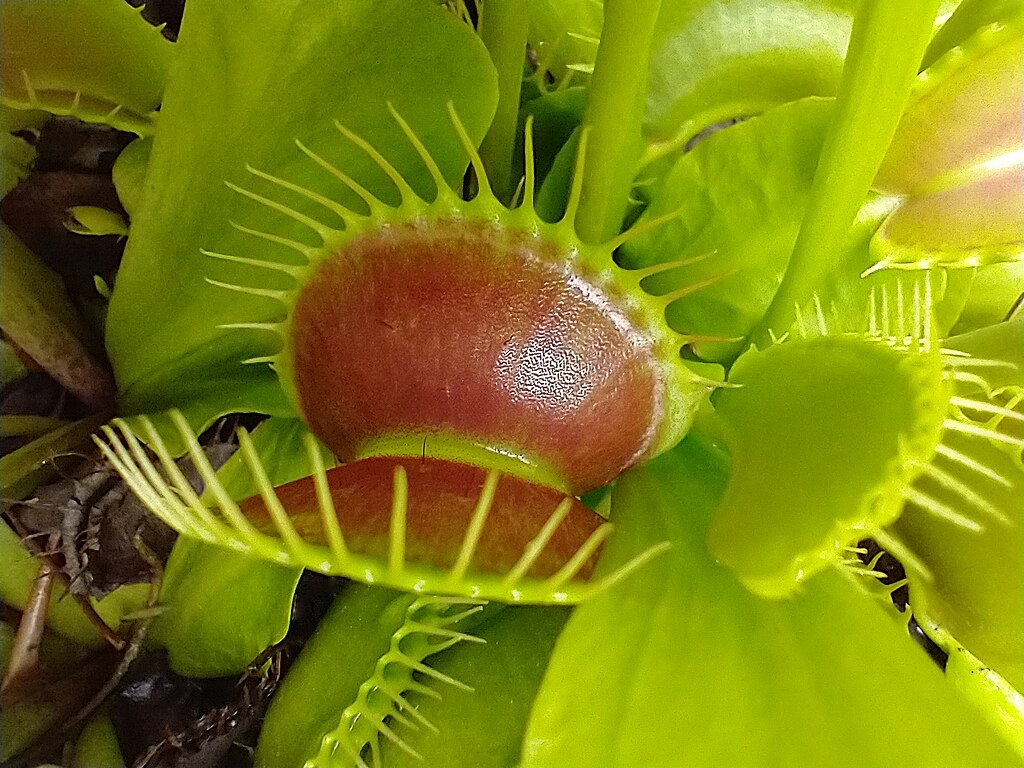
Venus flytraps can catch and digest much larger prey including beetles, spiders, and even small frogs that would easily escape from sticky traps. The mechanical closure creates a sealed prison that even strong insects can’t break out of once the trap is fully closed.
The snap trap design allows these plants to take bigger risks for bigger rewards. They might catch fewer individual prey items than sticky plants, but each successful capture provides much more nutrition per hunting effort.
Sticky plants digest prey externally, while snap plants digest internally.
Plants with sticky traps begin digesting their prey immediately on the leaf surface, secreting enzymes that break down the insect while it’s still stuck to the outside of the plant. This external digestion means nutrients are absorbed directly through the leaf surface.
Snap trap plants like Venus flytraps create a sealed internal chamber where digestive enzymes break down prey in a controlled environment. This internal digestion is more efficient but requires more complex leaf structures to contain and process the meal.
Environmental conditions determine which strategy works better.
Sticky trap plants thrive in consistently humid environments where their adhesive secretions won’t dry out, while snap traps work better in more variable conditions because they don’t rely on maintaining surface moisture for hunting effectiveness.
The habitat requirements explain why you find sundews in bogs and wetlands with constant moisture, while Venus flytraps have evolved in areas with more seasonal variation where sticky traps might fail during dry periods.
Sticky traps are energy-efficient but slow.
Maintaining sticky secretions requires relatively little energy compared to the complex mechanical systems needed for snap traps. However, sticky plants take much longer to fully digest and absorb nutrients from their prey, sometimes requiring several days per insect.
The slow digestion process means sticky trap plants need to catch prey more frequently to meet their nutritional needs, but the low energy cost of their hunting method makes this sustainable over time.
Snap traps are expensive but fast.
Venus flytraps invest enormous energy in maintaining their spring-loaded trap mechanisms and can only use each trap a limited number of times before it wears out. However, they can digest prey much faster and extract nutrients more efficiently per capture.
The high energy cost means snap trap plants need to be very selective about what they catch. After all, triggering a trap for prey that’s too small wastes valuable resources, which is why the trigger mechanism requires multiple stimuli to activate.
Weather affects the two strategies differently.
Rain can wash away sticky secretions and make adhesive traps less effective, while snap traps actually work better in humid conditions because the enclosed environment prevents prey from drying out before digestion is complete.
Wind also impacts the strategies differently. Sticky plants benefit from breezes that bring more flying insects into contact with their traps, while snap plants prefer calmer conditions where their sensitive trigger hairs aren’t constantly being activated by moving air.
Both strategies evolved multiple times independently.
Sticky traps have evolved separately in at least five different plant families, while snap traps are much rarer and have only evolved independently a few times. This suggests that sticky hunting is easier to evolve, but snap traps might be more effective when they do develop.
The repeated evolution of sticky traps across unrelated plant groups shows that adhesive hunting is a relatively simple solution to nutrient-poor environments, while the rarity of snap traps indicates they require more complex evolutionary steps to develop successfully.
Hybrid strategies combine both approaches.
Some carnivorous plants use combinations of sticky and mechanical traps to maximise their hunting success. Butterworts have sticky leaves for small prey but can also curl their leaf edges to help secure larger insects that might otherwise escape.
These hybrid approaches show that the two strategies aren’t mutually exclusive. Plants can evolve intermediate hunting methods that take advantage of both adhesive capture and mechanical containment, depending on prey size and behaviour.
Human activities are affecting both trap types differently.
Air pollution can interfere with sticky trap effectiveness by coating adhesive surfaces with particles that reduce their ability to catch prey, while habitat destruction affects snap trap plants more severely because they have more specific environmental requirements.
Climate change is also impacting the two strategies unequally. Increased drought stress affects sticky plants more because they depend on maintaining surface moisture, while temperature changes can affect the mechanical properties of snap trap mechanisms and their triggering sensitivity.