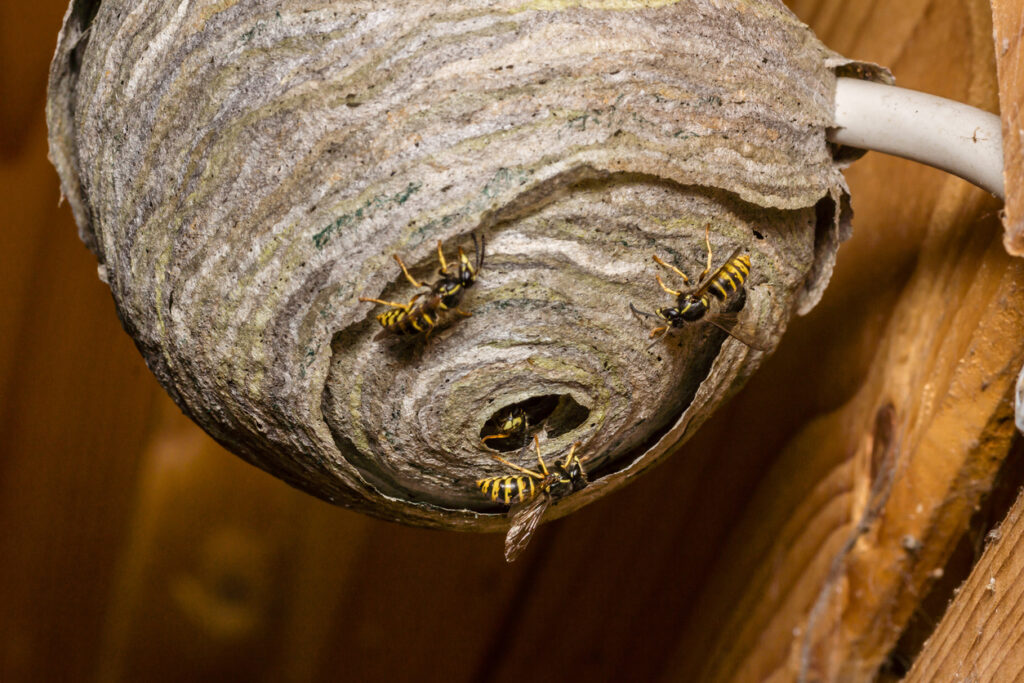
If you’ve ever stumbled across a papery-looking nest hanging in a tree or tucked into a shed, you might’ve wondered: was that a wasp nest or a hornet’s, and does it even matter? Actually, it does. While both wasps and hornets are part of the same insect family, their nests (and temperaments) are different enough to be worth recognising. Here’s how to tell them apart, and why you’ll definitely want to.
1. Hornet nests are usually rounder and fully enclosed.
Hornet nests tend to look like giant grey footballs hanging from trees, roof edges, or eaves. They’re fully enclosed except for a small entrance hole at the bottom. The outer shell is smooth and papery, with a layered, swirled appearance. If the nest looks neat, compact, and dome-shaped, and it’s way up high, there’s a good chance it’s a hornet nest. They’re tidy builders, and their nests look it.
2. Wasp nests are often open and umbrella-shaped.
Paper wasp nests look more like open umbrellas, with hexagonal cells visible from underneath. They’re usually attached to the underside of surfaces like eaves, porch ceilings, or beams. No outer shell, no hiding the structure. They also tend to be smaller and flatter. If you can see the cells clearly, and it’s not covered by an outer layer, you’re almost definitely looking at a wasp nest.
3. Hornets usually nest higher up.
Hornets prefer higher-up, less accessible areas. You’re more likely to spot their nests up in tree branches, at the peak of your roof, or tucked into attic spaces. That distance isn’t random; it’s part of their natural defence. The higher and more hidden, the harder it is for predators (or curious humans) to mess with them.
4. Wasps are more likely to nest where people are.
Paper wasps are opportunists. They’ll build their open nests just about anywhere sheltered: under furniture, inside outdoor light fixtures, or even on window frames. They’re not shy, and they don’t mind building close to humans. Which unfortunately means they’re more likely to make your patio or garden feel…tense.
5. Hornet nests are often larger.
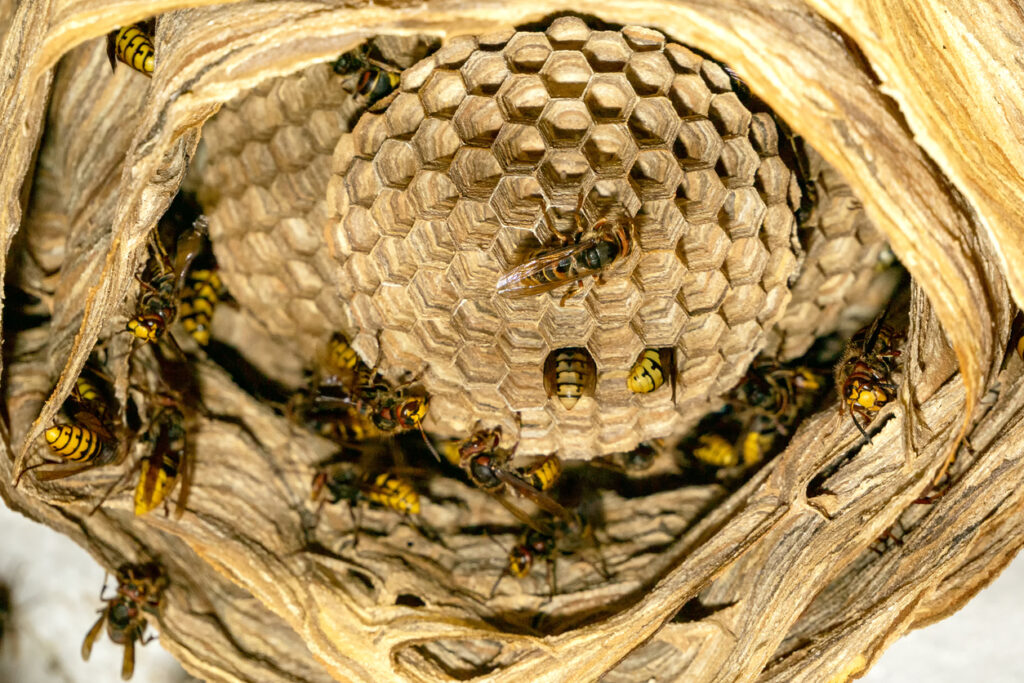
Hornet colonies can grow quite a bit bigger than paper wasp colonies, especially toward the end of summer. Their nests reflect that. In fact, some get as big as basketballs or larger, especially if left undisturbed. So, if the structure you’re seeing is large and sealed, and seems to be growing fast, you’re likely dealing with hornets rather than wasps.
6. Wasp nests tend to appear earlier in the season.
Paper wasps often get started in early spring, when the queens emerge and begin building their first little clusters of cells. So if you see a small open nest early in the season, it’s probably a paper wasp starting out. Hornets usually appear a little later and expand rapidly once summer kicks in. Their nests start smaller but grow faster and more aggressively once things warm up.
7. Hornets are more defensive of their nests.
Both wasps and hornets will protect their nests, but hornets are quicker to get aggressive if they think you’re a threat. Just getting too close can be enough to set them off. If you’re unsure what kind of nest it is, but the insects are flying out fast and seem ready to fight, it’s safer to assume hornets and keep your distance.
8. Wasp nests often look abandoned when they’re not.
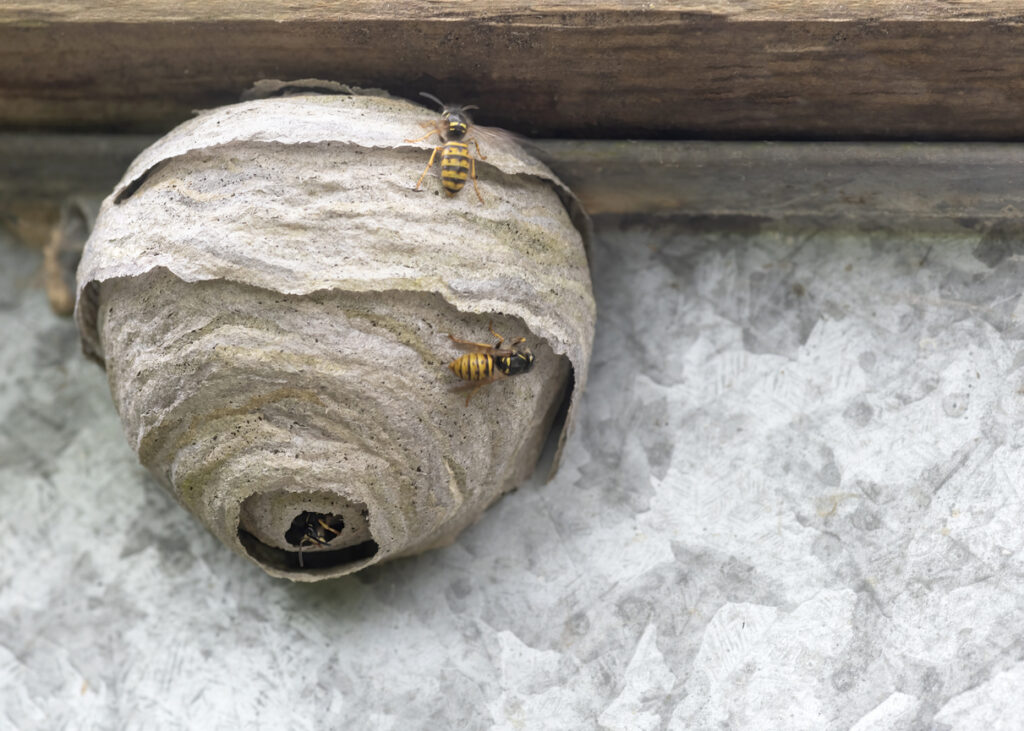
Because paper wasp nests are open, they can look empty when the wasps are off foraging, but don’t be fooled. They usually return in short cycles and won’t hesitate to defend if you start poking around. Even small wasp nests can be active, so unless you’ve seen zero activity for days and nights in a row, treat it as live and stay hands-off.
9. Hornets mostly work at dusk and dawn.
Hornets tend to be most active around twilight hours. That’s when you’re more likely to see them buzzing around the nest entrance or out collecting food and materials. Knowing this can help you avoid stumbling into their flight path, especially if you’re doing evening gardening or heading into a shed at dusk.
10. Both should be left alone, or handled professionally.
Whether it’s a hornet or wasp nest, disturbing it is risky. Even small nests can set off a defensive swarm, and multiple stings are no joke, especially if you have allergies or kids around. If a nest is near your home or where people regularly pass, it’s safest to call in pest control. Let someone experienced deal with it, no broom handles or DIY sprays needed.