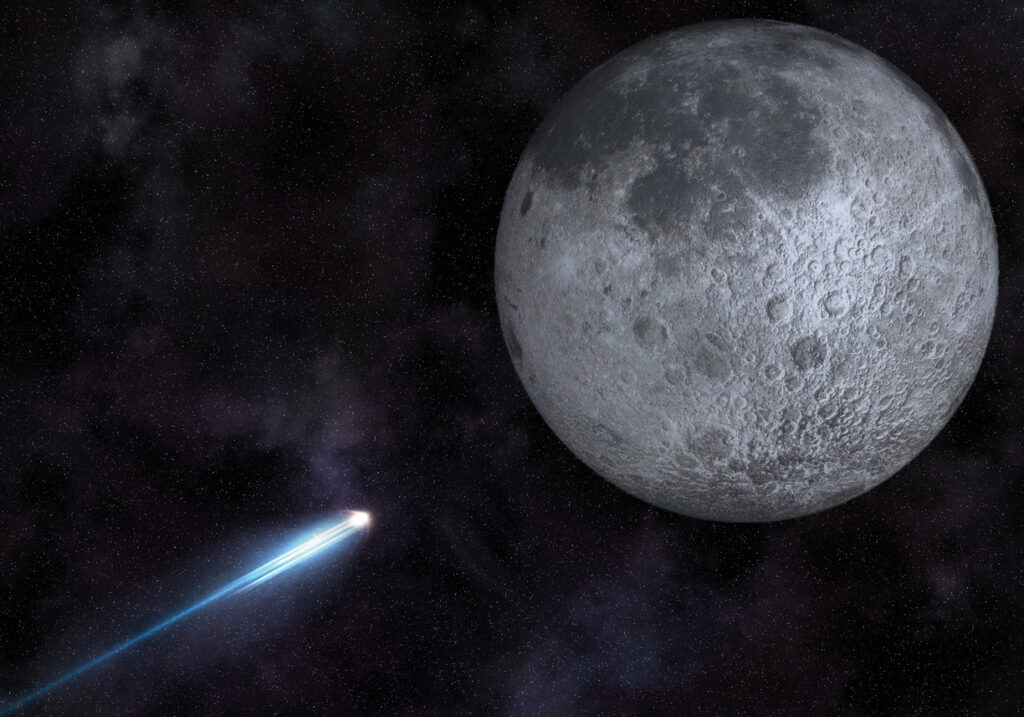
The Moon might seem like a distant nightlight we take for granted, but it plays a huge role in how Earth functions. So what happens if something massive, such as a huge asteroid, slams into it? The short answer: Earth would feel it, just not in the way Hollywood suggests. Here are 14 realistic things that could happen if a large asteroid collided with the Moon.
1. The Moon’s surface would be massively scarred.
The Moon’s been hit by objects before, of course. That’s why it’s covered in craters. However, if a truly massive asteroid hit, it could create a new crater big enough to be seen from Earth with the naked eye. Depending on the impact angle and size, it could even knock loose chunks of the Moon’s crust.
We’d likely see a visible mark or plume for days, possibly weeks. Telescopes worldwide would immediately be aimed at the Moon, and the event would dominate global headlines. For amateur skywatchers, it would be equal parts terrifying and awe-inspiring.
2. A shower of lunar debris could head toward Earth.
Depending on how forceful the impact is, bits of the Moon could be ejected into space. Some of those fragments might get pulled in by Earth’s gravity and fall through the atmosphere as meteorites. These would likely burn up, or if large enough, make it to the surface.
We’d see more shooting stars than usual, and in rare cases, a few pieces of the Moon might land here, giving scientists an unexpected batch of lunar samples. It wouldn’t be the end of the world, but it could make for a very strange week on Earth.
3. There could be temporary disruptions to satellite systems.
If the collision throws off enough debris, it could pose a threat to satellites, especially ones orbiting in the Moon’s vicinity or positioned for lunar observation. The sudden increase in space junk would be closely monitored by space agencies worldwide.
While the chance of widespread satellite failure is low, sensitive systems like GPS, satellite communications, and Earth-monitoring tech could experience brief interruptions, depending on how things unfold in orbit after the impact.

4. Tides could change, either temporarily or long-term.
The Moon plays a big role in Earth’s tides. A major asteroid impact likely wouldn’t knock the Moon out of orbit, but it could change its shape or slightly alter its mass distribution, which could have subtle effects on how tides behave on Earth.
This wouldn’t look like oceans suddenly rising overnight, but certain coastal areas might notice higher highs or lower lows over time. It’s the kind of thing that would show up more in charts than in dramatic waves—but it matters, especially to places already dealing with sea level issues.
5. Nights could become slightly darker, or even brighter.
If the impact kicked up enough dust, it could temporarily dim the Moon’s surface, making full moons appear darker for a while. On the other hand, if fresh material with higher reflectivity got exposed, it could also make the Moon look even brighter.
Either way, regular skywatchers and photographers would notice. It wouldn’t be a global catastrophe, but it would make for some eerie or oddly brilliant nights until the surface settled again.
6. The Moon might ring like a bell again.
When previous impacts (and even spacecraft crashes) have hit the Moon, its seismic activity has been weird. Apollo-era instruments once recorded the Moon “ringing” for hours. A massive asteroid strike could trigger even deeper seismic waves.
While we wouldn’t hear this from Earth, any seismometers on the Moon would record it. The data would be a goldmine for scientists trying to understand the Moon’s interior, and proof that even in silence, the Moon is far from lifeless.
7. There’d be massive international response from space agencies.
A lunar impact would be a global science event. NASA, ESA, China’s space agency, and private companies would all turn their attention to the Moon instantly. Missions might get redirected, and new lunar programs would launch faster than you can say “asteroid deflection.”
The collision would raise big questions about planetary defence, not just for Earth, but for future Moon missions. It would also spark new urgency around building lunar bases with proper shielding, just in case it happens again.
8. Earth’s rotation and axis wouldn’t budge, but it’s worth asking.
Unless the asteroid was truly colossal, the Moon’s gravitational effect on Earth wouldn’t change enough to alter our spin or tilt. However, this is always one of the first questions asked because those things are tied to seasons and day length. In short: no, your days wouldn’t suddenly get longer, and winter wouldn’t vanish. Earth is stable enough to handle the Moon taking a hit, though if the Moon were somehow shattered, that’d be a different story entirely.
9. Lunar missions could be delayed, or rushed.
If the impact site was near a planned Moon landing zone, missions could get postponed for safety reasons. On the flip side, if the impact exposed deep material or created new geological features, scientists might push to get there fast before conditions change.
It could also prompt entirely new missions aimed at studying the impact itself. The Moon would instantly become one of the most high-priority targets in space exploration all over again.
10. It could change how the Moon looks forever.
The Moon hasn’t had many major impacts in recent human history, so a fresh, giant crater would be a permanent new feature. Depending on where it hit, it might even slightly reshape the face of the Moon we’re used to seeing.
Something as visible as a new crater in the Sea of Tranquillity or near the Mare Imbrium would feel eerie at first, like the Moon’s been scarred in real time. Future generations would grow up seeing that change as just another part of the lunar landscape.

11. There’d be a flood of conspiracy theories.
Let’s be honest: no matter how clearly science explains what happened, there would be endless online speculation. Some would say it was a weapon test. Others would claim the Moon is hollow and this “proved it.” TikTok would be chaos for weeks. Meanwhile, actual astronomers and researchers would be working overtime to share real footage, data, and observations. But in the background, the internet would spiral with everything from alien theories to apocalyptic countdowns.
12. People would rush to observe it any way they could.
Telescopes would sell out. Camera lenses would go up in price. Backyard astronomers would be out every night trying to catch a glimpse of the aftermath. For many, it would be the first time they really looked at the Moon closely.
In a strange way, the event would bring people together. Stargazing apps would trend. Photos would flood social media. It might even spark a broader interest in space science, or at least give people something awe-inspiring to obsess over beyond Earth’s drama.
13. The Moon’s long-term stability would become a hot topic.
If the asteroid left a noticeable dent, people would start asking whether the Moon is safe, or if future impacts could do real harm. Scientists would be forced to talk publicly about probabilities, lunar vulnerabilities, and Earth’s own risk profile. Even if Earth wasn’t directly threatened, the incident would push the Moon into the spotlight. It would no longer feel like a fixed, reliable companion, but something a bit more fragile and reactive than we realised.
14. It would be a wake-up call about asteroid threats in general.
If something big enough to smash the Moon can sneak through space, it raises a bigger question: what’s stopping the next one from aiming at us? The Moon taking the hit might feel like a lucky miss, but it wouldn’t go unnoticed by people in charge of planetary defence programs.
We’d likely see renewed interest in asteroid tracking, deflection tech, and emergency preparedness, not in a panic-driven way, but with a bit more urgency. Sometimes it takes a big cosmic thud to remind us we’re not the only ones out here.