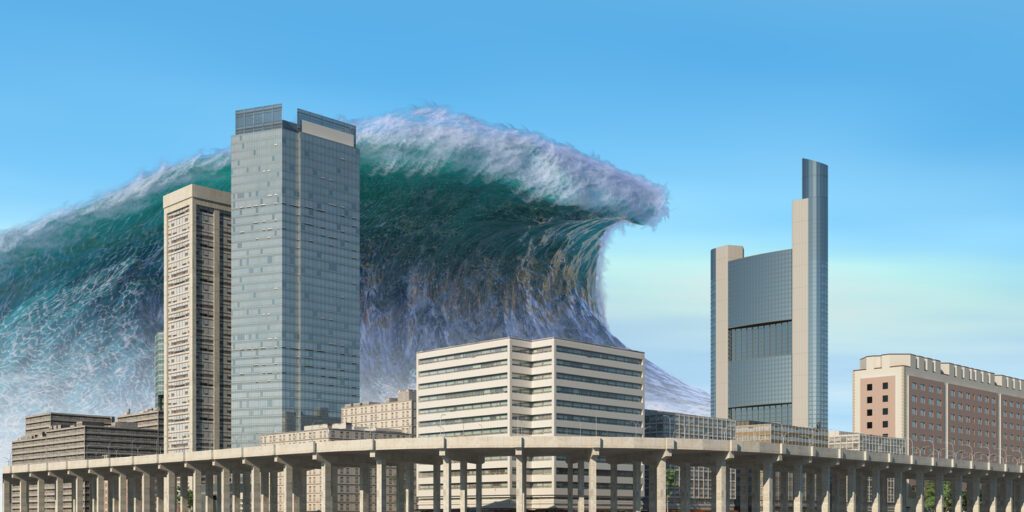
A megatsunami hitting the UK sounds like something pulled from a disaster film, but it isn’t pure fantasy. While it’s unlikely in everyday terms, there are real, documented scenarios scientists keep an eye on because the physics behind them is sound. A megatsunami isn’t caused by storms or distant earthquakes in the way normal tsunamis are. It comes from sudden, violent displacement of massive amounts of water close to shore. These are the scenarios that could realistically trigger something on that scale in or near British waters.
1. A major underwater landslide off the Norwegian continental shelf
The seabed off Norway has a long history of instability, shaped by glaciers and layers of loose sediment left behind after the last ice age. If a huge section of this sediment were to collapse suddenly, it would push an enormous volume of water outward in all directions. Because the North Sea is relatively shallow, that energy wouldn’t dissipate quickly.
This kind of event has happened before in prehistoric times, and evidence shows it sent large waves across what is now the UK coastline. In a modern context, the concern isn’t just the wave height, but how fast it would arrive. Coastal communities around eastern Scotland and northern England would have very little warning, making this one of the most closely watched natural risks in northern Europe.
2. Collapse of a volcanic flank in the North Atlantic
Large volcanic islands can fail not through eruptions, but through sudden structural collapse. When a massive section of an island’s side gives way and slides into the sea, it displaces water violently. This is one of the few known natural mechanisms capable of creating waves hundreds of metres high near the source.
While the UK is far from active volcanoes, waves generated by such collapses can travel vast distances with surprising strength. By the time they reach Britain, they would be lower than near the source, but still potentially devastating. The risk is low, but the physics behind it is well understood, which is why it remains on scientific radar.
3. A large asteroid impact in the Atlantic Ocean
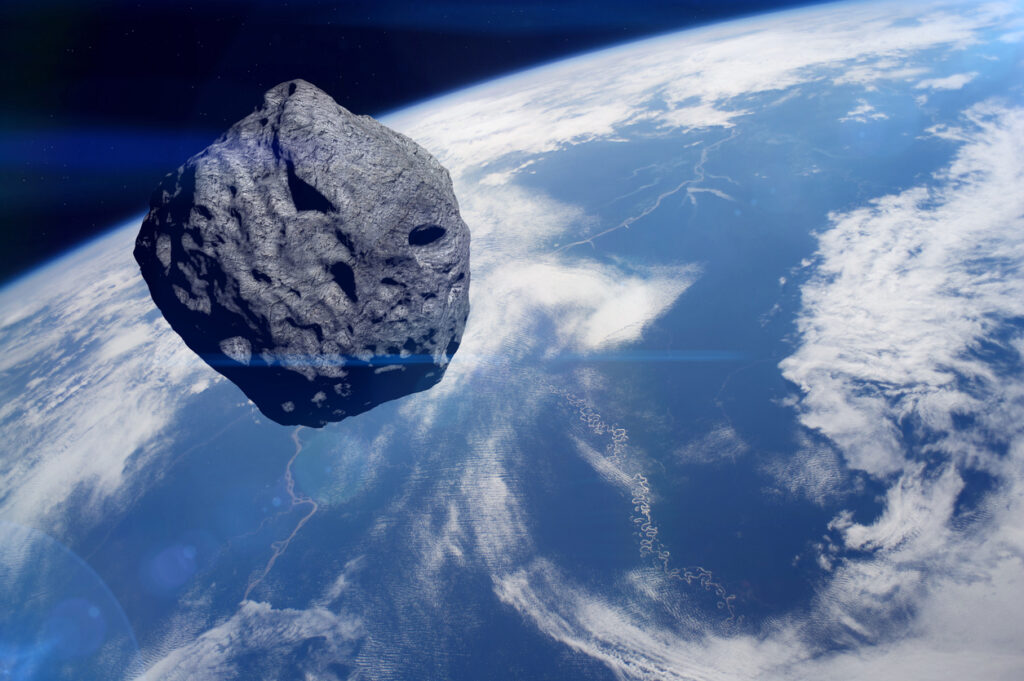
An asteroid striking the ocean would instantly vaporise water at the impact site and send shockwaves through the sea. The resulting displacement could generate waves far larger than those produced by earthquakes. Unlike typical tsunamis, these waves would be steep, fast, and chaotic.
If such an impact occurred in the North Atlantic, the UK could be directly affected, depending on distance and angle. While the odds are extremely small, space agencies track near-Earth objects precisely because the consequences of impact are so extreme. This is a low-probability, high-impact scenario that sits firmly in the category of rare but real.
4. A massive submarine landslide triggered by an earthquake
The UK isn’t known for strong earthquakes, but distant seismic activity can still destabilise underwater slopes. A quake elsewhere in the North Atlantic could act as the trigger rather than the main cause, shaking loose millions of tonnes of sediment.
The danger comes from the suddenness of the movement. Water has no time to adjust gradually, so it surges upward and outward. Even if the quake itself caused no damage on land, the secondary effect could create waves capable of flooding low-lying coastal areas with little warning.
5. Sudden collapse of methane hydrate deposits
Methane hydrates are ice-like structures that trap gas beneath the seabed. They remain stable under specific pressure and temperature conditions. If those conditions change rapidly, the hydrates can break down, releasing gas and destabilising sediment.
A large-scale collapse could cause sections of the seabed to fail almost instantly. While this is still being studied, scientists know that hydrate breakdown has contributed to ancient underwater landslides. If a collapse happened close enough to the UK, the resulting water displacement could generate a powerful tsunami.
6. Failure of a natural submarine cliff near the continental slope
The edges of continental shelves often feature steep underwater cliffs formed over millions of years. These structures can look solid but may be weakened by erosion, pressure, and internal fractures.
If a large section were to give way all at once, the falling mass would act like a giant underwater avalanche. The water above it would be forced upward violently, creating a wave that radiates outward. The closer such a collapse occurred to the UK, the more dangerous the outcome would be.
7. Sudden ice-related collapse linked to polar instability
Rapid melting in polar regions doesn’t just raise sea levels gradually. In some cases, it can destabilise massive ice structures or the seabed beneath them. When large volumes of ice or sediment move suddenly, they can generate strong waves.
While the UK is far from polar ice, the connected nature of ocean systems means effects can travel. A large collapse event in the North Atlantic connected to polar instability could still send energy toward British shores, especially along exposed coastlines.
8. Chain-reaction seabed failure triggered by industrial activity
Human activity on the seabed, such as drilling, deep-sea mining, or large-scale construction, alters pressure and structure beneath the ocean floor. While tightly regulated, there is concern that activity in unstable regions could contribute to failure.
This wouldn’t mean a single drill causing a tsunami, but rather activity acting as a trigger in an already unstable environment. If a large landslide were initiated near the UK’s continental shelf, the resulting waves could be significant, particularly in enclosed seas.
9. Collapse of an ancient submerged sediment fan

Over thousands of years, rivers deposit vast amounts of sediment into the ocean, forming underwater fans. These structures can become enormous and unstable, especially if built on sloping seabeds.
If one of these fans were to fail suddenly, it could release a massive underwater flow. The resulting displacement of water could create waves capable of travelling long distances. Some of these sediment structures lie within reach of the UK’s coastal waters.
10. A rare combination of multiple triggering events
The most dangerous scenario may not be a single dramatic cause, but several smaller ones aligning. A modest earthquake, combined with weakened sediment, changing ocean temperatures, and existing seabed instability, could collectively trigger a major collapse.
This kind of compound event is harder to predict and easier to underestimate. It’s also the reason scientists model worst-case scenarios rather than isolated events. While unlikely, it represents how natural systems sometimes fail not through one huge cause, but through accumulated stress reaching a breaking point.
Megatsunamis are rare, but rarity doesn’t mean impossibility. The UK’s position near complex seabed structures and enclosed seas means certain scenarios deserve serious attention, not panic, but awareness. Understanding these risks isn’t about fear. It’s about recognising how powerful and unpredictable the planet can be when conditions line up just right.