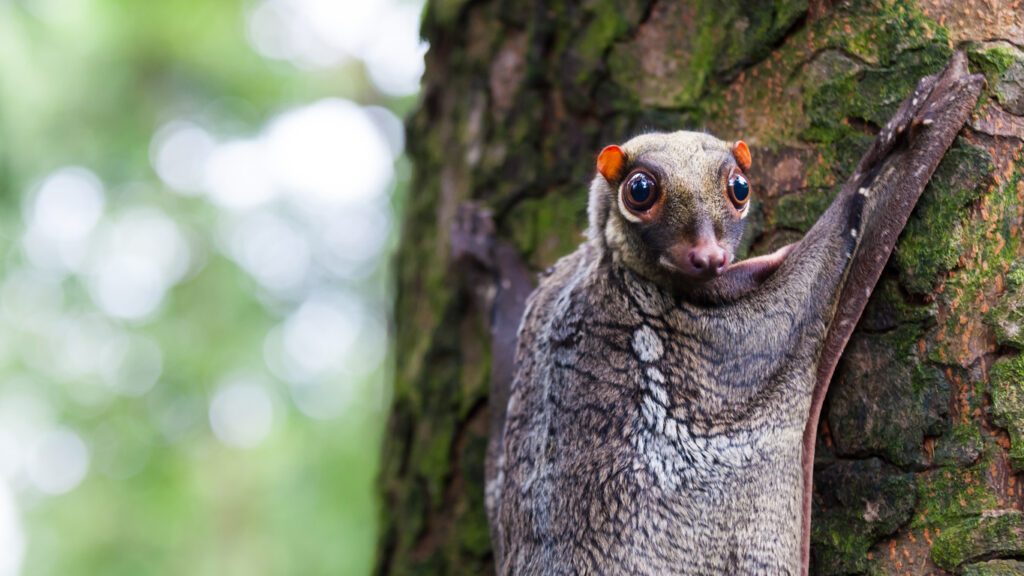
The colugo is often nicknamed a “flying lemur,” but that name couldn’t be more misleading. These unusual mammals don’t fly, and they’re not lemurs, either. What they do excel at is gliding, and they’ve evolved one of the most impressive gliding systems in the natural world.
Hidden away in the forests of Southeast Asia, colugos remain unfamiliar to most people, but they’re among the most fascinating creatures alive today. If you’ve never seen one in person, you’re not alone—their secretive lifestyle makes encounters rare. Still, learning about them reveals an animal unlike anything else.
It’s not actually a lemur.
Despite the common nickname, colugos have nothing to do with lemurs. Lemurs are primates, living exclusively on the island of Madagascar, while colugos live thousands of miles away across Southeast Asia. The term “flying lemur” came from early naturalists who tried to make sense of what they were seeing, and the name simply stuck.
In truth, colugos sit in their own order of mammals, called Dermoptera, which has just two living species: the Sunda colugo and the Philippine colugo. Genetic research shows they are more closely related to primates than most other mammals, but they branched off millions of years ago, creating a lineage all their own.
It can’t actually fly, but it glides brilliantly.
Colugos don’t flap wings like birds or bats. Instead, they glide using a skin membrane that stretches across nearly their entire body, from the neck down to the fingers, toes, and tail. This makes them look like a living blanket when they leap from tree to tree. Their glides can cover distances of more than 100 metres, often with little loss of height.
Having that ability allows them to move efficiently through the forest without having to climb down to the ground, where predators such as snakes, civets, and wild cats are waiting. For an animal that looks so awkward when clinging to a tree, their mastery of the air is nothing short of remarkable.
They live their lives in the trees.
Colugos are almost entirely arboreal, meaning they spend nearly every moment up in the forest canopy. Descending to the ground is extremely rare, and when they do, they move clumsily, making them vulnerable. Their long, sharp claws help them grip onto tree trunks, and their flat bodies keep them pressed close against bark, where they blend in with the mottled patterns of the forest.
Their tree-bound lifestyle has shaped nearly every aspect of their biology—from their specialised gliding membranes to their feeding habits.
Their babies cling on tightly.

Female colugos give birth to one young at a time, and unlike many mammals, the newborn arrives very underdeveloped. In many ways, their reproduction is more similar to marsupials than other placental mammals. The mother’s loose folds of skin form a kind of pouch around her belly, protecting the tiny infant as it clings to her fur.
For months, the baby rides everywhere with its mother, relying on her protection until it is strong enough to start gliding on its own. This unusual system is a reminder of how distinct colugos are, sitting at a curious crossroads of mammalian evolution.
They’re masters of the night.
Colugos are nocturnal, preferring to glide between trees under the cover of darkness. Their huge, forward-facing eyes are adapted for excellent night vision, helping them see both potential food and safe landing spots in the forest. Being active at night helps reduce competition with animals that forage during the day, and it provides some protection from predators that rely on daylight hunting.
To watch a colugo launch silently into the night, sailing through the canopy with precision, is to see an animal perfectly tuned to its environment.
Their diet is almost entirely leaves.
For all their acrobatics, colugos eat a surprisingly plain diet. They feed mainly on leaves, shoots, and flowers, nibbling slowly for hours each night. Leaves aren’t particularly nutritious, so their digestive systems are highly adapted to process large amounts of fibrous plant material.
Special gut microbes help break down tough cellulose, and their slow, deliberate lifestyle conserves energy. It might seem improbable that such a limited diet could support an animal capable of gliding such long distances, but colugos show that efficiency, rather than speed, can be a winning survival strategy.
They have enormous gliding membranes.
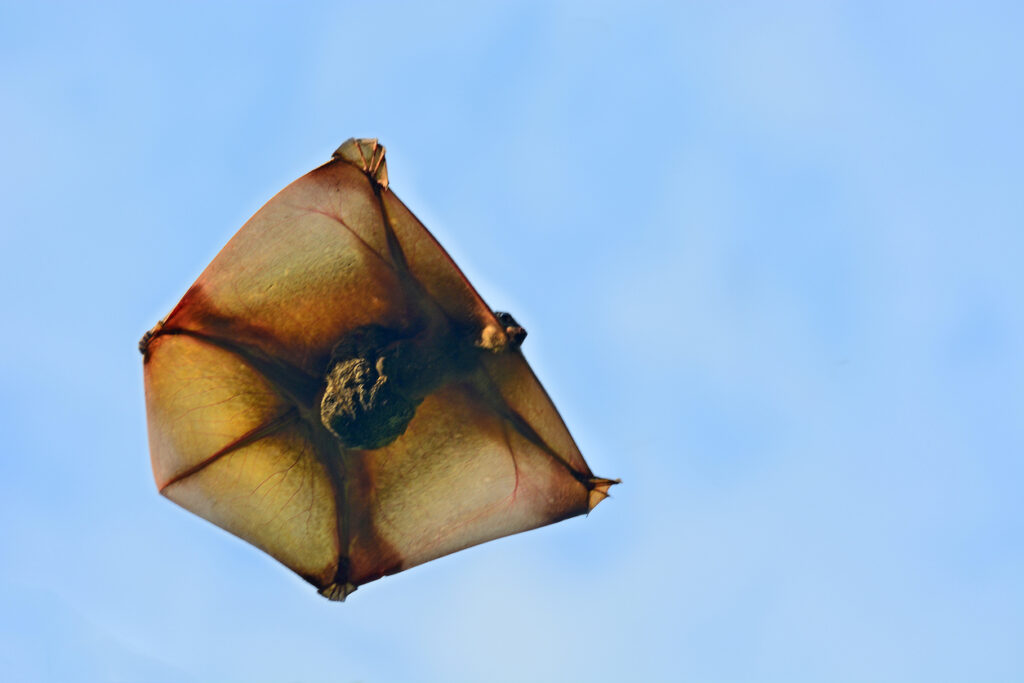
The colugo’s skin membrane, known as a patagium, is the most extensive gliding structure of any mammal. Unlike flying squirrels, whose membranes stretch only between their limbs, a colugo’s patagium extends between nearly every digit, including fingers, toes, and even the tail. This makes them unrivalled gliders, able to control their descent with incredible precision.
Scientists studying them have found that their glide ratios are among the best in the mammal world, allowing them to travel far while losing minimal height.
They inspire research into flight technology.
The aerodynamic efficiency of colugos hasn’t gone unnoticed. Engineers and biologists have studied their gliding mechanics to learn more about aerodynamics and energy-efficient flight. Their membranes act like natural wingsuits that are far more advanced than the human versions used in extreme sports.
Insights from colugos could influence the design of parachutes, drones, or other gliding technologies, showing that even obscure animals can have an unexpected role in human innovation.
They’re rare to see in the wild.
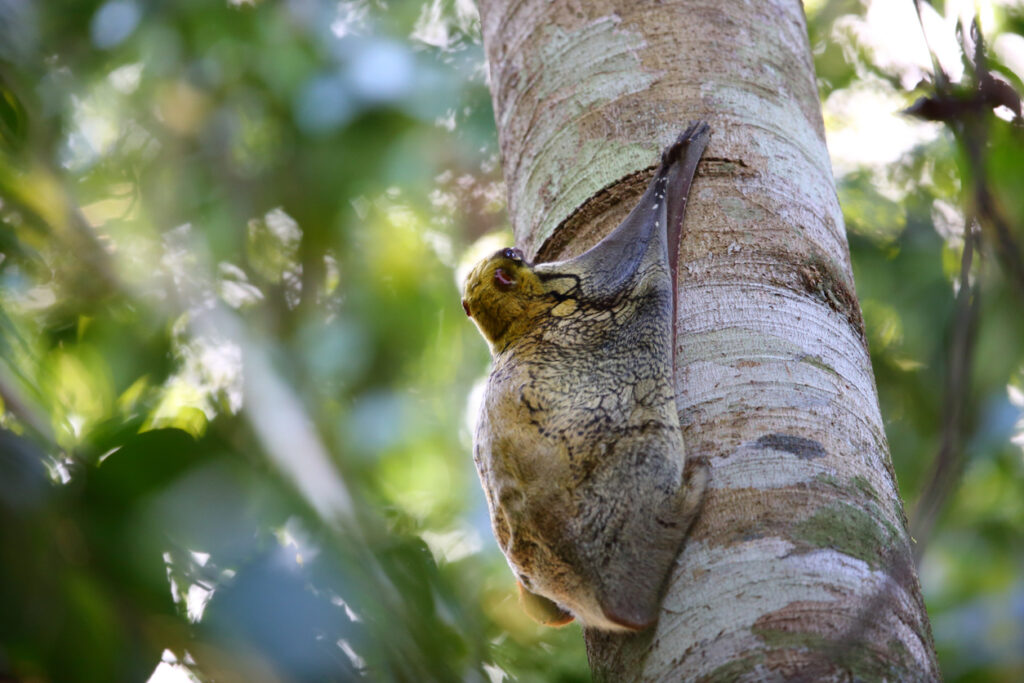
Even in forests where colugos are relatively common, they’re still a challenge to find. Their fur is mottled grey-brown, which blends seamlessly into tree bark and dappled leaves. They spend the day pressed flat against trunks, remaining motionless, which makes them nearly invisible.
Night is when they emerge, but even then, their silent glides make them ghost-like figures in the canopy. Many travellers and even local people can live near colugo habitats without ever noticing one. When sightings do happen, it’s usually a fleeting glimpse as one soars silently across the forest.
Their survival depends on forests.
Like many forest-dependent animals, colugos are under threat from deforestation. They need large, continuous stretches of trees to glide effectively, and when forests are cleared or broken up, their movement becomes restricted. Habitat loss in countries such as Malaysia, the Philippines, and Thailand puts pressure on their survival.
While they’re not as widely known as tigers or orangutans, they play an important role in the ecosystems they inhabit. Protecting Southeast Asia’s forests doesn’t just preserve iconic species. It also safeguards unique and little-understood creatures like the colugo.