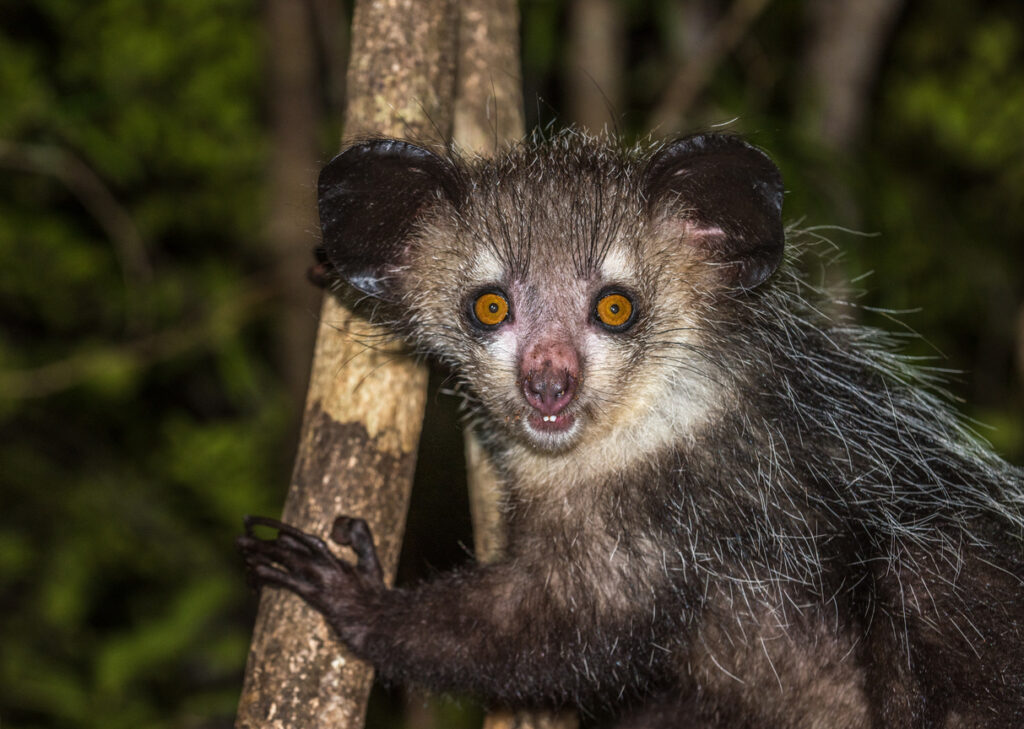
The aye-aye looks like someone took a bat, a rat, and a gremlin and stuck them in a blender, then gave the result one incredibly long middle finger that it uses like a Swiss Army knife. This bizarre creature is so weird-looking that local legends claim it’s a harbinger of death, but it’s actually just Madagascar’s strangest success story in evolutionary problem-solving.
That skeletal finger is basically a built-in tool kit.
The aye-aye’s middle finger grows up to three times longer than its other fingers and stays incredibly thin, allowing it to tap on tree bark to locate hollow spaces where insects are hiding. It then uses the same finger to fish out grubs, like using a biological fishing rod.
Its finger is so specialised that it has its own ball-and-socket joint for maximum flexibility, plus it never stops growing throughout the animal’s life. If the finger gets damaged, it can regenerate, which is pretty impressive for a mammal.
They use echolocation like bats but with their fingers instead of sound.
Aye-ayes tap tree bark with that freaky finger and listen for the hollow sounds that indicate insect tunnels underneath. Their hearing is so sensitive, they can detect tiny differences in sound that reveal exactly where grubs are hiding and how big the tunnels are.
That percussive foraging technique is unique among primates and makes them incredibly efficient hunters. They can find food sources that other animals miss completely because they’re essentially x-raying trees with sound.
Their teeth never stop growing and self-sharpen.

Unlike most mammals, aye-ayes have continuously growing incisors like rodents, which allow them to gnaw through tough tree bark to get to insects and larvae underneath. These teeth wear against each other to maintain sharp edges for their entire lives.
The combination of ever-growing teeth and that specialised finger makes them perfectly equipped for their ecological niche. They’re basically living power drills that can find and extract insects from seemingly solid wood.
They’re nocturnal and build elaborate tree nests.
Aye-ayes spend their days sleeping in spherical nests made from leaves and branches, built high up in tree forks, where they’re safe from predators. Each individual builds multiple nests throughout their territory and rotates between them.
These nests are sophisticated structures with waterproof roofs and comfortable interiors lined with soft materials. Building multiple nests means they’re never far from shelter and can confuse predators who might be tracking their movements.
Local superstitions nearly drove them extinct.
Many Malagasy people believe aye-ayes are omens of bad luck or death, and seeing one means someone in the village will die soon. This superstition led to aye-ayes being killed on sight, which devastated their already small population numbers.
The curse belief is so strong that some people won’t even say the animal’s name out loud. Conservation efforts have to work around these cultural beliefs, which makes protecting aye-ayes more complicated than just habitat preservation.
They’re surprisingly large for lemurs.
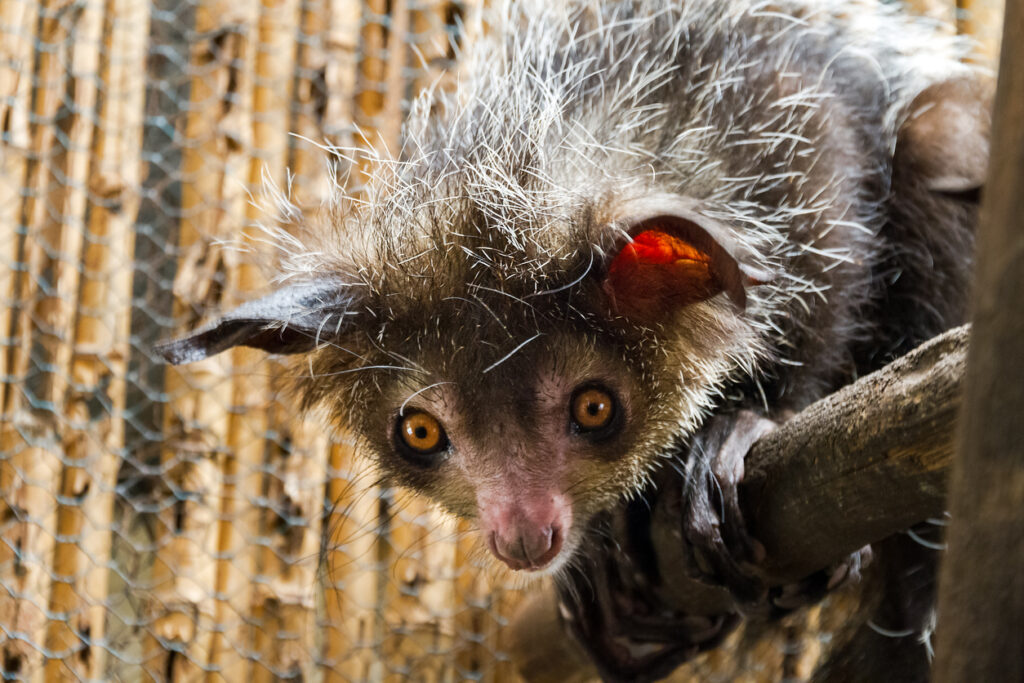
Aye-ayes are about the size of house cats, weighing up to 6 pounds (2.72 kg), which makes them one of the larger lemur species. Their size combined with their nocturnal habits and weird appearance often startles people who encounter them unexpectedly.
Despite their substantial size, they’re incredibly agile climbers who can navigate through trees with remarkable grace. Their long fingers and toes give them excellent grip on branches, even when moving quickly through the canopy.
Each aye-aye needs a massive territory to survive.
Individual aye-ayes require territories of up to 80 acres because their specialised diet means food sources are scattered and not very dense. They spend most of their nights travelling between feeding sites across these large ranges.
Their huge territorial requirement makes them particularly vulnerable to habitat fragmentation. Small forest patches can’t support aye-aye populations because they simply don’t contain enough suitable feeding areas.
Their weird appearance serves specific survival purposes.
Every strange feature of the aye-aye serves a function. The bat-like ears provide exceptional hearing for locating insects, the bushy tail helps with balance during tree climbing, and even their scraggly coat provides camouflage in the forest.
What looks like a random collection of weird features is actually a perfectly integrated tool kit for nocturnal insect hunting. Evolution doesn’t care about pretty – it cares about what works, and everything about aye-ayes works for their lifestyle.
They’re primarily insectivores, but occasionally raid coconuts.

While insects make up most of their diet, aye-ayes will use their specialised finger to extract coconut milk and meat from coconuts, and they’ll also eat nuts, fruits, and bird eggs when available. Their tool-like finger makes them more versatile feeders than other lemurs.
Their dietary flexibility probably helped them survive when other specialised lemurs became extinct. Being able to exploit multiple food sources means they’re less vulnerable to environmental changes that might eliminate any single food type.
Scientists originally thought they were giant squirrels.
When European naturalists first described aye-ayes in the 1700s, they classified them as rodents because of their continuously growing teeth and general appearance. It took decades to figure out they were actually primates, making them one of the most misunderstood animals in scientific history.
That classification confusion reflects just how unusual aye-ayes are. They don’t fit neatly into expected categories and represent a completely unique evolutionary solution to survival challenges in Madagascar’s forests.
There are probably fewer than 2,500 left in the wild.

Habitat destruction combined with persecution due to superstitions has reduced aye-aye populations to critically low levels. They’re now found only in scattered forest fragments, and some populations are so isolated they have little chance of long-term survival.
Conservation programs are working to protect remaining forest habitat and educate local communities about the ecological importance of aye-ayes. Some areas have had success changing local attitudes by emphasising this creature’s role in controlling insect pests.
They might be Madagascar’s most important ecosystem engineers.
Aye-ayes control insect populations that would otherwise damage trees, and their feeding activities help distribute seeds and nutrients throughout the forest. Their ecological role is probably much more important than their small population numbers would suggest.
Losing aye-ayes could have cascading effects on Madagascar’s already fragile forest ecosystems. They’re a keystone species whose weird appearance hides their critical importance to the health of their entire habitat.