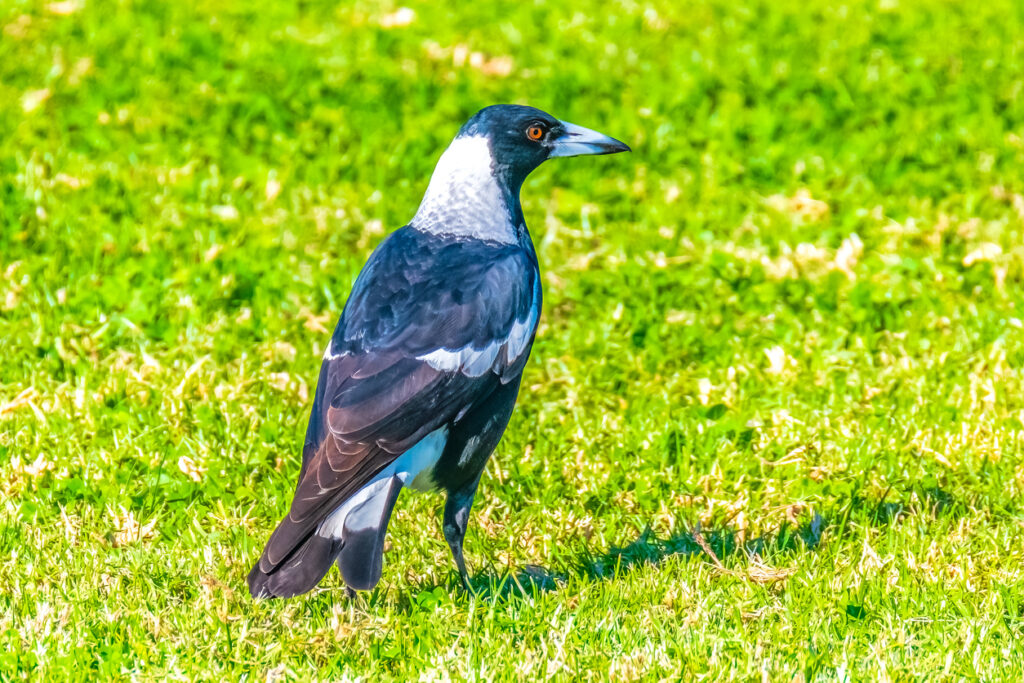
Both magpies and crows belong to the corvid family, a group renowned for exceptional intelligence that rivals primates in many cognitive tasks. These black-and-white or all-black birds demonstrate problem-solving abilities, social learning and memory that seem remarkably advanced for creatures with brains the size of walnuts. Determining which species is actually smarter requires looking at specific cognitive abilities rather than making sweeping generalisations about avian intelligence.
Crows excel at tool use and creation.
New Caledonian crows have demonstrated the ability to not just use tools but actually manufacture them for specific tasks, something previously thought unique to humans and great apes. They fashion hooks from twigs to extract insects from tree bark, and can even create multipart tools that work in sequence to solve problems. British carrion crows don’t show quite the same level of tool sophistication as their New Caledonian cousins, but they’ve been observed using tools in various contexts. Magpies can use tools when trained in captivity, but they don’t demonstrate the same spontaneous tool creation and use in the wild that crows do.
Magpies pass the mirror test
Magpies are one of only a handful of non-mammal species that pass the mirror self-recognition test, which involves recognising that a reflection is themselves rather than another bird. When researchers placed coloured marks on magpies’ bodies that they could only see in a mirror, the birds tried to remove the marks from their own bodies rather than pecking at the reflection. This suggests magpies possess self-awareness, a cognitive ability that’s considered fairly advanced. Crows haven’t consistently passed this test, though some researchers question whether the mirror test is the best measure of self-awareness for birds who rely more on other senses.
Crows remember human faces for years.
@thecorvidcorner My flock always recognises me when I visit – I have moved almost one year ago, so I can only see them once a month. But every time I step foot into that park, it is like I have never left. ❤️ #crows #memory #corvidbehaviour #corvidlove #corvidae #carrioncrows #crowtok #befriendthecrows #abondlikenoother ♬ The Ludlows – From Legends Of The Fall – André Rieu & Johann Strauss Orchestra
Research has shown that crows can recognise and remember individual human faces for at least five years, and they pass this information to other crows who’ve never encountered the person before. When researchers wearing masks captured and tagged crows, the birds remembered those specific masks years later and would scold and mob anyone wearing them. Magpies also recognise individual humans, particularly those who’ve threatened their nests, but we don’t have evidence they maintain these memories quite as long or share information as systematically.
Both species understand water displacement.
In experiments based on Aesop’s fable, both crows and magpies demonstrated they understand water displacement. When presented with a tube of water with a floating reward just out of reach, both species figured out they could drop stones into the water to raise the level and obtain the food. They chose heavier objects over lighter ones and solid objects over hollow ones.
This suggests both birds grasp cause-and-effect relationships and can reason about hidden properties of materials. Neither species has a clear advantage here, indicating they’ve evolved similar cognitive abilities for understanding physical properties.
Crows plan for the future.
Studies have shown that crows can plan ahead by saving tools they’ll need later or caching food in locations they know they’ll visit in the future. They demonstrated this by choosing to keep a tool that would help them get food later rather than taking an immediate smaller reward, something that requires abstract thinking about future scenarios. Magpies also cache food and can remember where they’ve hidden items, but we have less evidence they plan as far ahead or make trade-offs between immediate and delayed gratification.
Magpies have complex social hierarchies.
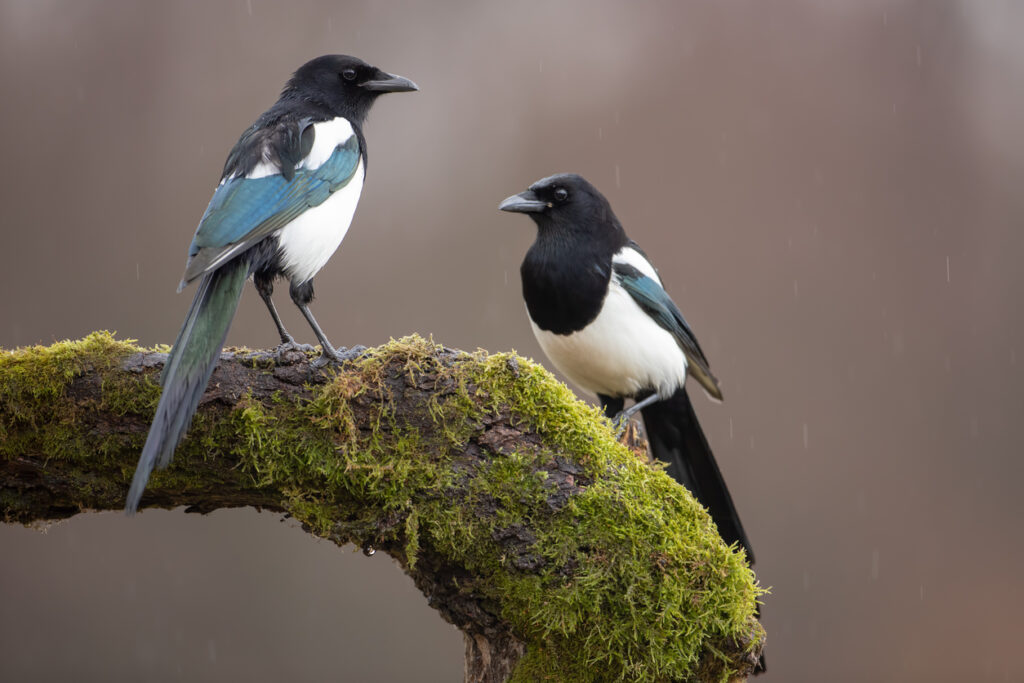
Magpies live in sophisticated social groups with established territories and dominance hierarchies that they navigate through individual recognition and memory. They maintain long-term pair bonds and cooperate in raising young, with older offspring sometimes helping parents raise the next generation.
Crows also live in social groups and show similar cooperative breeding, so neither species has an obvious advantage in social complexity. Both birds need to track relationships, remember past interactions and predict how others will behave, which requires substantial cognitive resources.
Crows understand analogies and abstractions.
Recent research showed that crows can solve problems requiring analogical reasoning, matching relationships between objects rather than just the objects themselves. When shown a pair of identical objects and asked to choose which of two test pairs matched that relationship, crows could identify “same” versus “different” as concepts independent of specific items.
That abstract relational thinking was thought to be uniquely human. We don’t have comparable studies testing whether magpies can perform the same abstraction tasks, so it’s unclear if this represents a true difference or just a gap in research.
Both species hold grudges and seek revenge.
Crows famously remember people who’ve wronged them and will gather other crows to mob and harass those individuals, sometimes for years. Magpies show similar behaviour, particularly during nesting season, when they’ll aggressively swoop people who’ve come too close to their nests in previous years. It’s clear that both species have episodic memory for specific events and can connect those memories to individuals, then use that information to guide future behaviour. Neither bird forgives easily, suggesting their memory systems prioritise threat information.
Crows understand traffic patterns.

Urban crows in Japan have been observed placing walnuts in front of stopped cars at traffic lights, then waiting for the lights to change, so cars will drive over and crack the shells. They retrieve the nuts during the next red light when traffic stops, showing they understand the predictable pattern of traffic signals.
This demonstrates remarkable observational learning and the ability to use human infrastructure as a tool without any direct teaching. While magpies are also urban-adapted birds, we don’t have documented examples of them using traffic patterns in this sophisticated way.
Both species can be deceptive.
Crows and magpies both engage in tactical deception, particularly around food caching. They’ll pretend to cache food in one spot while actually hiding it elsewhere if they know another bird is watching, suggesting they understand what others can see and know. It requires theory of mind, the ability to attribute mental states to others and recognise that others’ knowledge differs from their own. Both species demonstrate similar levels of this social cognition, indicating that living in groups where competition over resources is common drove the evolution of deceptive abilities.
Crows have larger relative brain sizes.
Crows have a larger brain-to-body size ratio than magpies, and their nidopallium, the avian equivalent of the mammalian cerebral cortex, is particularly well-developed. Brain size isn’t everything when it comes to intelligence, but the density of neurons and the structure of corvid brains allows for complex information processing despite their small absolute size. The anatomical difference might explain why crows show slightly more sophisticated problem-solving in some experimental contexts.
Magpies adapt songs and learn vocal patterns.
@feather_hearts_ I think these beautiful birds are the best songbirds 🪶🖤🪶 #magpie #magpies #feather_hearts #australianmagpie #birdwatching #magpiesong #warble #birdwatching #magpiesrule #birdsoftiktok #magpiesoftiktok #australia #maggie #happiness ♬ original sound – Bec Styles
Magpies have more varied and complex vocalisations than crows, with regional dialects and the ability to mimic other birds and even some human sounds. Their vocal learning demonstrates neural plasticity and the ability to modify behaviour based on social learning rather than just instinct.
Crows also have varied calls and can learn to recognise specific vocalisations, but their vocal repertoire isn’t quite as elaborate as the magpie’s. Vocal learning correlates with cognitive flexibility because it requires the brain to create and modify complex motor patterns based on auditory input.
The answer depends on the test.
Declaring one species definitively smarter oversimplifies the reality that intelligence comprises multiple distinct abilities, where different species excel. Crows show advantages in tool use, future planning and possibly abstract reasoning, while magpies demonstrate self-recognition and elaborate vocal learning. Both species excel at social cognition, memory, problem-solving and adapting to human environments.
Rather than crowning one species as “smarter,” it’s more useful to recognise that corvids as a family represent one of evolution’s most successful experiments in creating sophisticated cognition, with both crows and magpies demonstrating just how much intelligence can emerge from remarkably small brains.