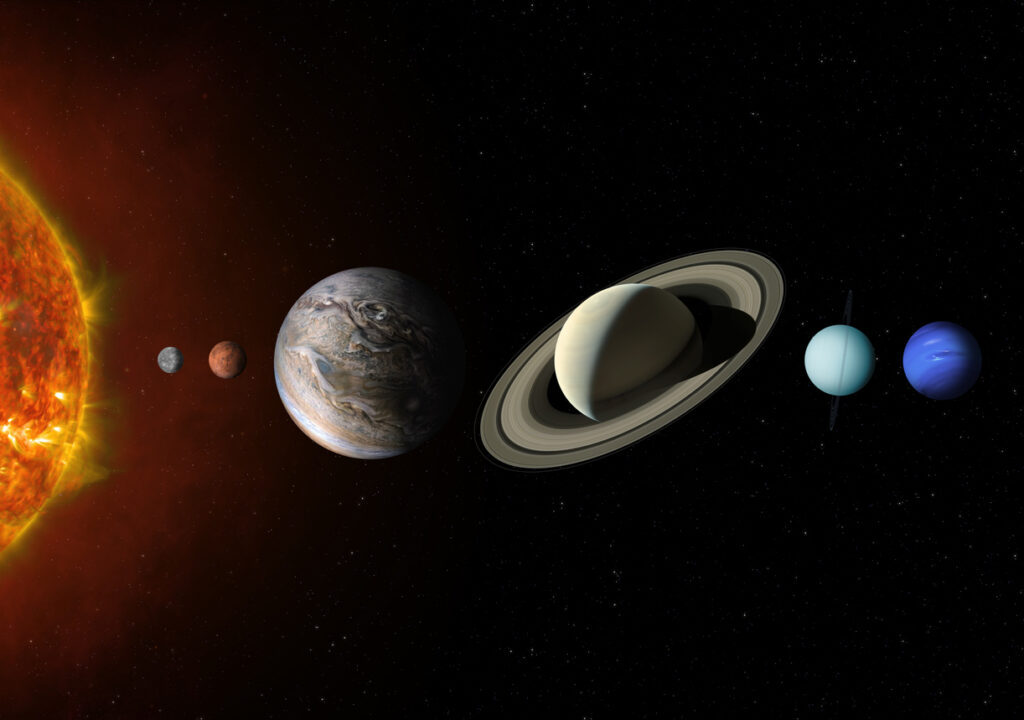
Whether you’ve heard it mentioned in a film, a horoscope, or a late-night conversation about the universe, the idea of all the planets lining up in a perfect row captures people’s imagination like almost nothing else in astronomy. The reality is a bit more complicated than the movies suggest, and quite a bit more interesting.
What people mean when they talk about planetary alignment
When most people picture planets aligning, they imagine a perfectly straight line stretching out from the sun with every planet sitting neatly on it. That’s not actually what astronomers mean when they use the term, and it’s also not something that happens in any strict geometric sense.
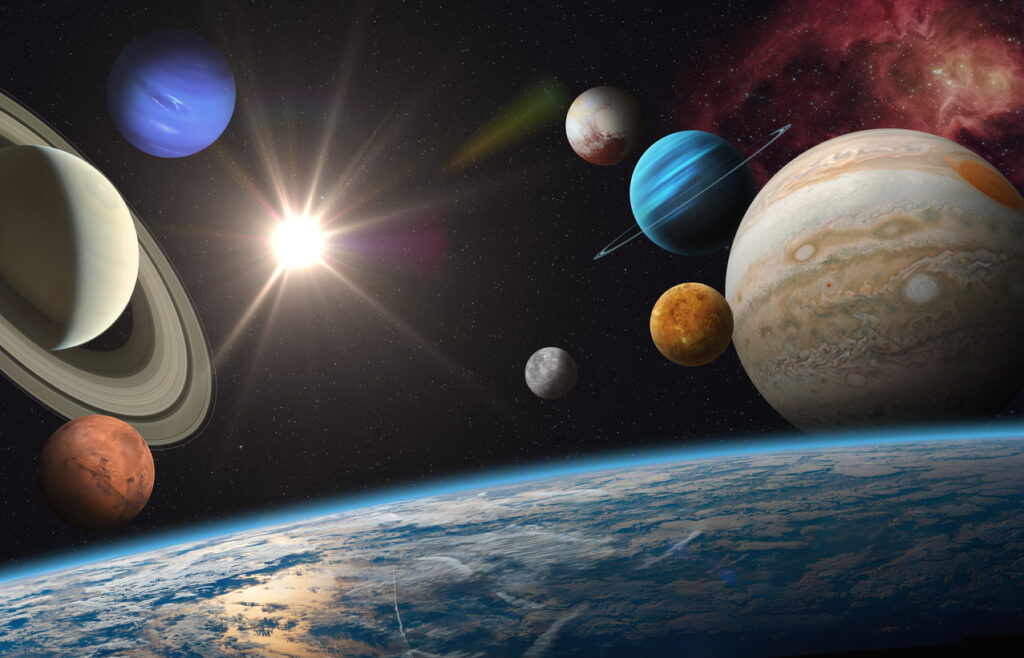
What does happen, and fairly regularly compared to what people assume, is that several planets appear close together in the same region of the sky when viewed from Earth. That’s what astronomers call a conjunction, and it’s genuinely visible to the naked eye on the right night.
Why a perfect straight line is essentially impossible
The planets all orbit the sun in roughly the same flat plane, called the ecliptic, but they orbit at different speeds, different distances, and on paths that are slightly tilted relative to each other. For all eight planets to form a truly straight line at the same moment, every one of them would need to reach the same angular position simultaneously.
Given the different lengths of each planet’s year, ranging from Mercury’s 88 days to Neptune’s 165 Earth years, the maths simply doesn’t work out in a way that produces a genuine straight line. Computer models suggest a perfect geometric alignment of all eight planets has never happened in recorded history and isn’t expected to happen anytime soon.
What actually happens instead
Rather than a straight line, what occurs is that planets occasionally cluster within a relatively narrow band of sky. Astronomers consider planets to be aligned when they fall within a 180-degree arc, which is a much looser definition than most people assume. By that measure, alignments of several planets happen fairly regularly and are worth going outside to look at. A tighter grouping within a 90-degree arc is rarer, but still occurs every few decades, and these are the events that tend to make the news and get people setting their alarms before sunrise.
When did the planets last come close to aligning
In early 2025, sky watchers were treated to a planetary parade that generated a lot of attention online. Six planets were visible in the night sky at the same time, including Venus, Mars, Jupiter, Saturn, Uranus, and Neptune, spread across a wide arc rather than bunched into a tight cluster.
It wasn’t a perfect alignment by any strict definition, but it was a genuinely impressive sight and the kind of event that only comes around every several years. These moments tend to reignite public interest in astronomy precisely because you don’t need a telescope to appreciate them.
How rare are the tighter groupings
The tighter the grouping, the rarer the event. Getting five of the brighter planets within a 30-degree arc of sky is something that happens roughly once every few decades. Getting all eight within even a 90-degree arc at the same time is extraordinarily uncommon and depends heavily on where Neptune and Uranus happen to be sitting in their very long orbits.
Because Neptune takes 165 years to complete a single orbit and Uranus takes 84 years, any alignment involving both of them alongside the inner planets requires a very specific and infrequent set of circumstances to come together.
Does planetary alignment have any effect on Earth
This is probably the most common question people ask, and the answer is essentially no. The gravitational pull of the planets is so vanishingly small compared to the sun and moon’s influence on Earth that even if every planet lined up perfectly, you wouldn’t feel a thing.
The combined gravitational effect of all the planets aligned would be far weaker than the pull of a nearby mountain range. Claims that planetary alignments cause earthquakes, extreme weather, or unusual human behaviour have been studied repeatedly and consistently found to have no basis in evidence.
Why astrology sees it differently
Astrology has always attached great importance to planetary positions, and conjunctions and alignments feature heavily in astrological interpretation. From an astrological perspective, planets aligning in a particular sign or house carries meaning about collective energy, transformation, or major shifts.
Whether you find that compelling or not, it explains why planetary events generate so much interest beyond the astronomy community. The two frameworks, astronomical and astrological, are looking at the same sky and drawing completely different conclusions from it, which is part of what makes the subject so endlessly discussed.
The most dramatic alignments in recorded history
Some past alignments have been genuinely striking. In 561 BC, five planets clustered within a fairly tight region of sky, which ancient astronomers recorded and interpreted as a major omen. In 949 AD, five planets came within about 12 degrees of each other, which is considered a remarkably close grouping by historical standards.
More recently, a five-planet alignment in 2000 was visible with binoculars and generated considerable public excitement. Each of these events is a reminder that the solar system, while never quite producing the perfect Hollywood line up, occasionally puts on something genuinely worth watching.
When is the next notable alignment?
Planetary events worth looking out for happen more regularly than people tend to assume. Conjunctions between two or three of the brighter planets occur every year or two and are often visible without any equipment. A more impressive multi-planet grouping involving five or more planets in a relatively tight arc is expected again within the next decade or so, though the exact timing depends on how loosely you define alignment. Astronomy apps make it easy to track what’s coming and give you a notification when something genuinely worth stepping outside for is on its way.
So, do all the planets ever truly align?
Not in the way the phrase usually implies. A perfectly straight line of all eight planets has never been observed and is considered so improbable as to be effectively impossible within any human timescale. But that doesn’t make the reality any less fascinating.
The planets are always moving, always shifting relative to each other, and occasionally arranging themselves in ways that have stopped people in their tracks for thousands of years. The sky is doing something remarkable on a fairly regular basis. It just rarely looks exactly the way the movies suggest it should.