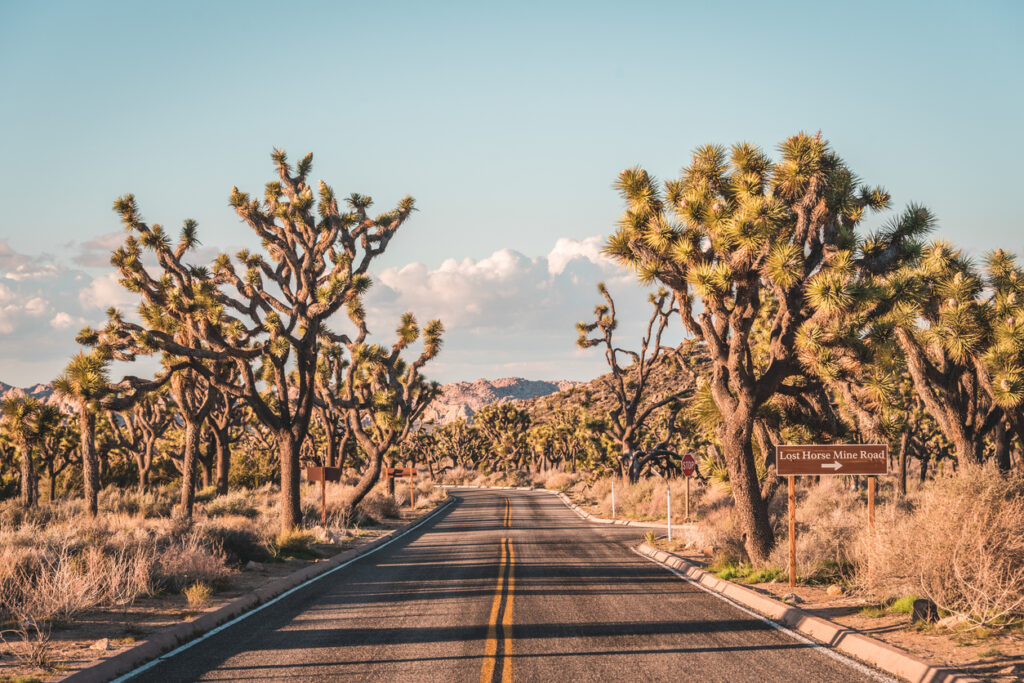
Joshua Tree feels like a different planet, mostly because it sits right at the junction where two massive deserts collide. It’s not just the twisted, Dr. Seuss-style trees that give the place its identity; it’s the way the high-altitude Mojave and the lower Colorado deserts create a landscape that shouldn’t really exist.
Between the massive, weathered boulders that look like they’ve been dropped from the sky and the sheer silence of the open plains, there’s an energy there that’s impossible to find in a standard forest or coastal park. It is a spot that forces you to slow down, largely because the harsh environment and the bizarre geology don’t care about your schedule.
The landscape feels like it belongs somewhere else entirely.
Most national parks are stunning in ways you can describe fairly easily: mountains, coastlines, forests, waterfalls. Joshua Tree doesn’t fit neatly into any of those categories. The combination of boulder formations, twisted trees, and flat desert stretching to the horizon creates something that genuinely stops people in their tracks the first time they see it. It has a quality that’s hard to put into words, which is part of why it ends up in so many photographs that still don’t quite capture what it’s actually like to stand in it.
It sits where two deserts meet.
Joshua Tree is one of the few places in the world where two distinct desert ecosystems run into each other. The Mojave Desert covers the higher, cooler western part of the park, and that’s where the Joshua trees themselves grow. Drop down into the lower eastern section, and you’re in the Colorado Desert, which is hotter, drier, and dominated by creosote bushes and cholla cactus. The transition between the two is visible as you drive through, and the difference in character between the two halves makes the park feel like two separate places that happen to share a boundary.
@asteronthego A one day travel guide to Joshua Tree National Park. 🌵 Note – the entrance fee is $30 per car, and that gives you a 7-day pass, so you can come back and explore as much as you want. Save this for your next trip 🌵 #joshuatree #joshuatreenationalpark #joshuatree #travel #archrock ♬ Walking Around – Instrumental Version – Eldar Kedem
The Joshua trees themselves are genuinely bizarre.
They don’t look like trees are supposed to look. They branch at odd angles, grow in unpredictable directions, and have a spiky, sculptural quality that makes each one look slightly different from the last. They’re actually a species of yucca rather than a true tree, and they can live for hundreds of years, growing slowly enough that a large one represents an enormous amount of time. Early Mormon settlers named them after the biblical Joshua because the outstretched branches reminded them of a figure pointing the way, which tells you something about how striking they are even to people seeing them for the first time.
The boulders are unlike anything else in the American West.
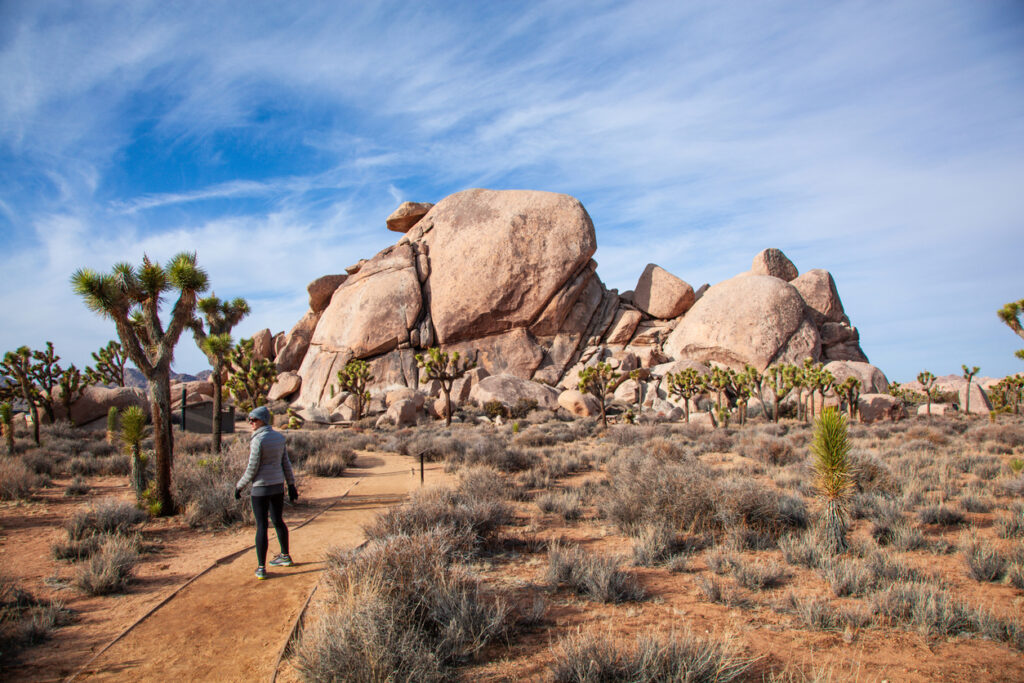
Scattered throughout the park are enormous piles of rounded granite boulders stacked in formations that look almost deliberate. They were formed by molten rock cooling underground millions of years ago, then gradually exposed by erosion over an enormous stretch of time. Some of the stacks rise 30 or 40 feet and create natural shelters, passages, and viewpoints that reward anyone willing to scramble around them. Climbing is enormously popular here and draws people from all over the world specifically for the quality and variety of the rock. Even if you’re not a climber, the formations are worth exploring on foot just for the scale of them up close.
The stargazing is exceptional.
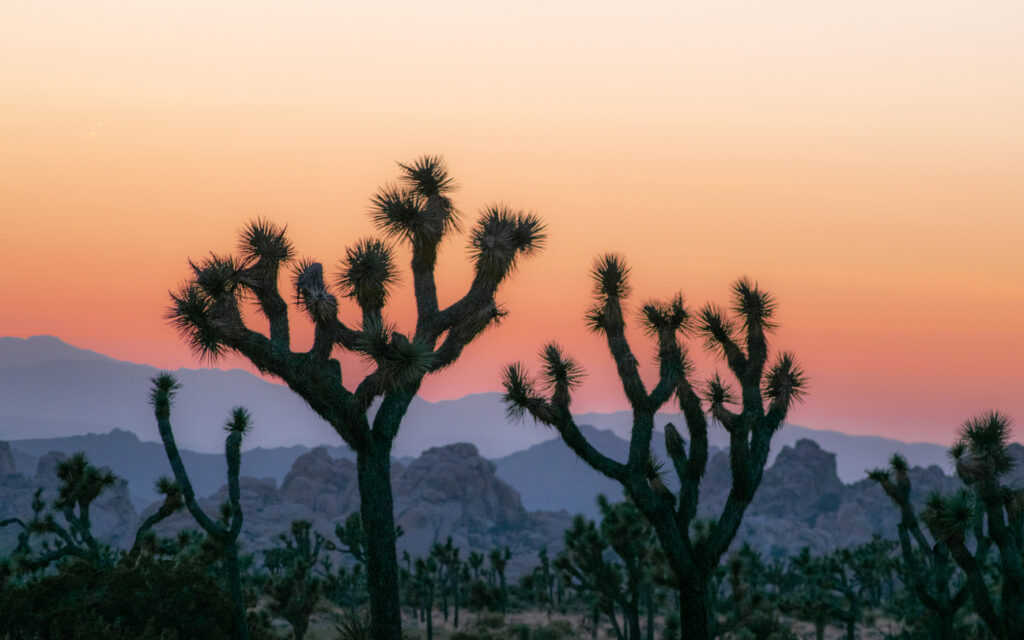
Joshua Tree is designated as a Dark Sky Park, which means light pollution is actively managed, and the night sky is protected as part of the park’s character. On a clear night away from the entrance areas, the Milky Way is visible with the naked eye in a way that most people raised near cities have genuinely never experienced. The combination of the dark sky and the silhouettes of the Joshua trees against it has made the park one of the most photographed night landscapes in the country. Arriving in the evening and staying after dark transforms the whole experience. It’s a completely different park at night.
It’s a seriously underrated spot for wildlife.
The desert looks empty, but it isn’t. Joshua Tree is home to around 250 species of bird, which makes it a notable destination for birders, particularly during migration season when species pass through that aren’t usually seen in the area. Coyotes are commonly spotted, especially around dawn and dusk. Desert tortoises live here, though they spend most of their time underground and sightings are genuinely lucky. Roadrunners are more frequently spotted than most people expect, and the park has a resident population of bighorn sheep that occasionally appear on the rocky hillsides. The key is slowing down and paying attention rather than just passing through.
The spring wildflower season is spectacular.
After a wet winter, the desert floor at Joshua Tree erupts with wildflowers in a way that feels completely at odds with the landscape the rest of the year. Patches of gold, purple, and orange spread across the ground between the rocks, and the contrast with the pale desert soil and dark boulders makes for something genuinely beautiful. It doesn’t happen every year—it depends entirely on the rainfall—but when conditions are right, it draws visitors specifically for the bloom. The park service runs a wildflower hotline during spring that gives updated reports on where the best displays are happening.
@grocerygettinggirl Our 1 day itinerary at @Joshua Tree National Park 🌵 We visited the Sun – Tues before Christmas. The holidays are one of the busiest times of year for Joshua Tree because it has some of the nicest weather in the country at that time of year. I recommend starting early to beat the crowds, we got into the park around 715am with no wait. When we left at 2pm there was a line of about 15 cars waiting to get in. There is almost no water available in the park so it’s important to bring lots of your own. There are no concessions in the park but is there a grab and go food place in the visitors center. This was our second trip to the park so we skipped it, but if you are visiting for the first time don’t miss Arch Rock. Any other questions? Leave them below 👇 #joshuatreenationalpark #joshuatree #holidaytravel #explorepage #sandiego ♬ original sound – Grocery Getting Girl
It’s close to Palm Springs but feels a world away.
The north entrance to Joshua Tree is about an hour from Palm Springs, which makes it an easy day trip from one of California’s most manicured resort towns. The contrast between the two couldn’t be sharper: golf courses and spa hotels one hour, alien desert landscape the next. That proximity makes it accessible for people who wouldn’t otherwise visit, and it means the park gets a mix of visitors that includes serious hikers and people who’ve never set foot in a national park before. Both groups tend to leave surprised by how much it got to them.
The hiking ranges from easy walks to serious backcountry.
There’s no shortage of trails, and they cover a wide enough range that the park works for people at very different fitness levels. Short loop trails around boulder formations are genuinely enjoyable without needing any particular preparation. Longer routes head out into open desert where the solitude is complete and the views stretch for miles. The backcountry is properly remote and requires permits and preparation, but it gives access to parts of the park that most visitors never see. Whatever level you’re working at, the park has something worth doing.
It has a strong creative history.
Joshua Tree has drawn artists, musicians, and writers for decades, partly because of the landscape and partly because of the quality of the light. The town of Joshua Tree just outside the park has a genuine arts community that’s been growing steadily, with galleries, studios, and music venues that give the area a character beyond the national park itself. The late musician Gram Parsons had a well-documented connection to the area, and the park appears in the work of a long list of artists who’ve found something in its strangeness that fed their creative work in ways other landscapes didn’t.
Sunsets and sunrises do something extraordinary here.
The open sky and flat desert floor mean that golden hour at Joshua Tree is genuinely something to plan around. The light turns the boulders warm orange and casts long shadows across the ground, and the Joshua trees go from strange to almost beautiful in those few minutes around sunrise and sunset. Keys View, a lookout point in the park’s western section, offers a wide panorama that on clear days extends to the Salton Sea and the mountains beyond. It’s one of those spots that’s busy for a reason and still worth the company.
The silence is something you notice immediately.
Away from the main roads and busier trails, Joshua Tree has a quality of quiet that’s increasingly rare and takes a few minutes to fully register. There’s no background hum of traffic, no distant sounds of civilisation; there’s just wind, occasionally a bird, and the particular stillness of desert air. People who visit regularly often mention the silence as one of the things they come back for, which sounds like an odd reason to travel until you’ve experienced it yourself. It has a way of resetting something that you didn’t realise needed resetting.
It rewards coming back more than almost anywhere.
A single visit gives you a solid impression but not the full picture. Joshua Tree in summer is an entirely different experience from Joshua Tree in winter, when temperatures are cooler and the light is lower and sharper. A rainy year changes the wildflower display completely. Coming at different times of day, in different seasons, shows you different versions of the same landscape in ways that keep it from ever feeling like you’ve fully seen it. Most people who visit once end up going back, usually sooner than they expected to.