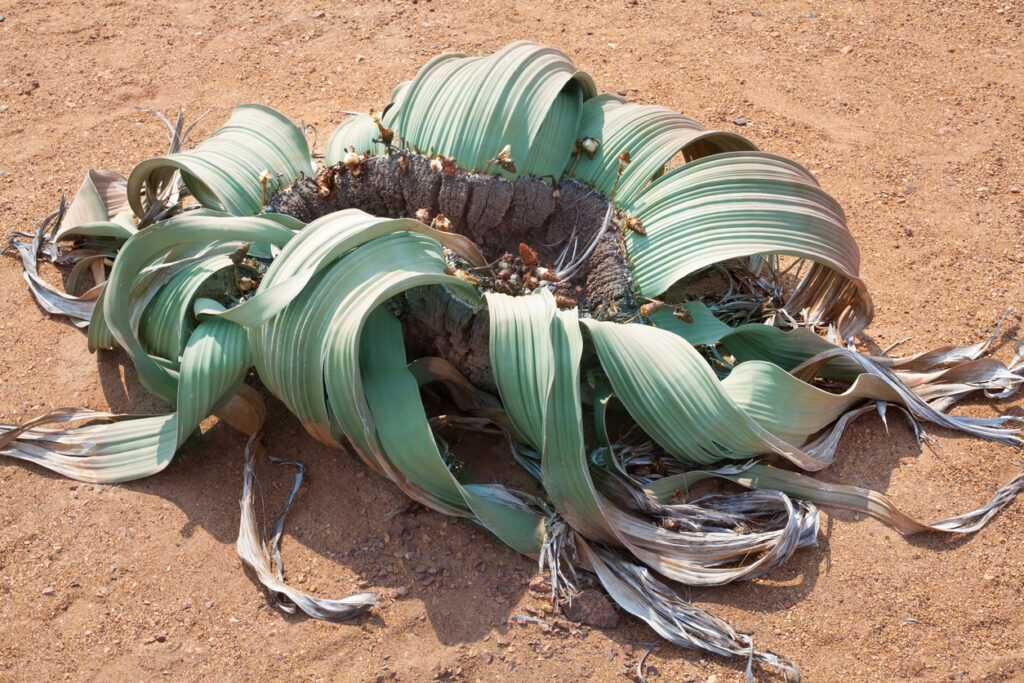
Welwitschia grows in one of the harshest deserts on the planet and looks like something from another world, with only two leaves that never stop growing. This ancient plant can live for over a thousand years in conditions that would kill almost anything else, and scientists still don’t fully understand how it survives with such a strange growth pattern.
The plant only grows two leaves in its entire life.
Welwitschia produces just two leaves when it’s a seedling, and these same leaves keep growing for the plant’s entire lifespan, which can stretch over a thousand years. Most plants constantly produce new leaves throughout their lives, but welwitschia commits everything to these two original leaves that emerge from opposite sides of the stem.
The leaves grow continuously from the base, while the tips die off and split into ribbons that spread across the desert floor. Over centuries, the leaves can reach several metres long and become so tattered and twisted that people often mistake one plant for a pile of separate dead leaves scattered on the ground.
It survives in a desert with almost no rainfall.
The Namib Desert where welwitschia grows receives less than two inches of rain per year in most areas, which makes it one of the driest places on Earth. Regular plants would die within weeks in these conditions, but welwitschia has adapted to extract moisture from the thick fog that rolls in from the Atlantic Ocean almost every night.
The leaves spread flat across the ground to catch fog droplets that condense on their surface and roll down towards the roots. This fog-harvesting system provides enough water to keep the plant alive even during years when no rain falls at all, which explains how welwitschia thrives where almost nothing else can grow.
The stem grows wider instead of taller.
@oldcrotchface Welwitschia is UNDERRATED 🌱✨🌱 #plants #plantlover #plantsoftiktok #welwitschia #greenhouse #strangerthings #strangerplants #weird #foryou ♬ original sound – Swifty
Most plants grow upwards to compete for sunlight, but welwitschia barely rises above ground level and instead puts all its energy into expanding its woody stem sideways. The stem can grow over a metre wide and sits like a giant woody bowl half-buried in the desert sand, with the two leaves emerging from its rim.
This low-growing habit protects the plant from the strong desert winds that would shred taller vegetation. The wide stem also stores water and nutrients that help welwitschia survive through long droughts, and the woody tissue becomes incredibly dense and hard after centuries of growth in the harsh environment.
Male and female plants look completely different.
Welwitschia produces either male or female cones, but never both on the same plant, which means you need separate plants for reproduction to occur. The male cones stand upright in clusters and release pollen into the wind, while female cones are larger and rounder and eventually produce seeds if pollen reaches them.
The cones grow on short stalks that emerge from the centre of the plant between the two leaves. Female plants put more energy into cone production because seeds require more resources than pollen, which often makes female welwitschia plants look bushier in the centre compared to males.
The leaves taste horrible to almost everything.
Most desert animals ignore welwitschia completely because the leaves contain bitter compounds that make them unpalatable to herbivores. This chemical defence system protects the plant from being eaten in an environment where fresh vegetation is incredibly scarce, and any edible plant would normally get devoured immediately.
A few insects have adapted to tolerate the bitter taste and feed on welwitschia leaves without harm. One species of bug feeds exclusively on this plant and can’t survive on anything else, which shows how some creatures have evolved alongside welwitschia over millions of years in the Namib Desert.
6. Scientists think it’s over 100 million years old as a species.
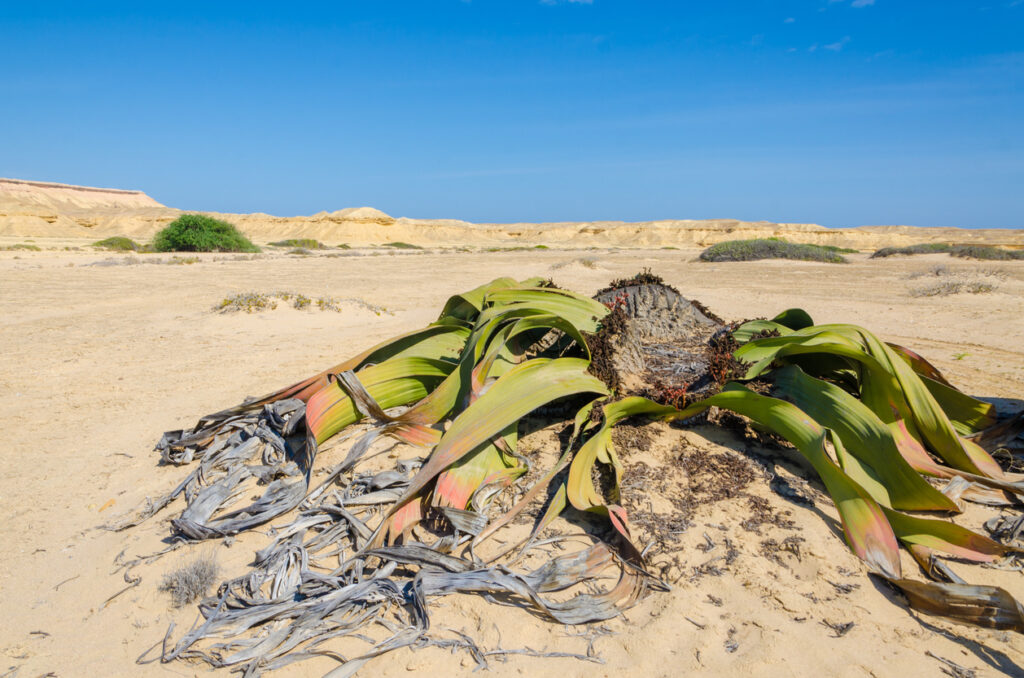
Welwitschia belongs to an ancient group of plants that was much more diverse during the age of dinosaurs, but now includes only this one species. Genetic studies and fossil evidence suggest welwitschia has existed in roughly its current form for over 100 million years, making it a living fossil that survived multiple mass extinctions.
The plant evolved during a time when southern Africa had a much wetter climate, and then adapted as the region gradually dried into desert. Most plants couldn’t adjust to such dramatic environmental changes, but welwitschia’s unusual growth pattern and fog-harvesting abilities allowed it to persist while related species became extinct around it.
Individual plants can live for 2000 years.
The oldest confirmed welwitschia plants are over 1500 years old, and some scientists believe certain individuals might reach 2000 years or more. These ancient plants were already growing when the Roman Empire still existed, and they’ve survived through centuries of desert conditions that would seem impossible for any vegetation.
Dating welwitschia accurately is difficult because the plant doesn’t produce annual growth rings like trees do. Scientists use radiocarbon dating on the woody stem to estimate age, but the extremely slow growth rate and unusual structure make precise measurements challenging even with modern techniques.
The roots go deeper than anyone expected.
@oldcrotchface Reply to @b0tanica Let’s start a Welwitschia Fan Club #plants #plantlover #plantsoftiktok #weird #unique #welwitschia #greenhouse #fyp ♬ original sound – Swifty
Welwitschia develops a taproot that drills straight down into the desert soil, searching for underground water sources. This main root can extend several metres deep to reach moisture that sits far below the surface, where fog condensation can never penetrate.
The deep root system works together with the fog-harvesting leaves to give welwitschia two separate water sources. During foggy periods, the plant absorbs moisture through its leaves, and during dry spells it relies more heavily on the deep roots to pull up groundwater that accumulated from rare rainfall events.
It grows so slowly that you can’t see daily changes.
Welwitschia adds only a few centimetres of new leaf growth each year, which makes it one of the slowest-growing plants on Earth. You could watch a welwitschia plant every single day and never notice any visible change because the growth happens at such a gradual pace.
This incredibly slow metabolism helps welwitschia conserve water and nutrients in an environment where resources are extremely limited. Fast-growing plants need constant supplies of water and minerals, but welwitschia has adapted to survive on almost nothing by simply taking its time with every aspect of growth.
The name comes from the Austrian botanist who found it.
Friedrich Welwitsch discovered this plant in 1859 while exploring Angola and immediately recognised it as something completely unique. He sent specimens back to Europe, where botanists struggled to classify the plant because it didn’t fit neatly into any existing plant family.
Scientists eventually placed welwitschia in its own family, with no close living relatives anywhere on Earth. The plant represents an evolutionary branch that split off from other seed plants millions of years ago and then remained essentially unchanged while the world around it transformed completely.